Chapter 15 - Leases
 Call Kai
 Learn
Learn Practice Test
 Spaced Repetition
 Match
Match Flashcards
 Knowt Play
1/60

There's no tags or description
Looks like no tags are added yet.
Name | Mastery | Learn | Test | Matching | Spaced | Call with Kai | Chat |
|---|
No analytics yet
Send a link to your students to track their progress
61 Terms
What is a lessee?
The party making the payments to borrow the property
What is a lessor?
The party who ownes the leased property
In leases, we assume every lease is an operating unless it meets 5 requirements, after which it becomes a Finance/Sales-type lease. What are the 5 requirements of a finance lease?
agreement specifies transfer of ownership
there is a purchase option reasonably certain to exercise
The lease term is 75% of the asset economic life
The PV of lease payments is 90% of the asset fair value
The asset has no alternative use after the lease
What is a sales-type lease?
A lease that meets one of the five criteria. Is the lessor perspective.
What is a finance lease?
A lease that meets one of the five criteria. Is the lessee perspective.
What is an operating lease?
The lessee merely uses the asset temporarily and returns it
T/F A sales-type lease for the lessor cannot have selling profit
False; a sales type lease CAN have selling profit or not
What’s the difference between a finance lease and a sales-type lease?
A finance lease is from the lessee perspective, sales-type lease is from the lessor perspective.
Which of the following leases is economically similar to issuing an installment note for the purchase of an asset? (assume lessee perspective)
a. Finance/Sales-type lease
b. Operating lease
c. Both of the above are economically similar.
A
Which of the following meets the criteria for classification as a finance lease?
a. At the end of the lease term, the asset has an alternative future use.
b. The lessee has the option of acquiring the asset during or at the end of the lease term at a price of fair value plus 10%.
c. The lease term is 8 years, and the asset’s economic life is 9 years.
d. The present value of the minimum lease payments is approximately 70% of the fair value of the leased asset.
The correct answer is c.
Explanation: The five FASB criteria for a lease to be categorized as a finance lease are: (1) Transfer of ownership; (2) Purchase option reasonably certain to exercise; (3) The lease term is the major part of the economic life of the asset; (4) the present value of the minimum lease payments is substantially all of fair value; (5) No alternative use for the asset.
An intangible that represents a lesee’s rights to use an asset for a specified period of time
a. Lease liability
b. Right-of-use asset
c. Lease receivable
d. Leasehold improvement
B
How are right-of-use assets typically amortized?
a. Over the life of the lease
b. Over the life of the asset
c. Over 75% the life of the lease
d. They are not amortized
A
How is amortization of right-of-use assets estimated, if at all?
a. Double-declining method
b. Sum-of-years digits method
c. Straightline method
d. Right-of-use assets are not amortized
C
Which of the following is false regarding Finance/Sales-type leases?
a. Lessee records a right of use asset and a lease payable for the present value of the payments
b. Lessor records a lease receivable and removes the asset from their books
c. Lesee records a right of use asset and lease payable for the present value of the asset
d. Lessor recognizes any profit at the beginning of the lease term
C is wrong because the lessee records a payable for the PV of the payments, not the asset
T/F Selling profit only affects the lessor
True
When does selling profit occur?
a. When the lessor charges the lessee a rate above market value
b. When the fair value exceeds the carrying value (cost) of the asset
c. When the lease term exceeds 75% of the asset's economic life
d. When the present value of lease payments exceeds the fair value of the asset
B
When is selling profit recognized?
a. Selling profit is recognized at the end of the lease term
b. Selling profit is recognized at the beginning of the lease term
c. Selling profit is recognized evenly over the entire lease term
d. Selling profit is recognized at when the asset is disposed
B
For the lessor, what entries are changed when a lease has selling profit?
a. The beginning entry only
b. The beginning entry and the payments
c. The payments only
d. The entries are the same regardless of selling profit
A
For the lessee, what entries are changed when a lease has selling profit?
a. The beginning entry only
b. The beginning entry and the payments
c. The payments only
d. The entries are the same regardless of selling profit
D
LeaseCo Industries leased equipment to UserCorp. on July 1, 2024. LeaseCo recorded the lease as a sales-type lease at $810,000, the present value of lease payments discounted at 10%. The lease called for ten annual lease payments of $120,000 due each July 1. The first payment was received on July 1, 2024. LeaseCo had manufactured the equipment at a cost of $750,000. The total increase in earnings (pretax) on LeaseCo’s December 31, 2024, income statement would be:
a. $ 0
b. $ 93,000
c. $ 94,500
d. $100,500

How is lessee interest expense calculated in an operating lease?
a. Starting balance of lease payable x effective rate
b. Fair value of the asset x effective rate
c. Current balance of lease payable x incremental rate
d. Current balance of lease payable x effective rate
D
How is lessee interest expense calculated in a finance lease?
a. Starting balance of lease payable x effective rate
b. Fair value of the asset x effective rate
c. Current balance of lease payable x incremental rate
d. Current balance of lease payable x effective rate
D
How is lessee amortization expense calculated in a operating lease?
a. Interest expense + yearly amortization
b. Payment amount - Interest expense
c. Current balance of lease payable x incremental rate
d. Current balance of lease payable x effective rate
B; Amortization is calculated as the amount needed to cause the total lease expense (interest plus amortization) to be equal to the lease payment. In other words, it’s the same amount as the reduction in lease payable for that period.
How does the lessor in an operating lease treat the asset? Select all that apply.
a. The asset is removed from their books and a receivable is recorded
b. The lessor recognizes any interest revenue and selling profit
c. The lessor does not recognize interest revenue or selling profit
d. The lessor depreciates the asset normally
C & D. The lessor doesn’t recognize interest revenue or selling profit. They depreciate the asset normally.
How do lessor’s record lease payments for operating leases?
a. Debit cash and interest expense, credit lease receivable
b. Debit lease receivable, credit cash
c. Debit cash, credit lease revenue
d. Lessors do not record lease payments
C
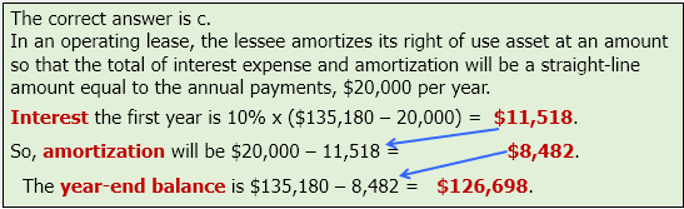
On January 1, 2024, Super Sports Supply recorded a right-of-use asset of $135,180 in an operating lease. The lease calls for ten annual payments of $20,000 at the beginning of each year. The interest rate charged by the lessor was 10%. The balance in the right-of-use asset at December 31, 2024, will be:
a. $115,180.
b. $121,662.
c. $126,698.
d. $135,180.
Which of the following is true regarding leases?
a. The lessee reports interest expense and amortization expense separately in an operating lease
b. The lessee reports interest expense and amortization expense separately in a finance lease
c. The lessor recognizes lease revenue and interest revenue in an operating lease
d. The lessor recognizes a single, straight-line revenue account in a finance lease
B
Explanation:
A is wrong because the lessee reports interest expense and amortization expense together on income statement for operating leases
C is wrong because the lessor recognizes only a single lease revenue account for operating leases
D is wrong because the lessor recnogizes interest revenue and lease revenue separately.
How does the lessee recognize interest expense and amortization expense on an operating lease?
a. Separately on the income statement
b. As a single amount on the income statement
c. The total amount less the lease payable balance
d. None of the above
B
How does the lessee report interest expense and amortization expense on a finance lease?
a. Separately on the income statement
b. As a single amount on the income statement
c. The total amount less the lease payable balance
d. None of the above
A
How does the lessor recnogize revenue on an operating lease?
a. As interest revenue calculated on the outstanding lease receivable balance
b. As a lease receivable and removal of the asset from its books
c. As a single lease revenue account in a straightline amount
d. Recognizes lease revenue and interest revenue separately
C
How does the lessor recognize revenue on an finance lease?
a. No revenue is recognized until the end of the lease term
b. As interest revenue, and possibly selling profit
c. As a single lease revenue account in a straightline amount
d. Recognizes lease revenue and interest revenue separately
D
What is the requirement for a lease to be considered “short-term” and thus allowed the shortcut method?
a. A lease term of 12 months or less with no purchase option
b. A maximum lease term of 5 years or less
c. A maximum lease term of 12 months or less
d. A lease with no right-of-use asset recorded
C
Which of the following is true regarding the shortcut method for short-term leases?
a. The lessee recnogizes a right-of-use asset or liability
b. The lessee recognizes lease payments as Lease Expense
c. The lesee recognizes interest expense and amortization expense
d. All of the above
B
Which rate is used to consider the time value of money while calculating present value?
Implicit rate
Which rate is used when the lessor’s implicit rate is unknown?
Incremental rate
Phil Wright Dental Services leased kitchen equipment under a 5-year lease. After the 5 years, the lease has an option to renew for an additional 3 years and an option to renew for an additional 3 years at the end of 8 years. The first 3-year renewal option can be exercised for one-half the original and usual rate. What is the length of the lease term that Wright should assume in recording the transactions related to the lease?
a. 5 years
b. 8 years
c. 11 years
d. cannot be determined
B; The lease term is the contractual lease term modified by any renewal or termination options that are reasonably certain to be exercised. The first three-year renewal option can be exercised for one-half the original and usual rate, which implies a reasonable certainty that the original lease term will be extended to 8 years.
Under lease accounting rules, when should a lease's option to extend or terminate early be factored into the official lease term?
a. If it's reasonably certain the company will use that option
b. Only after the company has formally exercised the option
c. Never; the lease term is always fixed at the original contract length
d. Only if the option is explicitly mandatory in the contract
A
Which three factors might create an economic incentive for the lessee to extend/not terminate a lease? (Select all that apply)
A. Bargain renewal rates
B. Proximity to public transportation
C. Penalty payments for cancellation or non-renewal
D. Significant customization or installation costs
E. The lessor's credit rating
A, C, D
Sometimes lease payments can be adjusted, which usually revolve around contingencies regarding: (select all that apply)
a. Profitability
b. Revenues
c. Residual Values
d. Asset usage
e. Fair values of the asset
A, B, and D
What are the two exceptions to not including variable payments in the calculation of the lease liability recorded at the beginning of the lease?
a. When variable lease payments are based on a lessee-guaranteed residual value
b. When variable lease payments are in-substance fixed payments
c. When variable lease payments depend on an index or rate
d. When variable lease payments are reasonably certain to be paid
B & C
How does an increase in the lease payment amount affect the balance sheet accounts for the lessee and lessor?
a. It increases the right-of-use asset and lease liability for the lessee, and the lease receivable for the lessor
b. It requires reassessment of the lease liability and right-of-use asset for the lessee and lease receivable for the lessor
c. It is added to the lease receivable and right-of-use asset
d. No effect on the balance sheet accounts; it’s reported as a lease expense by lessee and lease revenue by lessor
D
On January 1, Brighton Early Vineyard leased a truck for a five-year period, at which time possession of the truck will revert back to the lessor. Annual lease payments are $11,000 due on December 31 of each year, calculated by the lessor using a 4% discount rate. If Early’s revenues exceed a specified amount during the lease term, Early will pay an additional $3,000 lease payment at the end of the lease. Early estimates a 70% probability of meeting the target revenue amount. What amount, if any, should be added to lease payments used to determine the right-of-use asset and lease liability as a result of the contingent rent agreement?
a. 0
b. $3,000
c. present value of $3,000
d. present value of $14,000
A; it is not certain and it doesn’t explicitly say one of the two requirements:
When variable payments actually are fixed
The variable payments depend on an index or rate
What is residual value?
a. An estimate of what a leased asset will be worth at the end of the lease term
b. The present value of all remaining lease payments
c. The original purchase price of the leased asset
d. The amount the lessee guarantees to pay if they terminate early
A
Residual value affects:
a. The size of the lease payments
b. Whether the lease is classified as finance or operating
c. The amounts recorded by the lessee and lessor
d. All of the above
D
What generally happens to the lessee’s accounting when there is residual value?
a. The right-of-use asset and lease liability both decrease by the PV of the residual value
b. The lease is reclassified from operating to finance if the residual value is guaranteed
c. No change, though the payments will be lower
d. No effect at all on the accounting for the lessee, only the lessor
C
When would a lessee expect to make a cash payment at the beginning of a lease related to a guaranteed residual value?
a. The guaranteed amount is exactly equal to the estimated residual value
b. The guaranteed amount exceeds the estimated residual value of the asset
c. The estimated residual value exceeds the guaranteed amount
d. The lease is classified as an operating lease
B
How should a lessee account for an expected cash payment tied to a guaranteed residual value shortfall?
a. It is expensed immediately in the period it's identified
b. It is recorded as a separate liability account, distinct from the lease payable
c. The present value of the cash payment is added to the Right-of-Use Asset/Lease Payable
d. It has no impact on the lessee's accounting until the end of the lease
C
In a sales-type lease with selling profit where residual is guaranteed, the present value of the residual value:
a. is added to the lease receivable but excluded from both sales revenue and COGS
b. is included as a part of the sales price that is recorded as sales revenue
c. reduces both sales revenue and COGS by the same amount
d. is not included in the sales revenue
B
In a sales-type lease with selling profit where residual is not guaranteed, the present value of the residual value:
a. is included in sales revenue but excluded from COGS
b. is included as a part of the sales price that is recorded as sales revenue
c. reduces both sales revenue and COGS by the present value of the residual value
d. is not included in the sales revenue
D
What is a purchase option?
a. An offer for the lessee to buy a leased asset during or at the end of the lease term
b. A clause requiring the lessor to repurchase the asset from the lessee
c. An option for the lessee to extend the lease instead of returning the asset
d. A penalty payment owed for early lease termination
A
If a purchase option is reasonably certain, what 3 things happen?
The lease is classified as finance/sales-type
The exercise prices is considered an additional cash payment
The lease term ends on the exercise date
In practice, a purchase option whose exercise is reasonably certain is often referred to as a
a. Certain purchase option
b. Expected purchase option
c. Gauranteed purchase option
d. Bargain purchase option
D
How does the lessee amortize an asset if a purchase option is reasonably certain?
a. The asset is amortized over its useful life
b. The asset is amortized over the lease term
c. The asset is not amortized because it’s an intangible
d. The purchase option has no affect on the decision made
A
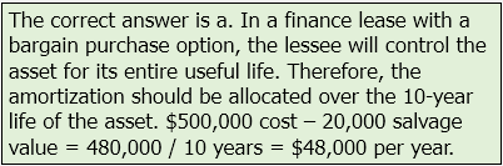
On Jan. 2, 2024, Al Dente Pasta (lessee) entered into an 8-year lease for equipment. Dente accounted for the acquisition as a finance lease for $500,000, which includes a $15,000 purchase option at the end of the lease. Dente is reasonably certain to exercise the purchase option. Dente estimates that the equipment’s fair value will be $20,000 at the end of its 10-year life. For the year ended Dec. 31, 2024, what amount should Dente recognize as amortization expense on the leased asset?
a. $48,000
b. $50,000
c. $60,000
d. $62,500
What is a leasehold improvement?
a. An improvement made to a leased property by the lessor
b. Improvements made to a leased property by the lessee
c. A movable asset installed for the lessee's temporary use
d. Costs paid by the lessor for maintenance or hazard insurance
B
The construction of new buildings or remodeling of existing structures is an example of
a. Initial direct costs
b. Nonlease components
c. Leasehold improvements
d. Right-of-use assets
C
How is the cost of a leasehold improvement amortized/depreciated? (there are two technically correct answers)
a. Over the lifetime of the asset
b. Over the lifetime of it’s useful life to the lessor
c. Over the lifetime of its useful life to the lessee
d. The shorter of the lease term or the physical life of the asset
C & D
Are moveable assets considered household improvements?
No
Jimmy brings couches, an oven, and a grill into a leased house. 10 years later, he decides to move out after he bought a house for himself. Before packing up, the landlord says he cannot take the furniture because it is a household improvement and thus part of the house. Is this correct? Why?
No; moveable objects are not considered leasehold improvements. Jimmy can take his equipment and furniture with him as long as he is the owner of the assets.
Are improvements required to be attached to the property?
Yes
Which of the following is true regarding the accounting for leasehold improvements?
a. The leasehold improvement should be depreciated over its useful life
b. The leasehold improvement should be depreciated over the life of the underlying asset.
c. Leasehold improvements include improvements made to a leased property by the lessor.
d. Movable assets are considered leasehold improvements.
A;
Leasehold improvements should be depreciated over the useful life of the leasehold improvement rather than the useful life of the underlying property. The latter treatment may inappropriately accelerate earnings.