Week 9: Infant Memory
 Call Kai
 Learn
Learn Practice Test
 Spaced Repetition
 Match
Match Flashcards
 Knowt Play
1/12

There's no tags or description
Looks like no tags are added yet.
Name | Mastery | Learn | Test | Matching | Spaced | Call with Kai | Chat |
|---|
No analytics yet
Send a link to your students to track their progress
13 Terms
What are the principles of infant memory development?
Older infants learn faster than younger infants (encoding)
Older infants remember for longer than younger infants (retention)
Older infants are better at remembering when parts of the situation have changed (retrieval) As Age increases → so does encoding, retention and retrieval
What are the challenges with studying infant memories?
Change is rapid, you are studying different animals → as locomotor development is rapid, and the behaviours that we can use to infer memory changes with age. One mechanism to address this, is to allow individuals to recall at different delays → or to learn and encode for different amounts of times. I.e. if an infant at age 1 can remember for 24 hours and an infant at age 2, can remember for 2 x 24 hours. → expose infants to different amount of time to stimuli in order to control for forgetting curves.
What is representational flexibility?
Young infant memories are specific to the conditioning context, however, as infants age, their ability to retrieve memories even when the cues and/or context changes improve. This allows learning to be generalised to novel situations.
How can visual recognition be used to measure memory?
Uses a familiarisation or habituation process. Individuals are exposed to stimuli repeatedly, at tested (at delay) with stimuli that are paired with novel or familiar stimuli. Retention is measured as a function of a child’s length of looking at novel stimuli (that is, their novelty preference). Forgetting = their null preference.
Describe abilities of differently aged infants in flexibility in visual recognition?
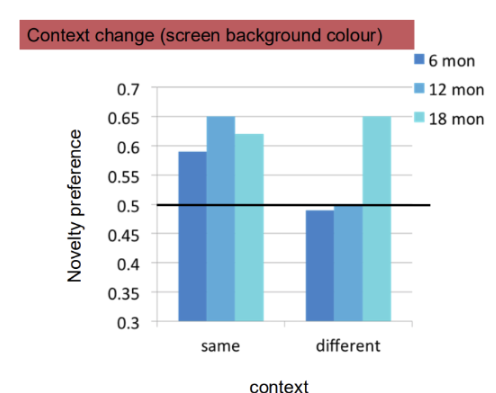
In this task, differently aged individuals are tested for their novelty preference in stimuli in which the context changed. (i.e. the colour of screen/background) They found that in the same context trials, 6, 12, 18 month children showed similar novelty preferences. The different context trials, the capacity for 6, 12 month olds did not perform at the same level they did when in the same context (showing a null preference) . This difference was not found in the 18 month children
How can operant conditioning be used to measure memory?
Infants are very good at learning contingencies between their actions and the consequences To bridge different locomotor abilities the task changed according to age, individuals are initially learnt the relationship between kicking and mobile moving. (then tested at delay) → Mobile conjugate reinforcement task, if kickings = to initial test, then learning has occurred. In order to test flexibility individuals can change in context= crib bumper
Describe findings in the flexibility in operant conditioning?
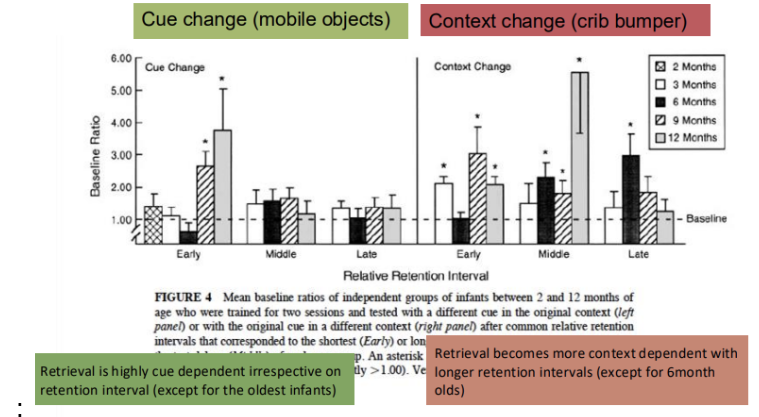
Finds that retrieval is highly cue dependent irrespective on retention interval Retrieval becomes more context dependent with longer retention intervals. The older infants seem to be able to handle context and delays better than younger infants
How can deferred imitation be used to measure memory?
The puppet task (6- to 24-month olds) Three actions (remove the mitten, shake it, replace the mitten) Individuals are exposed to a 60 s demonstration, 24 hour delay, Test Performance of infants in a demonstration group is compared to a baseline control group Experimenters tested the effect of Cue change- new puppet and Context change- home vs. lab.
Describe findings in the flexibility of deferred imitation?
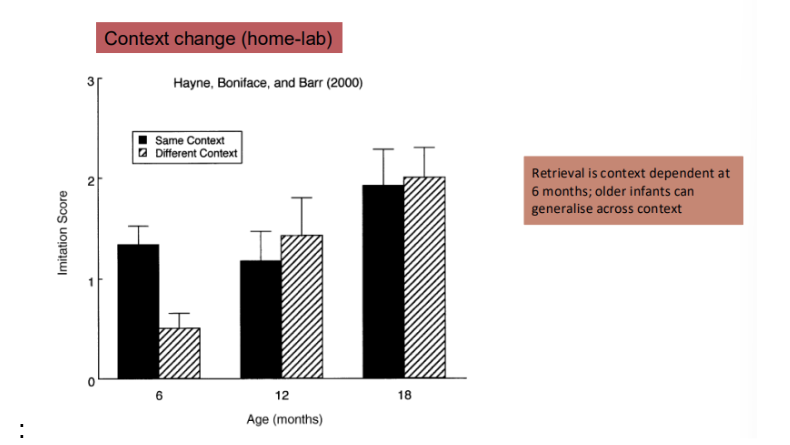
Retrieval is context dependent at 6 months, and that older infants can generalise across contexts. (look at the gap between black and stripped lines) However, when looking at performance within a lab or at home. It was found that 6, 9 and 12 month olds performed differently.
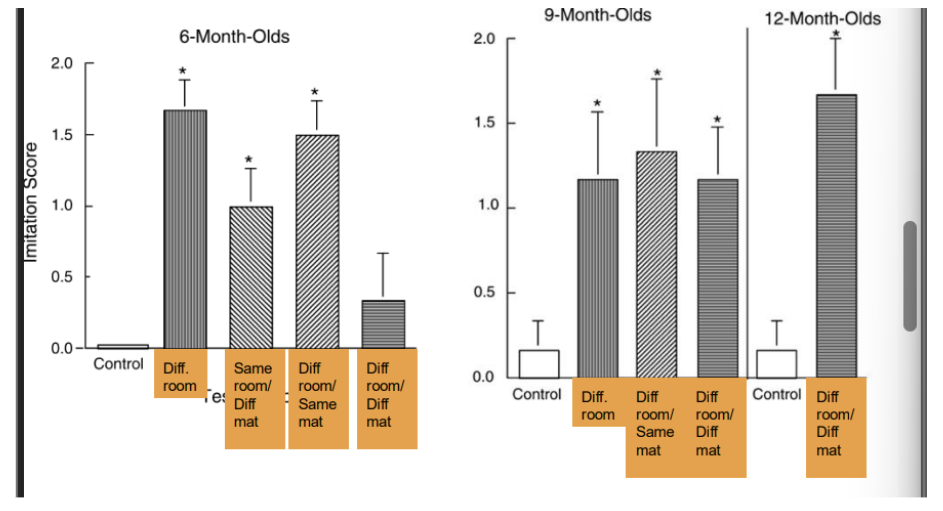
6 month olds can generalise across either rooms or mats but not both, but 9-months-olds and 12-month-olds can generalise to both a different room and a different mat.
What is the application of the deferred imitation study?
Could be used in the context of fixing a media deficit – the idea that a child’s ability to generalise learning from 2D media in real life is poor. Experiments exposed individuals to different forms of ‘imitating’ materials. – control, video or life. They found that live vastly out performed both control and video demonstration.
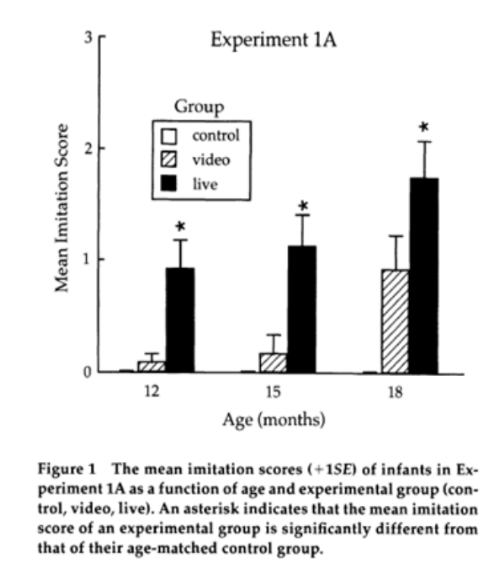
Babies learn better in real life, rather than on technologies.
– Explain how experience drives the shift from specificity to flexibility, using studies of locomotion and bilingualism as examples
Describe the shift from specificity to flexibility?
One theory supposes that this shift happens only when infants can notice that the situation is similar.
Supposing evidence adds overlapping cues to situations → e.g Visual cues – Categorisation (e.g. adding different categories or things - mobile conjugate task) – Sensory preconditioning (e.g. the puppet task - if you leave the puppets at different contexts) • Motor cues – Immediate imitation (letting babies practise or not practise the test) • Language cues – labels (giving more verbal cues to generalise across the prompts → really only found at 18 month year olds (ASL?))
This allows individuals to generalise in a much ‘larger way’ → you allow for a generalisation to be developed.
What is the effect of experience on locomotors?
Finding that babies who have begun crawling are more able to generalise and imitate the task, than those who have not. Task = touching a button at the back of touch for lights
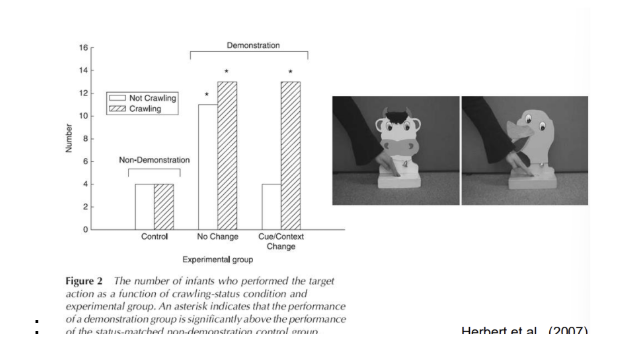
What is the effect of bilingualism on imitation task
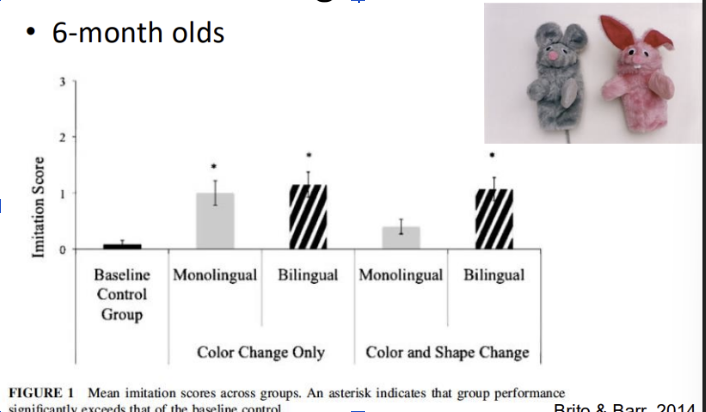
Puppet task between cow and duck - babies who are bilingual seem to be able to transfer knowledge more readily compared to others
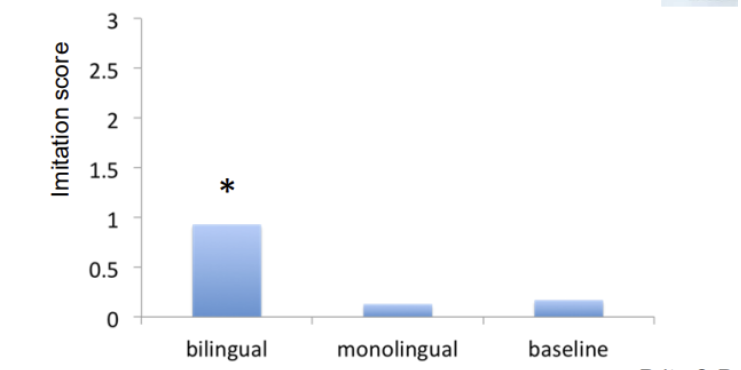
Next study tested further → changing the colour and shape? Found that bilingual babies are much better when both colour and shape change, as well as when there is a colour change only compared to monolingual babies.