ES 1 Reviewer - Terms
 Call Kai
 Learn
Learn Practice Test
 Spaced Repetition
 Match
Match Flashcards
 Knowt Play
1/67

There's no tags or description
Looks like no tags are added yet.
Name | Mastery | Learn | Test | Matching | Spaced | Call with Kai | Chat |
|---|
No analytics yet
Send a link to your students to track their progress
68 Terms
Mechanics
the science that which describes and predicts the conditions of rest or motion of bodies under the act of forces.
it is an implied science
Length
A physical quantity of a geometric measurement between two points.
It is needed to locate the position of a point in space.
Space
Associated with the notion of the position of a point, P, given in terms of three coordinates measured from a reference point or origin.
Time
Definition of an event requires specification of the time and position at which it occurred
Mass
Amount of matter an object contains.
Used to characterize and compare bodies.
Force
Represents the action of one body on another.
Characterized by its point of application magnitude and direction.
Strength of Materials
the study of the internal effect of external forces applied to structural members. Stress, strain deformation, deflection, flexure, shear diagram and moment diagrams are some of the topics covered.
Pa
Conversion for N/m²
MPa
Conversion for N/mm²
PSI
Conversion for lb/in²
External force
Force generated outside a body
Internal Force
Force generated inside a body.
Applied force
External force on the body that tries to change the state of movement of the body.
Reaction force
external force that inhibits change in the state of movement of a body when acted on by an applied force.
Distributed force
A force density
Concurrent
forces whose lines of action pass through a common point.
Parallel
forces whose lines of actions are parallel
Non-concurrent
forces whose lines of actions are neither parallel nor intersect in a common point
Newton’s first law
if the resultant force on a particle is zero, the particle will remain at rest or continue to move in a straight line.
Newton’s second law
A particle will have an acceleration proportional to a non-zero resultant force.
Newton’s third law
The forces of action and reaction between two particles have the same magnitude and line of action with opposite sense.
Principle of Transmissibility
The external effect of a force on a body is the same for all points of application along its line of action.
Fixed or Bound Vectors
Have well defined points of application that cannot be changed without affecting an analysis
Free vectors
may be freely moved in space without changing their effect on an analysis
Sliding Vectors
May be applied anywhere along their line of action without affecting an analysis.
Equal vectors
have the same magnitude and direction
Negative vector
has the same magnitude and the opposite direction of a given vector
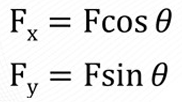
Components of a force in terms of x axis
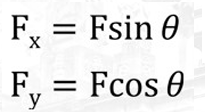
Components of a force in terms of y axis
First Quadrant
X - positive
Y - positive
Second Quadrant
X - negative
Y - positive
Third Quadrant
X - negative
Y - negative
Fourth Quadrant
X - negative
Y - negative
Moments of a Force
Is the measure of the tendency of a force F to make the rigid body rotate about a fixed axis perpendicular to the plane of the force F.
Statics
Deals primarily with the calculation of external forces which act on rigid bodies in equilibrium
Rigid body
is a combination of a large number of particles occupying fixed positions with respect to each other.
1
Number of unknowns in a Slider or Constrained pin
3
Number of unknowns in a Fixed support
1
Number of unknowns in:
Cables
Rollers
Sliders
Rocker
Member pinned to Collar
Weightless links
2
Number of unknowns in:
Pin or Hinge
Member Fixed to collar
Truss
a structure composed of slender members joined together at their endpoints.
Wooden struts and Metal bars
Common construction materials for Trusses
Planar Trusses
lie in a single plane and are often used to support roofs and bridges
Truss members
connected at their extremities only; thus no member is continuous through a joint.
Tension
Member reaction due to pulling forces at both ends and is denoted by (T); lengthening force
Compression
Member reaction due to pushing forces at both ends denoted by (C); shortening force
Method of Sections
Consist of cutting a truss into two sections at a point where the bar force is required.