health services management econ final exam
 Studied by 5 people
 Call with Kai
 Learn
Learn Practice Test
 Spaced Repetition
 Match
Match Flashcards
 Knowt Play
1/157

There's no tags or description
Looks like no tags are added yet.
Name | Mastery | Learn | Test | Matching | Spaced | Call with Kai |
|---|
No study sessions yet.
158 Terms
budgeting
an organization's plan for how it will accomplish its operational goals and objectives by earning revenue and spending funds during a specified time period
retrospective budgeting
evaluating past financial performance decisions
concurrent budgeting
- overseeing daily financial operations
prospective budgeting
planning long-term financial direction and deciding future strategy
management functions
Planning - set priorities and performance targets
Organizing - designate reporting relationships & responsibilities
Staffing - recruit, develop, and retain workforce
Controlling - monitor performance and take corrective action
Directing - lead motivate and communicate with staff
Decision making - weigh pros and cons of alternative actions
revenue
What the organization earns from providing services
Money available to fund operations
expenses
what it costs the organization to provide services
profit and PM
Profit (or loss) - total revenue minus total expenses
Profit margin - profit divided by total revenue
990 statement of revenue
section 7
Program service revenue (insurance reimbursement)
Government grants
Fundraising
What the organization earns from providing services
990 statement of functional expenses
section 9
Salaries and wages
Employee benefits
Fees (legal, accounting, fundraising expenses, etc)
Advertising
Office expenses
What it costs the organization to provide services
990 reconciliation of net assets
section 11
Total revenue less expenses
Organization’s profit (or loss)
organizational goals
the outcomes expected from operations; usually qualitative; change over time; challenging but reasonably achievable
organizational objectives
the quantitative targets that the organization must meet to achieve its goals
operating budgets
Revenue and expenses
Revenue minus expenses = profit
Monthly
assets
things the organization owns that can provide future economic benefits
liabilities
what the organization owes (money to be paid or services to be performed)
equity
Assets minus liabilities =
conventional/incremental budgeting
Use previous budget as starting point
Make adjustments to reflect changes in circumstances (ex. inflation)
zero based budgeting
All line items start at zero
Justify each revenue or expense item based on expected service volume and costs
volume forecasting
in private healthcare organizations (both for an non profits) most revenue comes from the direct provision of services
How many clinic visits do we expect to provide this year?
What is the insurance reimbursement rate per visit?
budgeting allocates for:
Programs and services to further the organizations mission
Direct care
Nonredirect care
Administrative activities to support mission-related programs and services
Human resources
budgeting/finance
Information technology
cost allocation
determining the total cost of producing a particular healthcare service
cost centers
organizational sub-units that incur costs but do not directly generate revenues
employees
profit centers
- organizational subunits that generate revenues and costs
cafeterias?
direct costs
traced to a particular product/service (ex. Supplies, salaries)
indirect costs
overhead (ex utilities, human resources staff)
You need to pay the electric bill, someone to bill insurance, pay rent
full costs
includes both direct and indirect costs
fixed costs
stay the same regardless of changes in amount of services provided (rent, utilities)
variable costs
change as amount of services provided changes (supplies, hourly employees)
semi variable costs
part fixed, part variable (Salaries are fixed until increase in number of patients warrants a new hire)
break even analysis
determining the level of volume where the total costs of producing a good or service equals the total revenue generated from that good or service
Above the break even point each additional unit produced contributes to profits, fixed costs are fully recovered and the only costs left to recover are variable costs
Below the break even point, services are being produced at a financial loss
job analysis
Identify responsibilities for each position
Avoid task duplication and role conflicts
workforce planning
Identify current staff needs
Project future staff needs
job descriptions
Define required skills and training for each position
Specify how each job fits into organizational reporting structure
recruitment and hiring
Identify candidates
Screen and interview candidates
Negotiate job offers
Orient new employees
employee relations and engagement
Identify needs and factors that increase job satisfaction
Employee recognition programs
Labor relations
training and development
New technology and laws
Continuing education
Interpersonal communication and teamwork
Leadership development and succession planning
compensation and benefits
Job pricing
incentives/bonuses based on performance goals
Benefits
assessing employee performance
Probationary period
Annual performance appraisal
factors affecting job pricing
Specialized skills and knowledge
Experience equity within the organization
Competition with other employers/average wages in local job market
Lower wages may mean higher contributions to profits but risk attracting lower quality workforce
Higher wages may attract higher quality workforce, which can increase revenues and efficiency
Nonexempt -
Paid hourly
Eligible for overtime
You cannot overwork your part time employees because you will have to pay them overtime
Exempt
Salaried
Not eligible for overtime
benefits offered to employees
Insurance
Dental
Vision
Medical
Life
Tuition reimbursement
Continuing education credits
Loan forgiveness
PTO
Mental health counseling
Sick, vacation, holiday, bereavement, maternity
401k
Flexible schedules
Signing bonuses
Transportation
Wellness
short/long term
extrinsic rewards
tangible
Money
Benefits
Flexible schedule
Promotion
feedback/recognition
intrinsic rewards
subjective
Connection with workers
Meaningful works
Skill development
choice/participation in decisions
Progress toward milestones
maslows hierarchy of needs
theory of motivation that organizes human needs into five categories, often represented as a pyramid: physiological needs (food, water), safety needs (security, stability), love and belonging needs (friendship, family), esteem needs (respect, status), and self-actualization needs (fulfilling one's potential). The theory posits that individuals must satisfy lower-level needs before they can move on to higher-level ones, though this progression is not always rigid.
theory x
Employees are unmotivated and need managers direction (extrinsic rewards)
theory y
Employees are industrious and managers to provide resources to facilitate work (intrinsic rewards)
healthcare braking point
Healthcare employees feel undervalued and unsatisfied - signalling that a profession built on providing care to others is running low on it themselves
Only 37% are very satisfied
Only 32% feel valued by their current employer
Only 3&% feel very loyal to their current employer
Healthcare professionals who feel valued by their organizations are 40% less likely to experience burnout
More than half say they'll look for new job opportunities
Inadequate compensation
Burnout or emotional fatigue
Lack of career advancement, personal development, or education opportunities
Projected to have a shortage of nearly 700,000 critical healthcare workers
predictors for well being
High burnout
Work load
Work life balance
Professional growth
Age
Increased Moral distress
Meaningfullness
Recognition
Race ethnicity
White non hispanic respondents are more likely to be burnt out compared to all other race/ethnic identities
Organizational tenure
Mission orientation
High engagement
Decreased Moral distress
Increased meaningfulness
Team
Supportive HC processes
race/ethnicity
Hispanic, black non hispanic, white non hispanic are more likely to be engaged
Compensation benefits
Worklife balance
Organizational tenure
Recognition
Strong intention to stay
Professional growth
Culture
Age
Worklife balance
Supervision
Meaningfullness
Compensation and benefits
Moral distress
Education
Organizational tenure
High job satisfaction
Culture
Professional growth
Decreased workload
Increased meaningfulness
Compensation and benefits
Work life balance
Leadership
Age
Supervision
Organizational tenure
err is human
Third party payment systems do not incentivise safety or quality
Decentralized and fragmented healthcare delivery system contributes to unsafe conditions
44000 to 98000 people per year were dying from preventable medical errors in the united states
The scale decreases
Lost income/productivity
Patient trust
Provider morale
Population health
The scale increases
Disability
Healthcare costs
Hospital length of stay
six domains of quality care
Safe - avoid injuries to patients from care that is intended to help them
Timely - reduce waits and sometimes harmful delays for those who receive and give care
Effective - avoid underuse (provide services based on scientific knowledge to all who could likely benefit) and overuse (do not provide services to those not likely to benefit)
Efficient - avoid waste of equipment, supplies, ideas, and energy
Equitable - care quality does not vary to personal characteristics
Patient centered - provide care that is respectful of and responsive to individual preferences, needs, and values, ensure patient values guide all clincal decisions
IHI triple aim
Better Experience of care
Better Population health
Lower Per capita costs
IHI quintuple aim
Population health
Per capita costs
Experience of care
Workforce well-being and safety (required to sustain improvement)
Health equity (explicit focus on underlying causes of inequity)
PPHEW
quality measurements
Performance data = recognized standard
Population health measures
Deaths
Births
Incidence of chronic disease
Life expectancy at birth
Infant mortality
Positives
Highly accurate
Can be adjusted for age, sex, race
Negatives
Not suitable for analyzing individual health
Does not capture quality of life or the duration, severity, or consequences of disease
core objectives
measurable high priority public health issues associated with evidence based interventions with 10 year targets
developmental objectives
- high priority public health issues associated with evidence based interventions that lack reliable baseline data
research objectives
public health issues with high health or economic burden or significant disparities between population groups that lack evidence based interventions
subjective health measures
Number of healthy days
Number of disability days
Morbidity (incidence of disease)
Activities of daily living limitations
Positives
Can be used at individual and population levels
Negatives
Depend on respondents interpretation of survey questions/self assessments
structure
rganizations capacity and systems to provide high quality care (facilities, personnel, policies)
Whether the organization uses electronic medical records
Number or proportion of board certified physicians
Ratio of providers to patients
Helps facilitate care
Non medical stuff that happens
process
what the organization does to maintain or improve patient health (services consistent with clinical guidelines)
% of people receiving flu vaccines
% of people with diabetes
outcome
impact of a healthcare service or intervention on patient health status
% of patients who die as a result of surgery
Rate of hospital acquired infections
patient experience
feedback on care experience
$ of patients who say their provider explains treatment options in a way that is easy to understand
Length of wait time for appointments
health systems
At least 1 non federal general acute care hospital
At least one group of physicians, providing comprehensive (primary and specialty care)
At least 50 total physicians
At leat 10 primary care physicians
Connected through common ownership or joint management
As of 2021
635 health systems
93% of hospital beds
52% of physicians
horizontal market consoldiation
2 direct competitors merge or one direct competitor acquires another
Example: 2 acute care hospitals
vertical market consolidation
Entities that are not direct competors but are in the same supply chain merge
Example: Hospital acquires physician practice
cross market consolidation
Entities from separate geographic areas merge,
Example: facilities in upper midwest and facilities in southeast
impacts
Benefits
Developing est practices
Participating in complex value based payment programs
Purchasing supplies in greater volume
Drawbacks
Higher prices
Reduced access to care
Reduced spending on community benefits
determining medicare hospital prices
Flat base rate payment, set in advamce, adjusted for
Patient health
Service intensity
Geographic location
Disproportionate share low income patients
Residency training
determining private insurance hospital prices
flat rate per stay - may scary by patient health/diagnosis
per diem - flat daily rate
discounted charges - % of hospitals list prices
prices set through negotiation to network contracts to commercial insurers prices
spending on hospital care makeup
private insurance (37%), medicare (25%), and medicaid (19%)
factors influencing hospital prices
providers market power
Market concentration - mergers, barriers to entry
Reputation for quality care
Delivery of specialized services (limited market)
Delivery of “unshoppable” services (ex, emergency)
Patients limited price sensitivity
Lack of information about prices
Reliance on providers when deciding what to consume
Difficulty comparing price with expected benefit
Established relationships, hassle of switching
Flat copays shield patients from price variation
Labor costs were the largest expense category for hospitals in 2023, followed by supply and pharmacy expenses
requirements for nonprofit hospitals to obtain federal tax exemption
Organizational and operational requirements
A hospital must be organized and operate to achieve a charitable purpose the promotion of health for the benefit of the community
Community benefits
Operate an emergency room open to all, regardless of ability to pay
Maintain a board of directors drawn from the community
Maintain an open medical staff policy
Provide care to all patients able to pay, including those who do so through medicare and medicaid
Use surplus funds to improve facilities, equipment, and patient care
Use surplus funds to advance medical training, education, and research
Patient protection and affordable care act (PRACA) requirements
Hospitals must
Conduct a community needs assessment
Set a limit on charges
Maintain a financial written assistance policy
Set billing and collection limits
IRS must review each tax-exempt hospital's community benefit activities at least once every three years
what is charity care?
Free or discounted health services provided to people who
Meet the organization's eligibility criteria for financial assistance
Are unable to pay for all or a portion of the services
Services for which the organization does not seek reimbursement or payment
health information technology
The technology used to collect, store, and use health information/data
Three major purposes of health IT
Clinical information systems - electronic health records
Administrative information systems - payments, billing, budgeting
Decision support systems - medication alerts, best practices, notifications
electronic health record
Real time digital version of a patient’s paper chart
Contains information from all healthcare providers involved with a patient’s care
Can contain information such as:
Medical history, vital signs, treatment plans, allergies, lab test results, diagnoses, medications, immunization records, radiology images
Billing data, patient demographics, progress notes
HITECH act of 2009
2011-2015 - providers were eligible for $35 billion in incentive payments if they demonstrated “meaningful use” of EHR
After 2015 - providers receive a reduction in their medicare payments if they fail to demonstrate “meaningful use” of EHR
ransomware
a type of malicious software that encrypts data on a computer, making it unusable
Data is stolen and held hostage until a ransom is paid
hospitals are most impacted
Hospital mortality rises as doctors are unable to look up past care, communicate notes to colleagues or check patient allergies
Scheduled surgeries canceled
Ambulances are rerouted to other hospitals
Lower care quality at nearby hospitals forced to take on additional patients
strategic planning
Inputs
Mission and vision
Internal and external factors
Priorities and resource allocation
Competitive advantage
Outputs
Desired future state
examples
Regional hospital adds free standing emergency department
Rapid population growth on edge of service area
30 minute drive to emergency department
Nursing hope reduces patient
Revised staff scheduling to reflect patient demand
Established recruitment partnership with nursing school
updated safety protocols, implemented by safety officers
Two health systems merge
Identified duplicative services and service gaps
Renegotiated insurance ocntracts
Developed common culture/identity
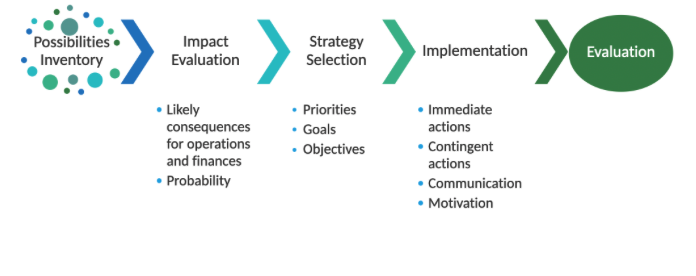
strategic planning process
Self assessment - who are we? Who do we want to be
Mission, vision, values
Current capabilities
Financial stability
Administrative capacity (staff, physical space, technology, board)
Environmental scan - what conditions affect us now? What about the future
Impact evaluation - how will our possible futures be impacted
Goal setting - what must we achieve for success?
Action plan - what steps should we take? What are the measures of success?
external factors
Private and public insurers
Competitors
law/regulations
Stakeholder demands
licensure/accreditation
Community demographics/need
internal factors
New service development
Technology acquisition
Financial performance
Patient satisfaction
Service quality
Budgeting
Staffing
environmental analysis
Demographic trends
law/policy
Reimbursement
Quality reporting
Economy
Workforce
Stakeholder input
Patients
Staff
Government
Other safety net providers
Others in health system
Market assessment
Geographic service area
General population
Subpopulations
Health indicators
Population size and payer mix
Market share
Competitors
Unmet needs
swot analysis
Strengths, weaknesses, opportunities and threats
environmental churn
bad for insurers because there’s more paperwork, bad for providers because of loss of revenue,
characteristics of oligopoly
A few sellers
Interdependence - any change in price or output by 1 firm directly affects other’s profits
Reliance on advertising to gain market share
Product differentiation - slight discernable differences
Sticky prices and stable profits (higher than perfect competition)
average monthly OOPC for insulin
In 2019 the average out of pocket cost was $58 and the average cost for uninsured people was $123 a month
As of 2024, congress capped costs for medicare enrolled, and the three major manufacturers agreed to cut prices and cap out of pocket costs leading to a $35 a month cap for medicare enrollees
Voluntary, they could change their minds at any time
It costs about 2-4 dollars per vial
California is manufacturing its own insulin because gavin said it was ridiculous
pharmacy benefit managers
Four market pharmacy benefit managers (PBMs) controlled ⅔ of the market as of 2024
OptumRX - 22%
CVS health - 19%
Express scripts - 16%
Prime Therapeutics - 11%
Other - 33%
Why not make money by processing drug claims for them?
Negotiating power to determine better prices and “discounts”
Pit drug makers against each other for a seat on the formulary
PBMs pocket money from the difference in payment
Draft formularies
FTC said drug companies couldn't own PBMs
Rebates “better prices”
PBMs insist they pass most rebates to clients (lies), PBMs skimming off rebates
Little direct benefit for consumers
Lawmakers in cali working on requiring transparency for rebates
How much of the rebate actually results in lower prices for patients?
Insurers pay flat fee for PBMs to administer drug coverage for everyone in the insurance plan
This is a mess, very complicated
formularies
preferred list of Rx drugs
Lowest copay = generic drugs
Medium copay = preferred, brand name drugs
Higher copay = non-preferred, brand name drugs, specialty drugs
what happened with insulin prices
Manufacturers drastically raised insulin list prices in the 2010s, reaching over 300$ per vial
Manufacturers were increasing rebates (which were calculated as a % of the list price) they paid to PBMs to obtain preferential formulary placement
Increase in insulin prices set by manufacturers, decrease in manufacturers revenue
In 2024 - the FTC sued PBMS for artificially inflating insulin prices
Abusing economic power by rigging pharmaceutical supply chain competition in their favor, forcing patients to pay more for life saving medication
Upside- down insulin market manufacturers
Rebates should bring drug cost down but we are paying higher list prices and don't benefit at the point of sale
GLP1 coverage for insurance
Pros
Lower long term costs due to lower disease burden
Obesity reduction/type of prevention
Effectiveness
Lose 10-20% of weight
Lower risk of stroke or heart attack
Increased employee productivity due to fewer missed day of work
Improve worker recruitment/retention
Cons
Health plan may not see the savings
Incredibly high cost
Remain on drugs lifelong
Higher costs = higher premiums
Potential savings uncertain for employer
High potential demand
options to control price in health plans
Reduce price - increase cost sharing & copays
Reduce quantity - require prior authorization, limit who qualifies to receive drug (disease severity), set quantity for dose limits
Substitute cheaper inputs - try another less expensive option first
Restructure - end coverage
medicare drug negotiation
Modified the medicare part D noninterference clause”
Original law - HHS secretary cannot interfere with negotiations between drug manufacturers and health plans or require a particular formulary or price structure for covered drugs
New law - HHS secretary must negotiate prices with manufacturers for a certain number of single-source brand names without generic competitors
Drugs are eligible for price negotiation if they are among the top 50 in total medicare spending (9-13 years of FDA approval)
Congressional budget office estimates
98.5 billion in medicare savings from 2022-2031
Reduction of 1% in the number of new drugs coming to market in the next 30 years
Medicare drug price negotiation factors
Manufacturer specific factors -
Research and development costs and extent to which manufacturer has recouped costs
Current unit costs of production and distribution
Federal financial support for research and development
Pending and approved patent applications
US market data and revenue and sales volume
Therapeutic alternatives
Extent to which selected drug represents a therapeutic advance compared to existing therapeutic alternatives and their costs
Prescribing information for the selected drug and its therapeutic alternatives
Comparative effectiveness of the selected drug and its therapeutic alternatives taking into account effects on specific populations, such as patients with disabilities, seniors, people who are terminally ill and children
Extent to which the selected drug and its therapeutic alternatives address unmet needs for a condition that is not adequately addressed by available therapy
estimated impact of 2026 Medicare price negotiation
Cms estimates that medicare would have saved $6 billion (net savings of 22%) if the 2026 negotiated prices were in place in 2023
CMS also estimates that medicare enrolees will save $1.5 billion when the 2026 negotiated prices take effect
Lower medicare out of pocket costs will depend on the copayment amounts or coinsurance rates for a drug
Medicare enrollees could also have improved access to drugs, since part D plans must cover all drugs with negotiated prices for drugs not subject to price negotiation
Plans generally can choose which drugs to include on their formularies (except the 6 protected drug classes)
Plans must also provide a clinical justification for more restrictive utilization management for drugs with negotiated prices compared to drugs in the same class
cost benefit analysis and cost effectiveness analysis
Economic evaluation methods that assist decision making by weighing pros and cons of alternative interventions in a standardized way
Can be used to compare alternatives (for the same condition or two unrelated treatments) or identify programs that do or don't make good use of scarce resources
Do not address ethical dilemmas
Only as good as the data used/available
Do not recommend whether an intervention should be implemented or is actually needed
cost benefit analysis
convert health outcomes into dollar amounts and subtract treatment costs
Costs are measured in dollars
Benefits are measured in dollars
exampleL does surgery add enough years of life expectancy to justify its cost?
Advantages
Able to compare monetary returns on investments in health with returns from investments in other areas of the economy
Able to determine whether a particular treatment offers an overall monetary gain net to society
Disadvantages
Human capital approach - ethical objections to placing monetary values on human life
Willingness to pay approach - amount people are willing to pay is often positively related to their level of income
cost effectiveness analysis
Costs are measured in dollars
Outcomes are measured in health units
Example: which treatment alternative provides the most additional years of life expectancy per dollar spent
Early detection of cervical cancer through pap tests saved 3-7 years of life per 100 tests and cost 2874 per life year saved
Effectiveness can be measured in terms of:
Cases treated appropriately
Lives saved
Life years gained
Pain or symptom free days
Cases successfully diagnosed
Complications avoided
cost utility analysis
a type of cost effectiveness analysis in which outcomes are measured in quality-adjusted life years (QALYs)
quality adjusted life year
Quantity of life (duration of time in a particular health state) + Adjusted for quality of life (desirability of living in a particular health state) = qaly
Population level measure
The value of a year of treatment is lowered by the degree to which a health condition is perceived to harm the person's quality of life during that year
Quality of life is assigned to a utility score ranging from 0 (death) to 1 (a year in perfect health)
An intervention is considered more cost effective if it has a lower cost per QALY compared to an alternative
steps in cost effectiveness analysis
Identify the intervention to evaluate
Need 2 approaches to compare
Identify the target population
Identify the perspective (patient, provider, payer, societal)
Identify, quantify, and standardize costs
Clinical
Nonclinical (lost wages, transportation, childcare)
Time (travel, wait)
Calculate the value of future costs in present dollars, adjust data from past years for inflation
Convert charges to costs
Determine QALY’s
Adjust clinical health outcomes to reflect how much patients value being in one health state vs another
Intervention extends life two years but in constant pain
You value 1 year in constant pain at 60% of a healthy year
QALY 1.2 b/c (2.0x0.6)
Calculate incremental cost effectiveness ratio
(costprogram1 - costprogram2) / (effectivenessprogram1- effectivnessprogram2)
how are health utility scores determined
Questionnaires ask participants how much they would prefer to be in one health state vs another
Health states represent the degree of impairment a person has certain categories of functioning
Time trade off: how many years of living with a certain disability would you trade for a shorter number of years in perfect health?
Standard gamble imaging having a disability, would you undergo a procedure that has a 50% chance of returning you to perfect health and a 20% chance of instant death
eq-5d quality of life domains
Mobility
Self care
Usual activities
Pain and discomfort
Anxiety and depression
Offers five levels of ordinal measurement, includes a child friendly version
Versatile enough to compare health across different types of patients and diseases
Impact of who is surveyed
People without disabilities systematically underestimate the quality of life of people with disabilities
Reduces the value of treatments that do not bring a person back to “perfect health” without a disability
People with disabilities tend to rate their quality of life higher than the general public’s perceptions
Increases value of treatment that extend life while reducing value of treatments that improve quality of life
QALY alternatives
Cost benefit analysis - convert health outcomes into dollar amounts and subtract treatment costs
Equal value of life years gained -
Supplemental unweighted measure of number of years of life extended using a particular treatment
Intended to show significant discrepancy between QALY vs evLYG
Multi criteria decision analysis
rank/weigh factors in terms of importance to decision maker (cost, clinical outcome, administrative burden)
Score each treatment fro each criterion and then generate single average weighted score to compare alternatives
Patient perspective value framework
Patients with the condition being treated define which treatments are of highest value and what high value means
Patients preferences/goals are used to weigh and score factors - treatment benefits drawbacks vs patient costs vs evidence of clinical effectiveness