Motor Learning, Neuroplasticity, and Rehabilitation Strategies in Physical Therapy
 Call Kai
 Learn
Learn Practice Test
 Spaced Repetition
 Match
Match Flashcards
 Knowt Play
1/174

There's no tags or description
Looks like no tags are added yet.
Name | Mastery | Learn | Test | Matching | Spaced | Call with Kai | Chat |
|---|
No analytics yet
Send a link to your students to track their progress
175 Terms
What is Motor Learning Theory?
A set of internal processes associated with practice or experience leading to relatively permanent changes in the capability for motor skill.
How is motor learning inferred?
It is inferred from changes in motor behavior over time.
What are neuroplastic changes?
Changes in the brain due to exercise, including synaptic modification, dendritic branching, and formation of neural connections.
What role does Brain-Derived Neurotrophic Factor (BDNF) play in exercise?
BDNF supports neuroplasticity, learning, and memory; it is increased by exercise and decreased by stress.
How does exercise affect the sensorimotor system?
Exercise improves sensorimotor integration, reflex activity, postural responses, coordination, and timing.
What are the cardiovascular effects of exercise?
Exercise improves oxygen consumption (VO₂), cardiac output, and oxygen extraction at the muscle.
What secondary impairments can exercise help prevent?
Muscle atrophy, contractures, cardiovascular deconditioning, and reduced oxidative capacity.
How can exercise regulate muscle tone?
Exercise can facilitate activation in low-tone presentations and inhibit excessive tone through weight bearing, repetitive movement, and sensory input.
What factors enhance motor learning capacity through exercise?
Ability to process feedback, adjust movement strategies, and refine motor performance, dependent on repetition and task-specific practice.
What is the goal of motor learning progressions?
To promote motor learning rather than just performance.
What is the difference between recovery and compensation in motor learning?
Recovery involves using the affected side more and increasing task difficulty, while compensation involves using the stronger side and modifying the environment.
What is massed practice?
A practice strategy where practice time is greater than rest time.
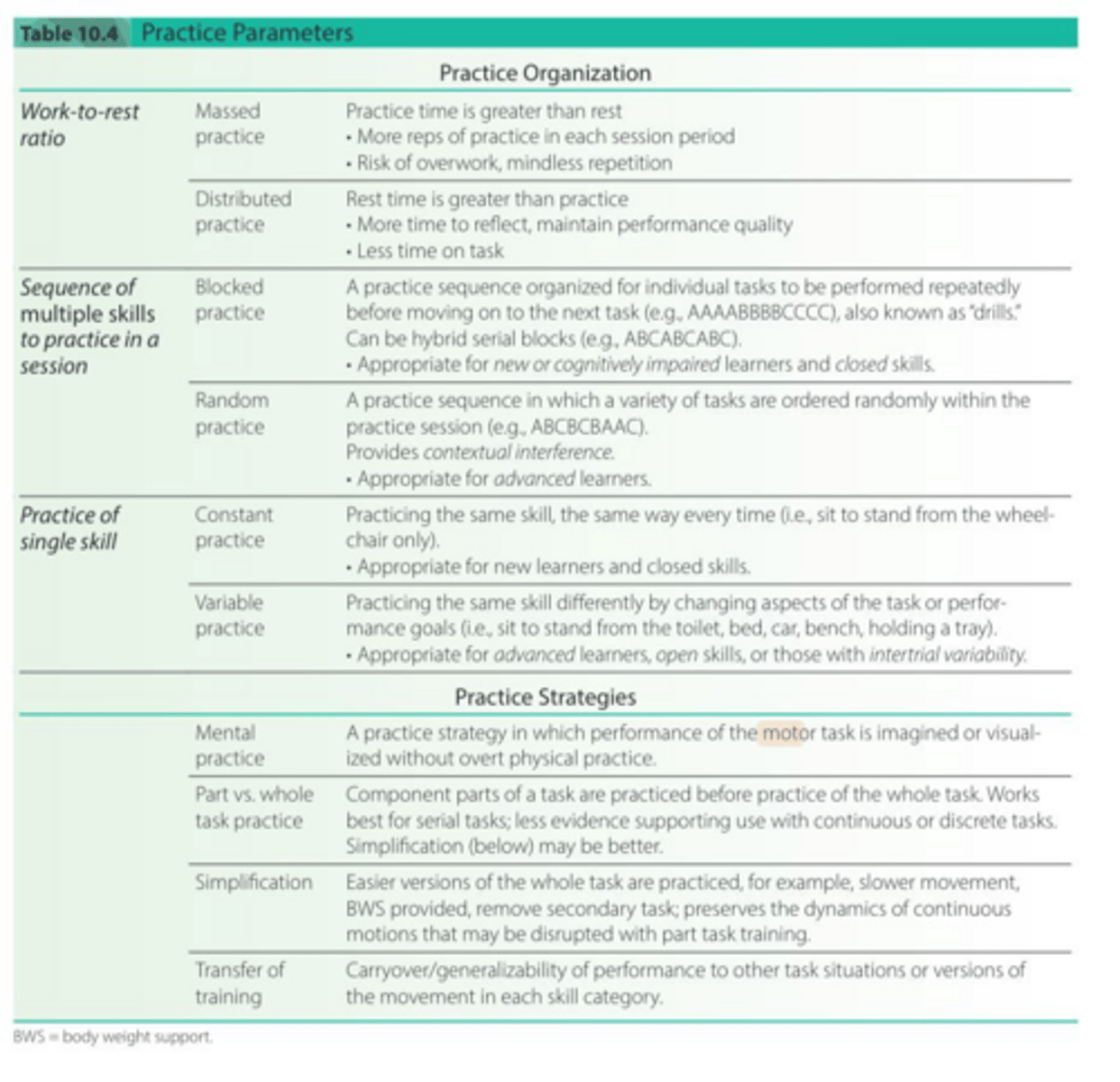
What is distributed practice?
A practice strategy where practice time is less than or equal to rest time.
What is constant practice?
A practice strategy where the task is practiced the same way each time with minimal variability.
What is variable practice?
A practice strategy where the task is practiced with variations in performance.
What is blocked practice?
A practice strategy where a task is practiced repeatedly before moving onto another task (AAABBBCCC).
What is random practice?
A practice strategy where several different tasks are performed in a random, unpredictable order.
What is concurrent feedback?
Feedback given during task performance, often related to knowledge of performance (KP).
What is terminal feedback?
Feedback given at the end of task performance, which can be knowledge of performance (KP) or knowledge of results (KR).
What is bandwidth feedback?
Feedback given only if performance falls outside a predetermined error range.
What is faded feedback?
Feedback given less frequently with ongoing practice.
What is the purpose of summary feedback?
Feedback provided after a set number of trials to summarize performance.
What is intrinsic feedback?
Individual's own sensory information, such as proprioceptive, visual, vestibular, auditory, and cutaneous signals.
What is extrinsic (augmented) feedback?
Supplemental information provided by a therapist that enhances intrinsic feedback, including verbal, visual, and tactile cues.
What does Knowledge of Performance (KP) focus on?
It focuses on the quality of movement, providing feedback like 'Lean forward more' or 'Shift your weight left.'
What does Knowledge of Results (KR) focus on?
It focuses on the outcome of the movement, such as 'You stood up successfully,' promoting motor learning.
What is visual feedback?
Using visual input to guide movement, such as mirror feedback or watching limb movement.
What is manual (tactile) feedback?
Hands-on input from a therapist, such as guiding trunk alignment or providing resistance.
What are the types of external feedback?
Includes verbal, visual, and manual (tactile) cues that supplement intrinsic feedback.
What is the purpose of task-oriented intervention?
To match the intervention to the patient's goals, ensuring it is repetitive, active, meaningful, and variable.
What is the progression in feedback scheduling?
It involves transitioning from constant feedback to faded feedback, and from immediate to delayed feedback.
What is the key clinical goal in rehabilitation?
To maintain movement quality and safety while providing enough intensity for functional improvement.
What does the ICF model assess?
It assesses body structure/function, activity performance, participation, personal factors, and environmental factors.
What are examples of physiological impairments in the ICF model?
Decreased strength, increased tone, poor coordination, decreased proprioception, visual deficits, and decreased endurance.
What activities might a patient struggle with according to the ICF model?
Bed mobility, sitting balance, scooting, transfers, sit-to-stand, and walking.
What are personal factors that can affect performance?
Age, motivation, cognition, beliefs, and fatigue.
What are environmental factors that influence performance?
Home setup, support system, assistive devices (AD), and obstacles.
What is the role of feedback in motor learning?
Feedback promotes motor learning by providing information on performance and results.
What is forced use of the involved limb?
A treatment approach known as Constraint-Induced Movement Therapy (CIMT) that encourages use of the affected limb.
What is neurofacilitation?
A treatment approach that includes sensory stimulation techniques like tapping and weight bearing.
What is the significance of variable practice in rehabilitation?
It improves carryover of skills to real-life situations.
What are some examples of static sitting activities in rehabilitation?
Sitting balance while reaching for objects or performing activities of daily living (ADLs) like brushing teeth.
What does the term 'dynamic sitting' refer to?
Activities that involve reaching outside the base of support (BOS) and weight shifting.
What is the purpose of cardiopulmonary considerations in treatment?
To ensure exercise is task-specific, repetitive, and intense while monitoring vital signs and patient tolerance.
What intervention is best for a patient who cannot roll due to decreased trunk dissociation?
Segmental rolling and PNF chop
What intervention can help a patient who cannot initiate rolling?
Task breakdown and repeated rolling with cues
If a patient cannot bridge due to decreased glute/core strength, what is the best intervention?
Bridging exercises with assistance and glute activation
What should be done for a patient who cannot maintain a bridge?
Hold bridges and perform repeated short bouts
What intervention is appropriate for a patient who cannot scoot in bed due to poor weight shifting?
Lateral weight shifting exercises to facilitate scooting
How can a patient who attempts to scoot but fails due to poor timing be assisted?
Practice sequencing: shift, lift, and move
What intervention is suitable for a patient who falls to one side in bed?
Positioning, trunk activation, and supported rolling
For a patient who cannot move from supine to sit due to trunk and hip coordination issues, what is the best approach?
Break the movement into components
What should be encouraged for a patient who uses only their stronger side due to learned non-use?
Encourage use of the involved side for recovery
What intervention can help a patient with slow and inefficient movement?
Repetitive task practice with feedback
What is the best intervention for a patient who cannot sit upright due to decreased trunk control?
Supported sitting with upper extremity support
If a patient falls forward or backward while sitting, what intervention should be used?
Facilitate trunk to neutral and practice static sitting
What can help a patient who falls to one side while sitting?
Lateral weight shifting with support
What is the best intervention for a patient who relies on UE support to sit?
UE-supported sitting with gradual removal of support
For a patient with slouched posture, what intervention should be implemented?
Trunk positioning and manual cues to achieve neutral alignment
What should be done for a patient who fatigues quickly while sitting?
Implement short bouts of sitting with rest breaks
What intervention can help a patient who cannot adjust their posture due to coordination issues?
Repetitive postural corrections with feedback
What is the progression order for dynamic sitting balance?
Weight shifting, reaching within BOS, reaching outside BOS, changing BOS, unstable surface, and adding speed/resistance
What is the best intervention for a patient who cannot initiate a transfer?
Use external cues like 'nose over toes'
How can a patient who cannot shift weight before lifting be assisted?
Practice seated weight shifting
What should be practiced for a patient who loses balance during a transfer?
Trunk control and controlled weight shifting
What intervention can help a patient who cannot lift their hips during a transfer?
Partial lifts and push-up practice
What should be done for a patient with uncoordinated movement during transfers?
Break the transfer into steps
For a patient who falls toward one side during a transfer, what is the best intervention?
Practice transfer toward both directions
What intervention can help a patient who uses only their stronger side during transfers?
Encourage use of the involved side
What is the best intervention for a patient who cannot initiate STS due to poor anterior weight shift?
Use external cues like 'reach forward'
What should be practiced for a patient who cannot lift off the seat?
Forward weight shift practice and partial STS
What intervention can help a patient who pushes straight up without leaning?
Practice forward trunk lean
How can a patient who cannot extend their hips or knees fully during STS be assisted?
Mini squats and repeated STS practice
What should be done for a patient who falls back into the chair after STS?
Controlled sit-down practice
What is the best intervention for a patient who is unsteady once standing?
Static standing balance training
What should be implemented for a patient who fatigues quickly during STS?
Repeated STS in short bouts
What is the progression for scooting interventions?
Weight shifting, partial lifts, full scooting, UE support reduction, symmetrical to asymmetrical scooting
What is the best intervention for a patient who cannot stand without support?
Supported standing with parallel bars or UE support
If a patient has excessive sway while standing, what should be done?
Practice static standing with cues
What intervention can help a patient who leans to one side while standing?
Weight shift to the weaker side
What should be done for a patient who cannot maintain a neutral posture?
Controlled alignment practice
What is the best intervention for a patient who relies heavily on vision for balance?
Gradually reduce visual input
What is a likely impairment for a patient who cannot roll and moves en bloc?
Decreased trunk dissociation and increased tone.
What is the best intervention for a patient who cannot initiate rolling?
Task breakdown and repeated rolling with cues.
What does a patient need to improve if they cannot bridge due to hips not lifting?
Bridging exercises with assistance and glute activation.
What intervention can help a patient who cannot maintain a bridge?
Holding bridges and repeated short bouts.
What is the likely impairment for a patient who cannot scoot in bed?
Poor weight shifting.
What intervention is effective for a patient who attempts to scoot but fails?
Practice sequencing: shift, lift, move.
What should be done for a patient who falls to one side in bed?
Positioning, trunk activation, and supported rolling.
What is a likely impairment for a patient who cannot move from supine to sit?
Decreased trunk and hip coordination.
What is the best intervention for a patient who uses only their stronger side?
Encourage use of the involved side for recovery.
What is a common issue for patients with flaccid upper extremities?
Poor muscle activation.
What intervention can help a patient with shoulder subluxation?
Arm support and proper positioning.
What is the best intervention for a patient who cannot weight bear through their upper extremity?
UE weight bearing on a table or mat.
What is a likely impairment for a patient with a fisted hand?
Increased flexor tone.
What intervention can help a patient with poor reaching ability due to tone?
Controlled reaching tasks.
What is the best intervention for a patient who cannot sit upright?
Supported sitting with UE support or therapist assistance.
What should be done for a patient who falls forward or backward while sitting?
Facilitate trunk to neutral and practice static sitting.
What is the best intervention for a patient who needs UE support to sit?
UE-supported sitting with gradual removal of support.
What is a likely impairment for a patient who cannot hold midline while sitting?
Decreased postural stability.