Unit 16: Chemistry (Theory)
 Call Kai
 Learn
Learn Practice Test
 Spaced Repetition
 Match
Match Flashcards
 Knowt Play
1/22

Name | Mastery | Learn | Test | Matching | Spaced | Call with Kai | Chat |
|---|
No analytics yet
Send a link to your students to track their progress
23 Terms
How to calculate # of neutrons?
Mass number (top) - Atomic number (bottom)

What is this?
Mass number

What is this?
Atomic number
The group number of an element is also its?
Number of valence electrons
What is the name of group 1?
Alkali metals
What is the name of group 2?
Alkaline Earth Metals
What is the name of group 7?
Halogens “salt-forming”
What is the name of group 8 (0)?
Inert (noble) gases
What is an anion?
Negatively charged ion (wants to gain electrons)
What is a cation?
Positively charged ion (want to lose electrons)
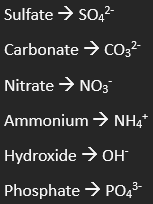
What is a polyatomic ion?
Ions with more than 1 atom/element in them
What are the characteristics of diamond?
Hardest known material
High melting and boiling point
Insoluble in water
Not conductive (no free electrons)
Lots of carbons bonding (each carbon is joined to another 4 carbon atoms)
Strong covalent bonding, used for cutting tools as it is hard
What can graphite be used for?
Lubricant as layers slide over each other, making it slippery
How many covalent bonds does Silicon Dioxide (SiO2) have?
4 Strong covalent bonds
What is malleable?
Can be bent or hammered without shattering
What is brittle?
Shatters when bent or hit
What is ductile?
Can be reshaped into long wires without snapping or breaking
Pneumonic for reactivity series?
Please Stop Cutting My Acoustic Zombie In Cuatro Sad Gold Pieces
What does OILRIG stand for?
Oxidation is Loss (of e), Reduction is Gain (of e)
Metal + Oxygen →
Metal Oxide

Metal + Water →
Metal hydroxide + Hydrogen (H2)

Metal + Acid →
Metal salt + Hydrogen (H2)

Metal + Steam →
Metal oxide + Hydrogen (H2)