Chapter 17: Adaptive Immunity: Specific Defenses of the Host
 Call Kai
 Learn
Learn Practice Test
 Spaced Repetition
 Match
Match Flashcards
 Knowt Play
1/36

There's no tags or description
Looks like no tags are added yet.
Name | Mastery | Learn | Test | Matching | Spaced | Call with Kai | Chat |
|---|
No analytics yet
Send a link to your students to track their progress
37 Terms
adaptive immunity
“specific” immunity or resistance to SPECIFIC pathogens (get rid of only CERTAIN pathogens → very picky)
develop later for specific microbe (acquired via infetion/vaxx → inject pathogens)
specific recognition & response to specific microbe (discriminates)
has immunological memory (encountered before)
slower immune response
3rd line of Host Defenses
immunology
study of host defenses against foreign substances (antigens)
antigen (Ag)
= foreign invader = pathogen
substance that stimulates a certain immune response → antibody production (ex. pathogens, foreign substance, vaccines)
antibody (Ab)
protective proteins made by the host in response to certain antigens
aka immunoglobulins (Ig) = Ab
humoral immunity
fights invaders/threats OUTSIDE of the cell (extracellular Ag’s)
involves B cells indirectly making antibodies that help destroy pathogens (mark for destruction)
cell-mediated (cellular) immunity (CMI)
attacks antigens that have entered the cell (intracellular Ag’s → usually animal virus)
produces T cells that recognize parts of antigens that get processed by phagocytosis & will destroy antigen
B cells & T cells
B cells mature in bone marrow
T cells mature in thymus
after B/T cells mature = migrate to lymphoid tissue (lymph nodes, spleen, etc.)
antigen’s (Ag’s)
substances cause production of antibodies (turn on immune system → humoral immunity)
most Ag’s have external components that interact w/ antibodies (Y) (antigenic determinants)
Ab’s
globular proteins called immunoglobulins (Ig)
recognize/bind to antigenic determinants → form Ag-Ab complex
only “mark” Ag for destruction
Ab’s structure
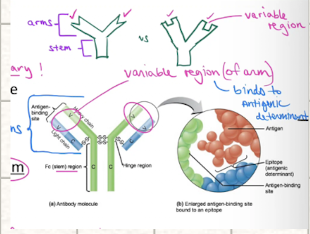
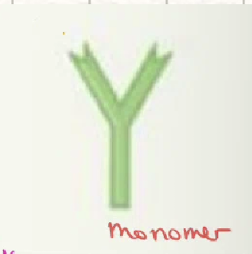
four proteins (4*) chains (subunits) form a “Y-shape” (2 identical light/2 identical heavy chains joined together)
antibodies
variable regions: at ends of arms
bind to antigenic determinants
constant region: the stem
IgG, IgM, IgA, IgD, IgE
IgG
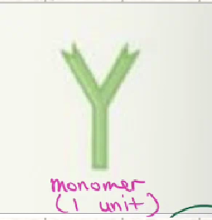
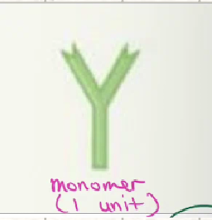
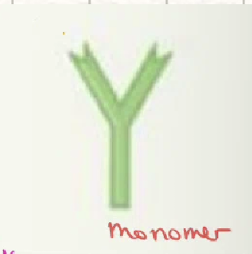
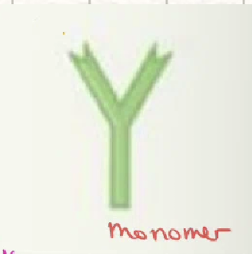
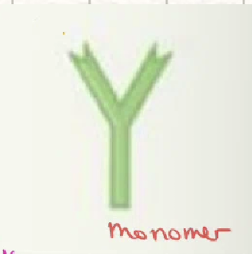
structure: monomer
location: blood, lymph, intestine
fxn: enhances phagocytosis & neutralizes toxins/viruses
abundance: MOST abundant in blood serum
misc: long-lived (3 weeks), provides long-term protection, crosses placenta (transplacental passage)
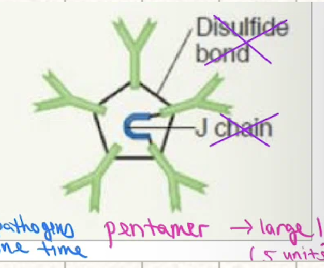
IgM
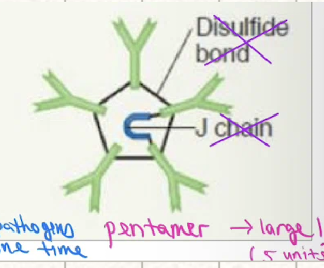
structure: pentamer
location: blood vessels
fxn: clumping (agglutination of pathogens → engulf several @ one time)
abundance: 6% of serum antibodies
misc: largest Ab, primary response to infection, short lived (if ↑ IgM ↓ IgG = new infection)
IgA
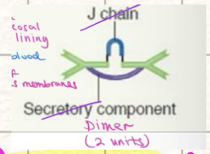
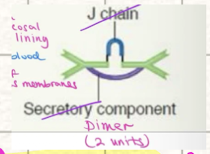
structure: mostly dimer in secretions → tears, saliva, breast milk (can be monomer when on mucosal lining)
location: mucus membrane surfaces/secretions
fxn: prevent attachment of pathogens to mucus membranes
abundance: MOST abundant in body (b/c mucus membrane) & 13% of serum antibodies
IgD
structure: monomer
location: blood, lymph, on B cells
fxn: may be involved in self-tolerance (ability to tolerate yourself so won’t attack yourself)
abundance: 0.02% of serum antibodies
IgE
structure: monomer
location: on mast cells/basophils, in blood
fxn: cause release histamines from mast cells/basophils → allergies & destruction of parasitic worm infections (by ADCC)
abundance: 0.002% of serum antibodies
Ig abundance (body)
A G M D E
Ig abundance (blood)
G A M D E
clonal selection & clonal expansion of B cells (big picture)
b cells → plasma cells → antibodies
clonal selection