Chem/phys flashcards mcat
 Call Kai
 Learn
Learn Practice Test
 Spaced Repetition
 Match
Match Flashcards
 Knowt Play
1/40

There's no tags or description
Looks like no tags are added yet.
Name | Mastery | Learn | Test | Matching | Spaced | Call with Kai | Chat |
|---|
No analytics yet
Send a link to your students to track their progress
41 Terms
ionic radii patterns
decrease with increasing atomic #
in isoelectronics species (same # of e-), ionic radii decrease with increasing atomic #
helpful in comparing cations, anions, & neutral atoms
catalyst changed activation energy; how do different activation energies affect reaction rate
only rate at which equilibrium is achieved changes, but equilibrium constants are still the same
law of mass action
expression w/ respect to equilibrium constant of rxn
when applied to dynamic equilibrium of elementary rxn, this law states rate of rxn is proportional to molar amount of each reactant raised to its power
rxn order = stoichiometric coefficient
How do catalyst particles affect surface area?
increase surface area
increase rxn rate by stabilizing transition state
where are e- generated & where do they flow to?
generated at anode (oxidation) & flow twds cathode (reduction)
electromagnetic spectrum wavelengths for each color
red: 650 to 740
orange: 590 to 650
yellow: 565 to 590
green: 490 to 565
blue: 450 to 490
violet: 400 to 450
Strong bases
Group 1 OH
Group 1 oxide
some group 2 hydroxide: Ba(OH)2, Sr(OH)2, Ca(OH)2, Metal oxides (NaNH2)
Strong Acids
HI
HBr
HCl
HClO4
H2SO4
HNO3
Electrical conductivity patterns
metal > metalloids > nonmetals
Conduction
heat transferred thru direct contact
Radiation
heat transferred thru emission & absorption of electromagnetic waves
Convection
heat transferred w/ flow of matter
Increasing stability for carbanion
methyl > primary > secondary > tertiary
how are multimeric proteins bound tg
noncovalent interaction, but can also have cov disulfide bonds btwn cysteine residues (broken by reducing agents)
Simple distillation:
used for mixtures of liquids that have bp below 150 C & more than 25C diff
Fisher projection
vertical lines: go to back of page, like dashes
horizontal lines: come out of page, like wedges
IR spectroscopy, measure molecular vibrations
Alkane: 2850-2960
Alkene-H: 3020-3100
Alkene: 1640-1680
Alkyne-H: 3300
Alkyne: 2100-2260
Alkyl halide
C-Cl: 600-800
C-Br: 500-600
Alcohol
OH: 3400-3650
C-O: 1050-1150
Arene
C-H: 3030
Aromatic:
1660-2000
1450-1600
Amine:
N-H: 3300-3500
C-N: 1030-1230
4 characteristics of ideal gases
no attractive/repulsive forces
size/ molecular volume of the individual gas molecules of an ideal gas is negligible (as zero), compared to volume/space of container the gas occupies
collisions btwn molecules of ideal gas are completely elastic (no E lost by interac or friction)
ideal gas molecules have average KE/ energy of motion that is directly proportional to gas temp
ideal under high T & low P
elastic collision vs inelastic
Elastic= same KE
w/o attractive interactions
no KE loss
total E of motion is unchanged
Inelastic = same KE
interactions occur during collision
some KE lost in collision
lost E changed to other forms (i.e heat)
lewis acid
accept e-
lewis base
donate e-
Bronsted-lowry acid
donate H+
Arrhenius base
produce OH-
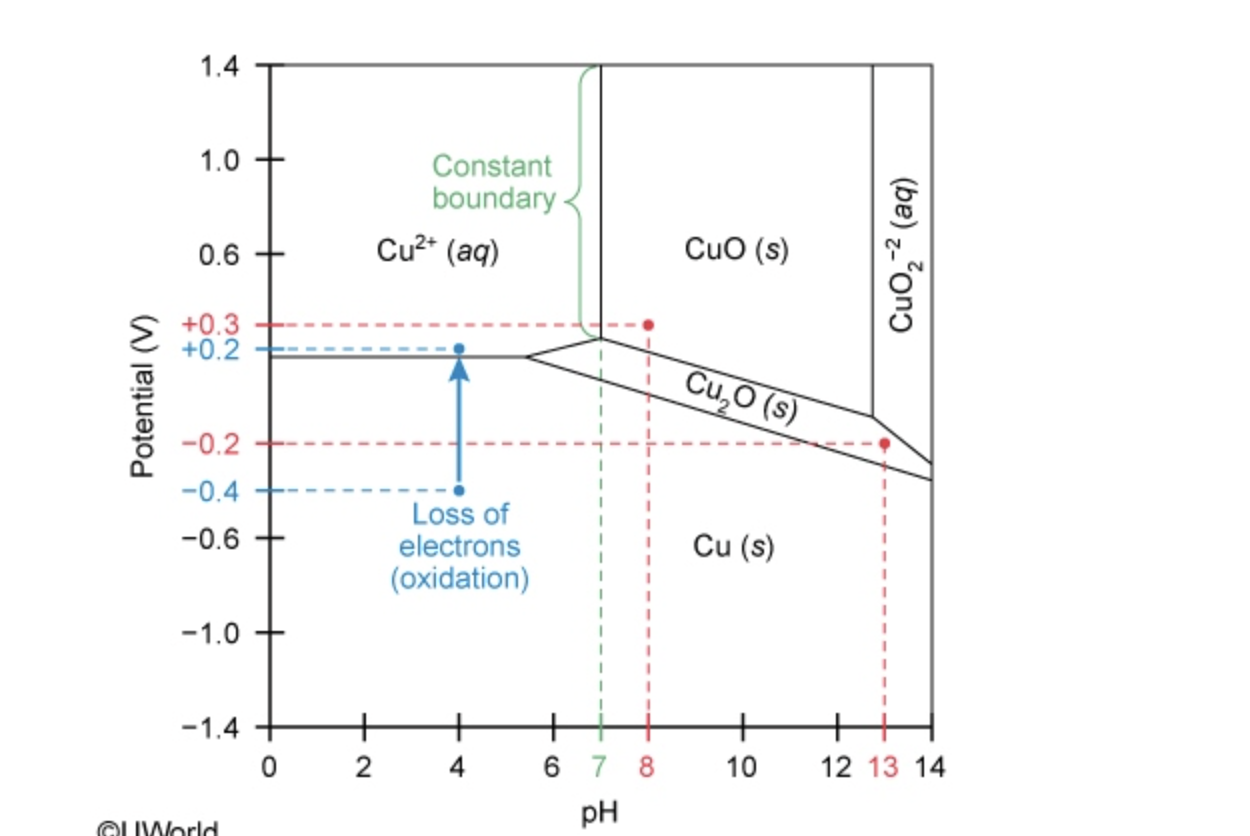
Pourbaix diagram
boundary lines btwn species domains indicate transition from 1 species to another
along boundary btwn aq & precipitating solid species, equilibrium can exist
show relationship btwn chemical species as function of given conditions
boundary lines btwn domains indicate transition from one species to another, also indicate equilibrium btwn aq & precipitating species
boundaries parallel to axis show constant ranges independent of changes
Bronsted lowry base
accept H+
galvanic cell
convert chemical E to electrical E via spontaneous redox rxns, acts as a power source
chemical to electrical
Delta G < 0
Anode (-)
Cathode (+)
no energy source required
electrolytic cell
uses external electrical energy to force non-spontaneous redox rxns, act as an energy consumer
electrical to chemical
Delta G > 0
anode (+)
cathode (-)
energy source required
Gas chromatography & phases
Vaporizes the liquid before separation, molecules are separated based on boiling point
consists of injection port, mobile & stationary phase, column in heated oven, detector, & computer for data analysis
molecules w/ lower bp reach detector before molecules w/ higher bp
mobile phase: inert gas, i.e: helium or nitrogen
stationary phase liquid that coats solid support on inside of column
how are gamma rays & intensity related?
more gamma rays = higher intensity
how are intensity of electromagnetic radiation related to individual energy of each emitted particles & # of particles emitted per unit time?
proportional, increase w/ higher photon E & emission rate
electrochemical cell
e- are always transferred from anode (where oxidation occurs) to cathode (where reduction occurs)
galvanic cell
overall cell potential must be positive & the electrode w/ greater standard reduction potential has a greater tendency to be reduced & function as cathode
relationship of wavelength to frequency & energy
inversely proportional
destructive interference
when path length of 2 waves differ by half the wavelength
diff in path length that are integer multiples of wavelength cause constructive interference
what is necessary for decarboxylation?
B-carbonyl is necessary bc cyclic transition state incorporating both carbonyls is formed
A photon is absorbed when…
it goes from lower, more stable E level to higher, unstable E level
A photon is emitted when…
it goes from higher, unstable E level to lower, stable E level
trend of atomic size
cations are smaller (greater tug, less e-) & anions are larger (smaller tug, more e-)
transverse waves displace components of medium ___________ to direction of wave’s propagation
perpendicular
longitudinal displace medium in a direction _____________ to direction of wave’s propagation
parallel
mechanical wave
created by disturbance in medium