Conscientious & Rational Prescribing
 Call Kai
 Learn
Learn Practice Test
 Spaced Repetition
 Match
Match Flashcards
 Knowt Play
1/70

There's no tags or description
Looks like no tags are added yet.
Name | Mastery | Learn | Test | Matching | Spaced | Call with Kai | Chat |
|---|
No analytics yet
Send a link to your students to track their progress
71 Terms
Pure Food and Drug Act of 1906
prohibited mislabeling and adulteration of drugs
Opium Exclusion Act of 1909
prohibited importation of opium
Amendment (1912) to the Pure Food and Drug Act
Prohibited false or fraudulent advertising claims
Harrison Narcotic Act of 1914
established regulations for use of opium, opiates, and cocaine (marijuana added in 1937)
Food, Drug, and Cosmetic Act of 1938
required that new drugs be safe and pure (but did not require proof of efficacy), enforced by FDA
Durham-Humphrey Act of 1952
Vested in the FDA the power to determine which products could be sold without a prescription.
Kefauver-Harris Amendment of 1962 to Food, Drug, and Cosmetic Act
required proof of efficacy and safety for new drugs and for drugs release since 1938, established guidelines for reporting of info about adverse reactions, clinical testing, and advertising of new drugs
Comprehensive Drug Abuse Prevention and Control Act of 1970
outlined strict controls in manufacture, distribution, and prescribing of habit-forming drugs, established drug schedules and programs to prevent and treat drug addiciton
Orphan Drug Amendment of 1983
Provided incentives for development of drugs that treat diseases with fewer than 200,000 patients in the USA
Drug Price Competition and Patent Restoration Act of 1984
manufacturers pay user fees for certain new drug applications, "breakthrough" products may receive special category approval after expanded phase 1 trials
Bioterrorism Act of 2002
Enhanced controls on dangerous biologic agents and toxins. Seeks to protect safety of food, water, and drug supply
Dietary Supplement Health and Education Act of 1994
established standards with respect to dietary supplements but prohibited full FDA review of supplements and botanicals as drugs
required the establishment of specific ingredient and nutrition information labeling that defines dietary supplements and classifies them as part of food supply but allows unregulated advertising
food and drug administration amendments act of 2007
granted FDA greater authority over drug marketing, labeling, direct-to-consumer advertising, required post-approval studies, established active surveillance systems, made clinical trial operations and results more visible to public
Biologics Price Competition and Innovation Act of 2009
authorized FDA to establish a program of abbreviated pathways for approval of "biosimilar" biologics
FDA Safety and Innovation Act of 2012
Renewed FDA authorization for *accelerated approval of urgently needed drugs*; established new accelerated process, "breakthrough therapy," in addition to "priority review," "accelerated approval" and *"fast-track" procedures*.
what does the FDA require manufacturers to demonstrate?
- free from adulteration (contaminated)
- free from misbranding/mislabeling
- safety & efficacy data for proposed med
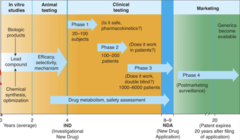
what are the phases of clinical testing?
Phase 1 - done in healthy volunteers
Phase 2 - done in 100's of volunteers with illness being studied, looks at dosing, efficacy, adverse effects
Phase 3 - larger group, double blind placebo controlled, looks at dosing, efficacy, adverse effects
Phase 4 - takes years, post marketing surveillance phase, looks at long term effects
what happened with thalidomide, inspiring changes to regulations?
did not undergo testing before and was given to pregnant women for N/V
resulted in 40% survival rate
what is the FDA is established to do?
protect public from harmful drugs
what are the 2 drug classes?
OTC and Legend (prescription)
what are over the counter drugs (OTC)?
no prescription required, manufacturer must provide general directions for use
what are legend (prescription) drugs?
must come with adequate directions for a health professional to prescribe
what does a prescription package insert contain info about?
drug PK/PD, approved indications, dosage/administration, side effects, cautions, monitoring
what act governs the regulation of dietary supplements?
Dietary Supplement Health and Education Act (DSHEA)
what are examples of dietary supplements?
-vitamin, mineral, herb or other botanical
- amino acid
- substance consumed to supplement the diet by increasing the total dietary intake
- concentrate, metabolite, constituent, extract
- combination of any of the above
the FDA has the authority to remove dietary supplements from the marketplace if...
- pose a "significant or unreasonable risk to consumers"
- adulterated
- marketed with inaccurate labeling
what is "Off-Label" use?
FDA-approved drug prescribed for condition, age group or in a manner not approved by the FDA
- cannot market off-label indications
- providers can prescribe for other uses
what is an example of off label use?
ceftaroline (Teflaro) - antibiotic for skin and soft tissue infections and pneumonia but can be used fro blood stream infections (off label)
what are some other examples of off label use?
weight loss shots, Xarelto
who enforces regulation of controlled substances?
enforced by DEA and Department of Justice
what are controlled substances?
opiates, sedatives, stimulants, hallucinogens
how are controlled substances categorized?
Schedule I (C-I) with a high potential for abuse to Schedule V (C-V) with a low potential for abuse
C-I Drugs
- high potential for abuse
- no accepted medical use in US
what is an example of a CS-I Drug?
-heroin
-LSD
CS-II Drugs
- high potential for abuse, physical and psychological dependency
- Rx, no strike overs
- NO REFILLS
-VO for emergencies for 72 hrs
what is an example of a CS-II Drug?
-hydromorphone
-oxycodone
-fentanyl
-morphine
-hydrocodone (APAP)
CS-III Drugs
- some potential for abuse, moderate psychological dependency
- Rx
- 5 refills within 6 months
what is an example of a CS-III Drug?
Tylenol with codeine
CS-IV Drugs
- low potential for abuse, limited psychological & physical dependency
- Rx
- 5 refills within 6 months
what is an example of a CS-IV Drug?
-alprazolam (Xanax)
-zolpidem (Ambien)
-tramadol
-carisoprodal
CS-V Drugs
- requires prescription
- Rx
- 5 refills within 6 months
what is an example of a CS-V Drug?
- lomotil
-robitussin with codeine
how should you write out the quanitity, especially on CS-II scripts?
write out the quantity, "sixty" not 60
CS-II rx writing tips
- "ongoing use" written on face
- date script
- write date script written
- no strike outs
how many medication errors are there per year?
180,000
how many ED visits and hospitalizations are due to ADEs annually?
1 million ED, >250,000 hosp.
how much is spent on extra medical costs of ADEs annually?
3.5 billion
what often causes medication errors?
- failed communication
- poor drug distribution (mail)
- complex/poor designed technology
- access to drugs by non-pharm (samples)
- dose miscalculations
- lack of info of patient history
- allow pt to leave before understanding therapy/drug
what are some types of medication errors?
-errors of omission
-poor prescription writing
-inappropriate drug prescribing
what are errors of omission?
assumption such as "resume home meds"
fails to specify strength, long acting formulation, "prn"
what cause poor prescription writing?
ambiguous decimal point, abbreviations
what could cause inappropriate drug prescribing?
failure to recognize contraindications
ex. drug interactions with drugs, foods, diseases
how does the FDA provide oversight of safety issues for safe medication practices?
- oversight associated with similarly named drugs
ex. Kapidex -> Dexilant
what was Kapidex name changed to Dexilant?
proton pump inhibitor that sounded too similar to a chemo drug, so changed the name
what are the two national reporting systems for medication errors?
-voluntary
-mandatory
what is the voluntary national reporting systems for medication errors?
provides confidential feedback to health providers so they can learn from other's mistakes
what is the mandatory national reporting systems for medication errors?
makes medication errors known the the public
what is on the USP's list of recommendations to improve the accuracy of presciption writing?
- brief notation of purpose
- write in metric system except insulin, vitamins
-include age and weight of pt
- leading zero should ALWAYS be used for decimal less than 1 (0.5g)
-terminal zero shoulder NEVER be used after decimal (5g not 5.0g)
-avoid abbreviations
what should be included for prescriber identification?
name, degree, office address, telephone number
what should be included for patient identifiers?
name and address
what should be included for inscription?
name of drug and strength
what should be included for DAW?
DAW with signature in correct box
what should be included for subscription?
instructions to pharmacist regarding dosage form and number of dosage units to dispense
what should be included for signa?
instructions by provider given to the patient
Pregnancy Safety Category A description
-no risk to fetus in 1st trimester
-no evidence of risk in later trimesters
Pregnancy Safety Category A example
-levothyroxine
-magnesium sulfate
Pregnancy Safety Category B description
no risk to fetus in animal studies, but no well-controlled studies in pregnant women
Pregnancy Safety Category B example
-HCTZ
-Amox/clav
Pregnancy Safety Category X description
-fetal abnormalities reported and positive evidence of fetal risk in humans
-risk outweigh benefits
-drugs should NOT be used in pregnant women
Pregnancy Safety Category X example
-warfarin
-simvastatin
how you stay vigilant for adverse drug effects?
- maintain high suspicion for ADE
-educate pt about potential side effects
-be alert for withdrawal symptoms masquerading as relapses