enzyme's catalytic power
 Call Kai
 Learn
Learn Practice Test
 Spaced Repetition
 Match
Match Flashcards
 Knowt Play
1/18

There's no tags or description
Looks like no tags are added yet.
Name | Mastery | Learn | Test | Matching | Spaced | Call with Kai | Chat |
|---|
No analytics yet
Send a link to your students to track their progress
19 Terms
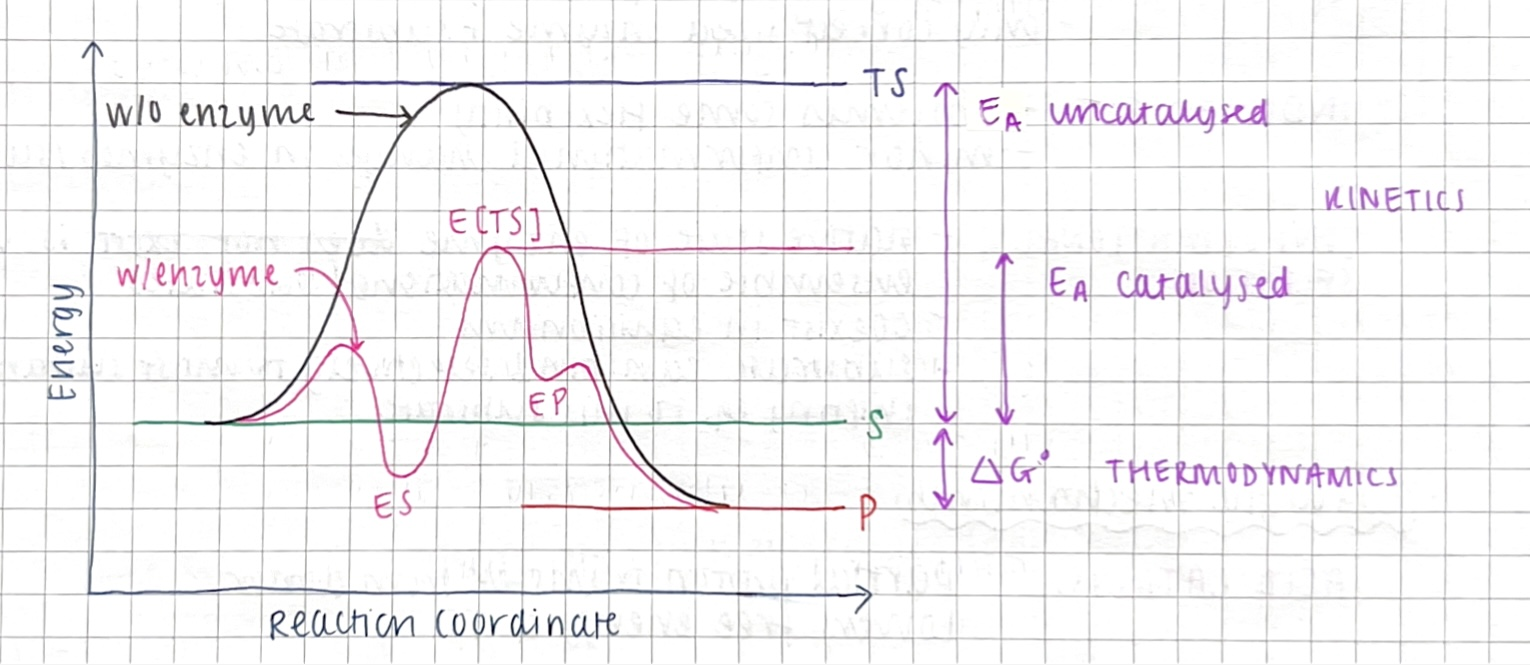
what are the four different stages that happen when substrate is turned into product by an enzyme?
E+S ⇌ ES ⇌ EP ⇌ E+P
how do enzymes increase rate of reaction?
enzymes accelerate rate of reaction by lowering activation energy of the reaction (stabilise the transition state)
enzymes never change the ΔG of a reaction, they can only alter kinectics
what are reaction intermediates?
temporary chemical species formed during a multi-step reaction that are produced in an early step and consumed in a later step
e.g. ES and EP are reaction intermediates
reaction coordinate diagram of reaction with and without enzyme?
what is rate enhancement?
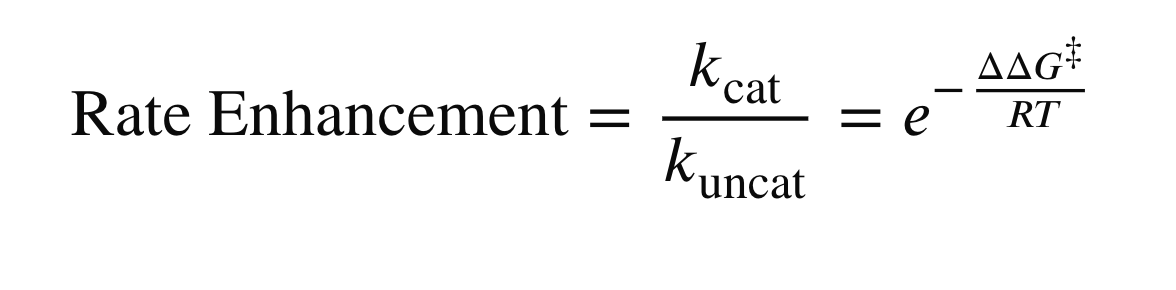
factor by which enzymes accelerate reactions compared to uncatalysed ones
rate of catalysed reactions typically 106 - 1014 times greater
equation for rate enhancement
R = gas constant
ΔΔG is the difference in free energy (ΔGcat - ΔGuncat)
why are enymes designed to bind the transition state more tightly than substrate
tighter binding leads to release of more energy, lowering EA
entropy is reduced: enzyme holds substrate/TS in place
desolvation: water is removed from substrate, exposing reactive groups
proper alignment: substrate is positioned in correct orientation for reaction to occur
what are the three main models for substrate binding?
lock and key
induced fit
conformational selection
what is the lock and key model?
enzyme and substrate are rigid structures
binding interface matches perfectly
only correctly sized enzyme and substrate can bind
what is the induced fit model?
assumes that enzyme and substrate have some flexibility in structure
minor conformational changes can be made to bind to each other
what is the conformational selection model?
an enzyme naturally shifts between different shapes on its own
substrate binds to enzyme shape that already fits it best (bind selectively)
what are the three main catalytic mechanisms?
acid catalysis
base catalysis
covalent catalysis
what is acid catalysis?
partial proton transfer from donor to acceptor
what is base catalysis?
partial proton abstraction by acceptor
what is covalent catalysis
interactions between substrate and enzyme’s functional group
what example enzyme displays all these modes of catalysis?
lysosyme
Asp52 covalent catalyst (displaces monosaccharide unit E)
Glu35 acid catalyst (protonates unit E to facilitate departure)
Glu35 base catalyst (abstracts proton from water to form OH-)
what factors affect enzyme activity?
temperature
pH
enzyme concentration
substrate concentration
inhibitor
activator
what factors affect enzyme activity?
temperature
pH
increasing enzyme activity
increasing substrate concentration
inhibitors
activators
(for detail look at one note page)
how are enzymes regulated
vary amount of enzyme
PTMs
inactive precuror
allosteric effects
cooperativity
look at one note page for detail and examples