Study Aid: MICS Medical Note Quiz
 Call Kai
 Learn
Learn Practice Test
 Spaced Repetition
 Match
Match Flashcards
 Knowt Play
1/39

There's no tags or description
Looks like no tags are added yet.
Name | Mastery | Learn | Test | Matching | Spaced | Call with Kai |
|---|
No analytics yet
Send a link to your students to track their progress
40 Terms
What is the purpose of using a standardized note format?
Conveys complete information
Conveys information in an order other providers are expecting
Helps guide diagnostic thinking process
Legal record of your encounter with the patient
What is a "chief complaint" or "chief concern"?
One-line opening statement
Contains the ONE major presenting concern/syndrome and duration
Answers, "What brings you in today?"
What does OPQRST stand for?
◼ Onset
◼ Provocative and Palliative factors
◼ Quality
◼ Region and Radiation
◼ Severity
◼ Timing
OPQRST:
Commencement
Gradual vs Sudden
"After eating"
"After living heavy object"
Acute vs recurrent
Onset
OPQRST:
What makes the pain better or worse?
Common measures or triggers?
Provocative/Palliative
OPQRST:
Sharp
Burning
Aching
Bilious vomitous
Spinning sensation
Tea-colored Urine
Quality
OPQRST:
Location-be specific!
Does the pain travel?
Region/Radiation
OPQRST:
Scale of 1-10
Mild, moderate, severe
Ex. Dyspnea so bad I couldn't climb a set of stairs
Severity
OPQRST:
Intermittent
Constant
Morning, Afternoon, Evening
Fall, Winter, Spring, Summer
Timing/Time Course
Consists of:
1. Opening Sentence
2. Analysis Review of all relevant signs/symptoms (OPQRST)
3. Full picture (Chief Complaint plus details)
History of Present Illness
Will most likely come from your ROS
Symptoms or signs that you would expect to find if a possible cause for a patient's problem were true, which then supports this diagnosis.
These are recorded in the HPI (as well as your ROS section)
Pertinent Positive
S/Sx which are absent and therefore help rule out causes considered for the presentation (rule out causes on your ddx)
S/Sx which are absent but which usually are positive in patients presenting with the diagnosis you most strongly suspect.
These are listed at the end of the HPI but made clearly distinct.
Pertinent Negatives
Complete Sequence of the H&P Note:
○ Chief Complaint
○ History of Present Illness
○ Review of Systems (ROS)
○ Past Medical History
○ Family history
○ Psychosocial history
○ Medications
○ Allergies
○ Physical Exam
○ Labs and diagnostic
test results
○ MDM
○ Assessment and Plan
Contains the following:
○ Age
○ Race
○ Gender
○ Chronic adult illnesses or health status, particularly if relevant
○ Setting of care and manner of presentation (Family practice, ED, EMS, police escort, etc.)
○ Reason for visit ( EXACT re-statement of chief complaint)
Proper Opening Sentence
Ex.
○ 57 y/o AAM with PMHx of HLD x 10y, HTN x 5y, and CAD x 2y who presents to the ED via EMS c/o chest pain x 2 hrs.
The components of proper documentation of a medication
○ Medication name
○ Dosage (include units)
○ Route (PO vs IM vs INJ vs INH vs intranasal)
○ Frequency (PRN or scheduled?)
○ Indication
What part of a note needs to in narrative form?
Psychosocial Documentation
Documentation of allergies need to include:
Includes ALL known allergies (Medication , Latex, Food ,Seasonal/Environmental)
Ask about each category - don't just ask "do you have any allergies?"
Listed in a bullet point format
List the reaction ( Is it a true allergy, or is it a side effect or intolerance)
Which part of ROS:
● Weight change ○ loss/gain
● Fever/chills
● Fatigue
● Weakness
● Weakness
● Night sweats
● Malaise
Constitutional
Which part of ROS:
● Changes in texture, or appearance of hair, skin, or nails
● Cyanosis or Pallor
● Rashes or lesions or bruises
● Dry Skin
● Jaundice (yellowing)
● Pruritus
Integumentary
Which part of ROS:
● Recent change in vision
● Blurry vision
● Spots/floaters
● Flashing lights
● Diplopia
● Red, jaundiced, or painful eyes
● Discharge/drainage
● Increased lacrimation
Eyes
Which part of ROS:
◼ Change in hearing, otalgia, otorrhea
◼ Tinnitus or vertigo
◼ Rhinorrhea (color, consistency), epistaxis
◼ Facial pain
◼ Post nasal drip
◼ Anosmia
◼ Dental pain, bleeding or swelling of gums
◼ Ulcers or lesions of tongue, teeth, gums, or mouth; dentures
◼ Sore throat, hoarseness, or voice change
Ears, Nose, Mouth, and Throat
Which part of ROS:
● Tenderness
● Masses or deformity
● Nipple discharge
● Changes in nipple or skin
Breasts
Which part of ROS:
● Cough
● Sputum production
● Hemoptysis
● Wheezing
● Dyspnea
● Pleurisy
Respiratory
Which part of ROS:
● Chest pain
● Palpitations
● Dyspnea on exertion (DOE)
● Diaphoresis
● Orthopnea
● Paroxysmal nocturnal dyspnea (PND)
● Pedal edema
● Claudication
● sensitivity or distal color change with exposure to cold
● leg pain or leg cramps
● erythema, or swelling
● ulceration or temperature change of extremities
● hair loss
Cardiovascular
Which part of ROS:
○ Dysphagia, odynophagia
○ Change in appetite/anorexia
○ Nausea, vomiting
○ Abdominal pain
○ Hematochezia or melena
○ Constipation or diarrhea
○ Change in bowel habits or stool appearance
○ Jaundice
○ Dyspepsia/indigestion, new food intolerance
○ Excessive belching or passage of flatus
Gastrointestinal
Which part of ROS:
● Change in frequency, volume, or nature of urination
● Dysuria, hematuria
● Nocturia (how many times per night?)
● Hesitancy or urgency
● Incontinence
● Flank or suprapubic pain
Genitourinary
Which part of ROS:
● Bleeding between menses or after intercourse
● Dysmenorrhea
● Dyspareunia
● Post-menopausal bleeding
● Vaginal discharge/pruritus
● Vulvar lesions/pruritus/pain
● Changes in sexual drive, sexual satisfaction or concerns
Genitourinary Female
Which part of ROS:
● Groin/thigh swelling or mass
● Penile lesions or discharge
● Testicular pain/masses
● Ability to achieve and maintain erection ● Ability to ejaculate
● Changes in sexual drive, sexual satisfaction or concerns
Genitourinary Male
Which part of ROS:
● Muscle weakness
● Myalgias
● Arthralgia
● Joint stiffness
● Joint swelling
● Neck or back pain
Musculoskeletal
Which part of ROS:
● Headaches
● Seizures
● Blackouts, syncope, or lightheadedness ● Dizziness
● Paralysis
● Anesthesia or paresthesias
● Tremors or other involuntary movement ● Weakness
● Muscle atrophy
● Difficulty speaking
● Memory loss, difficulty concentrating
Neurologic
Which part of ROS:
○ Weight gain or loss
○ Heat or cold intolerance
○ Hair, skin, or nail changes
○ Diarrhea or constipation
○ Palpitations
○ Polydipsia, polyphagia, or polyuria
Endocrine
Which part of ROS:
○Easy bruising or difficulty controlling bleeding
○ Tenderness or enlargement of lymph nodes (neck, axillae, or groin areas)
○ Unilateral limb edema
Hematologic/Lymphatic
Which part of ROS:
○ Atopy
○ Pet or food allergies
○ Frequent or chronic infections
○ Poor healing
○ Angioedema
Allergic/Immunologic
Which part of ROS:
● Insomnia/hypersomnia
● Sleep disruptions
● Disorientation
● Memory loss
● Change in ability to concentrate
● Excessive nervousness or crying
● Mood extremes
● Depressed mood
● Hallucinations
● Suicidal or homicidal ideations
Psychiatric
Consists of the following Components:
● Childhood Illnesses
● Adult Illnesses
● OBGYN history (Menstrual History, Sexual / Contraception History, Obstetrical History)
● Psychiatric history
● Accidents and Injuries
● Hospitalizations
● Surgical History
● Immunization history
● Screening Tests / Health Maintenance
Past Medical History
Consists of the following Components:
● Ethnic lineage
● Support systems
● Home situation / significant others
● Daily life
● Occupational history
● Financial situation
● Education
● Military history
● Other significant life events
● Travel
● Sleep
● Exercise / leisure activities
● Safety Measures
● Effect of Illness
● Diet
● Tobacco
● Alcohol
● Marijuana
● Illicit drug use
●Sexual History
Psychosocial Documentation
A 10 points scale is useful for documenting the severity of pain, but how might you document the severity of dyspnea?
"Cannot climb a set of stairs"
What is the purpose of the MDM section?
A narrative which provides the clinical reasoning for "why you did what you did"
The backbone of every patient encounter
Consists of:
○ Problems addressed
○ Complexity of data
○ Risks of patient management
What are the 4 components for the plan for each item listed in the assessment? (e.g. dx, etc)
○ Diagnostics
○ Therapeutics
○ Patient Education/Supportive Care
○ Disposition
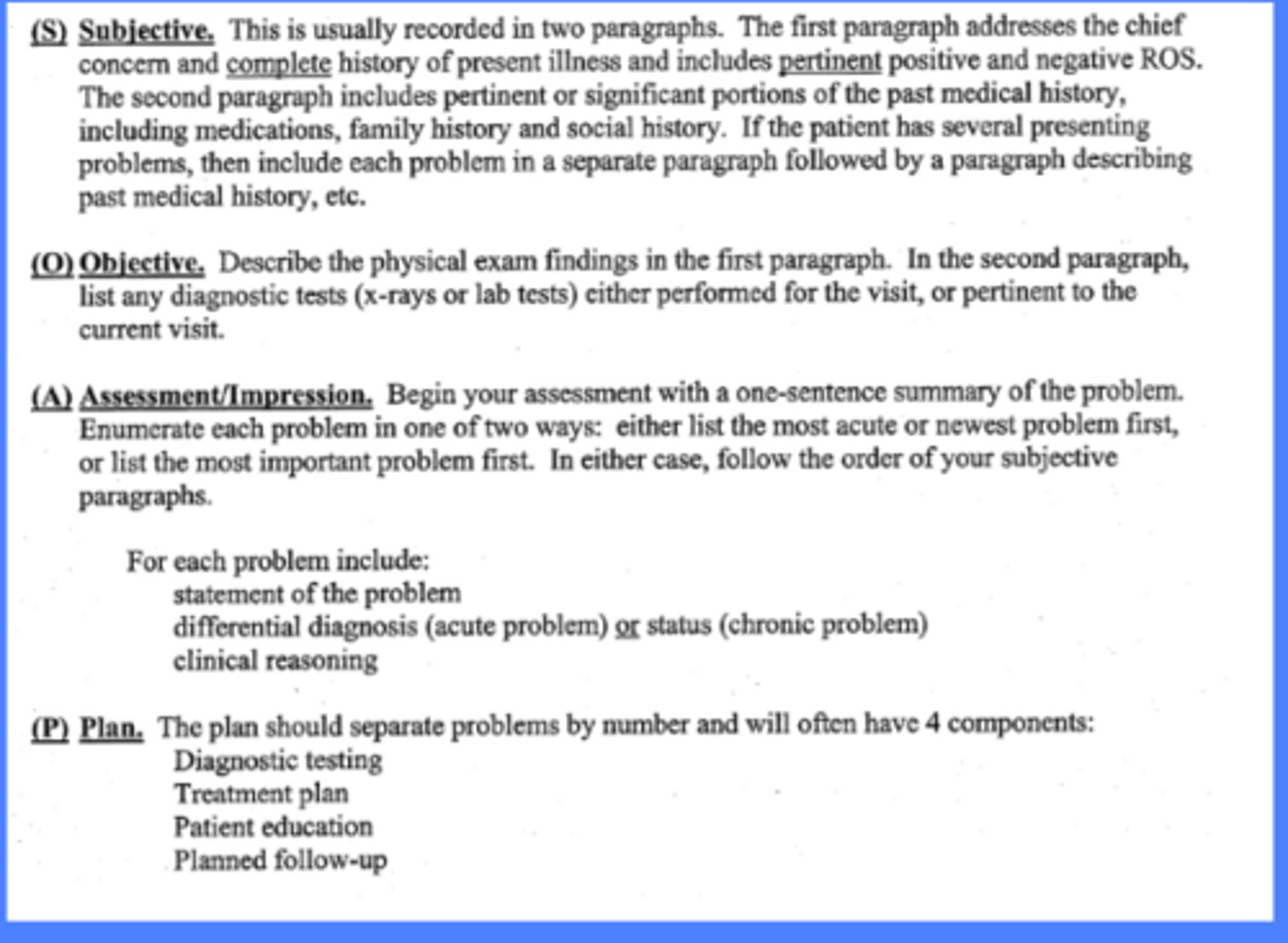
What do the sections of a SOAP note consist of and which of the complete medical note components would be an "S" versus an "O"?