Chapter 12: Decision making and reasoning
 Studied by 0 people
 Call Kai
 Learn
Learn Practice Test
 Spaced Repetition
 Match
Match Flashcards
 Knowt Play
1/44

There's no tags or description
Looks like no tags are added yet.
Name | Mastery | Learn | Test | Matching | Spaced |
|---|
No study sessions yet.
45 Terms
Judgment and Reasoning
Used to select from among choices or to evaluate opportunities
Decision-making
Cognitive process of choosing between multiple options to select a course of action or belief
We are very bad at making decisions
Type 1 (reactive) thinking
Fast and easy thinking; rely on heuristics
Quick and intuitive
“I did what felt right” or “listening to my gut”
Limbic system
Amygdala and hippocampus: process emotions and memories
Type 2 (reflective) thinking
slower, more effortful thinking
Logical and analytical (PFC)
Dorsolateral PFC
Emotions and decision making
Just like memories, anticipated events can cause a strong bodily reaction
Somatic marker
Bodily arousal in anticipation of certain events that we use to evaluate options and make decisions
Relying on your “gut feeling”
Affective forecasting
your predictions for your own emotions
However, we are very bad at predicting our future emotions
Overestimate intensity and duration of emotions
Utility Maximization
Weighing the costs and benefits to seek a path that maximizes gain and minimizes cost
Utility: value you place on a particular outcome (positive or negative)
Seek to gain as much utility as possible (ex - gain utility by eating at a fancy resturant vs. gain utility by saving money)
Example - Choosing classes for next semester (think about the classes that are interesting and that help fill your major requirments)
Heuristics
Mental shortcuts we use to make judgments and decisions quickly and efficiently
They save us energy and usually serve us well
Like schemas, they are automatic: unconsious, unintentional, not energy consuming
Want to make decisions in a reasonable time frame and reduce the avaliable information to a manageable amount
Types of heuristics
Satisficing
Elimination by aspects
Representativeness
Availability
(Ignoring) base rate
Anchoring
Benefits of Heuristics
Lighten the cognitive load
Efficient for making decisions fast
Often unconsious and automatic
Helpful for everyday decisions
Limitations of Heuristics
Error prone
Can lead to biases
Much greater chance of error
Satisficing (Heuristic)
Consider options individually, and then select an option as soon as we find one that is satisfactory, or just good enough to meet our minimum level of acceptability.
Decision making limited by bounded rationality
Strives for adequate, rather than perfect results
used to make decisions efficiently, rather than exhaustively
Example - buying a pack of gum before catching a plane
Satisficers
Find a solution that meets their needs and moves on without obsessing over alternatives
Settle for good enough options
Do not bother comparing decisons with others
More satisfied with outcomes
Maximizers
Compare all available options to find the absolute best one
Tend to be more overconfident in decisions
Less satisfied due to stress, regret, and second-guessing
looks for maximum benefit & highest utility
Compare decisions with others
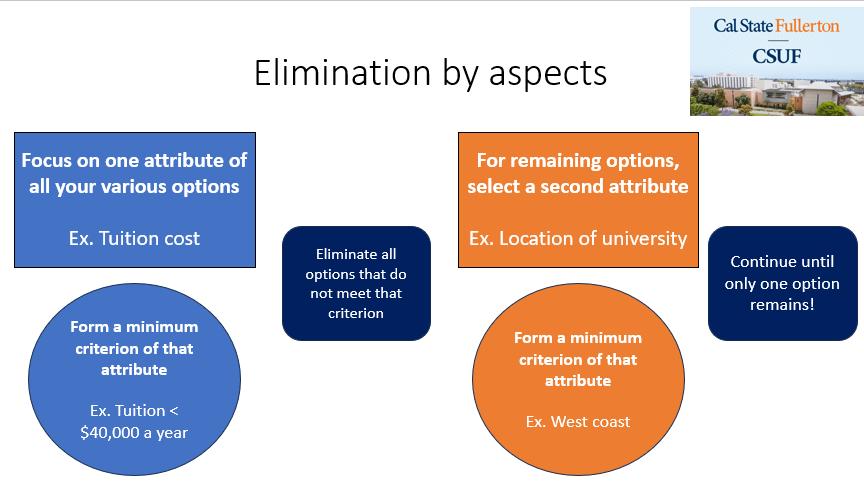
Elimination by aspects (heuristic)
Make decision by eliminating options based on perceived importance
Breaking down a complex choice into smaller parts, and then eliminating options that do not meet the criteria for each aspect (Tversky, 1972)
Helpful when we have more alternatives than we can consider in the time available
Use some elements of satisficing to narrow the range of options, then we rely on more thorough and careful strategies to make our final decision
Representativeness (heuristic)
When classifications are made based on how typical (representative) we think a thing is of a prototype or category
Similarity between an event and other events in the category
Many categories are homogenous enough so that category members do resemble one another
Very easy to use and often works (except when category members are not homogenous)
Errors with representativeness heuristic
Gambler’s fallacy: mistaken belief that the probability of a given random event is influenced by previous random events, and is now likely to change
Believe the pattern representative of past events is related and now must be “corrected”
Each coin toss is an independent event that has an equal probability of occurring
Hot hand fallacy: opposite of gambler’s fallacy; believe a certain course of events will continue
Can lead to poor judgments and decision-making if an existing schema doesn’t account for the situation
Make decisions based on small samples of data because we assume our sample is representative of the whole population
Contributes to prejudice and stereotypes
Availability heuristic
When judgment is based on how easy it is to bring something to mind
How “avaliable” something is in your mind
Error with availability heuristic
Attribute substitution: can lead to incorrect judgments because avaliability does not equal frequency or probabaility
Schwarz et al. 1991 Study
Four groups participate in recall task
Recall task: think of instances in which you are assertive or unassertive
Recall amount: asked to list 6 or 12 instances
DV: after that, rate how assertive you are
Why is some information more avaliable than others?
Ease of recall
Recency
Emotional impact
Media exposure
Ease of recall
mistake for frequency or probability
Recency
can have disproportionate impact on judgment
Emotional Impact
dramatic, emotionally charged, or impactful
Media Exposure
Sensationalized and rare events are likley to be covered in the news
& avaliability of information: high frequency, but less publicized causes of death (car accidents) lead people to believe these events are less probable than plane crashes
(Ignoring) Base- Rate Information
Not taking base-rate info (the actual likelihood of something) into account
We ignore general statistical information in favor of specific instances
Often accompanies other heuristics (representataiveness and avaliability)
Example of representativeness and ignoring base rate information: Alice enjoys poetry and dresses eccentrically. is alice more likley to be a poet or an accountant? - Most people say poet, even though statistically, there are far more accountants than poets in the general population.
Anchoring
Individuals rely too heavily on the first piece of information (the anchor) they receive
Using number as a starting point, and then adjusting one’s anwser away from this anchor
Negotiations
Sales prices
Anchors can be completley irrelevant
Implausible Anchors
Irrelevant numbers can influence a person’s judgment
Participants asked, “was Mahatma Gandhi younger or older than X years when he died?”
•Before or after age 9 (low anchor)
•Before or after age 140 (high anchor)
Results: despite knowing anchors were (obviously) wrong, participants in both groups were influenced by the initial number
•Low anchor: average estimate of 50
•High anchor: average estimate of 67
•Final guesses biased toward initial anchor
Biases
Systematic errors in thinking that can influence how people interpret information, make decisions, and act that resulting from heuristics
Framing bias
Illusory correlation
Confirmation bias
Framing Bias
The way options are presented influences the selection of an option
Decision based on whether the options are presented with positive or negative connotations
Choose options that demonstrate potential gains even if both options objectivley lead to the same outcome
Dependent on the wording, setting, speaker, and situation
Illusory correction
Predisposed to associate two unrelated events as if they are causally linked
The instances in which the relationship is confirmed are more easily recalled from memory than instances that contradict our biased expectations
Astrological signs and relationship compatibility
“Lucky” superstitions
Ice cream sales and violent crime
Confirmation Bias
Seek confirmation rather than disconfirmation of what we already believe
Seek evidence that confirms our beliefs
When disconfirming evidence is made available, we fail to use it to adjust our beliefs
When we encounter confirming evidence, we don’t question it (but we do with disconfirming evidence)
Logic and Reasoning
Categorical syllogisms: logical argument that involves drawing a conclusion from two premises
All syllogisms include two premises and one conclusion
Premise 1: All cognitive psychologists are athletes.
Premise 2: All athletes are kind.
Conclusion: Therefore, all cognitive psychologists are kind.
This syllogism is valid, but the conclusion is false because the premises are false
Syllogism Quantifiers
Universal affirmative statements
Universal negative statements
Particular affirmative statements
Particular negative statements
Universal affirmative statements
positive statements about all members of a class (all A are B)
Universal negative statements
negative statements about all members of a class (none of A are B)
Particular affirmative statements
positive statements about some members of a class (some A are B)
Particular negative statements
negative statements about some members of a class (some of A are not B)
Group decision making
Enhanced decision-making and problem-solving
Expertise from each group member
Collective information: increase in resources and ideas
Shared cognition: improved group memory over individual memory
Groupthink
Group decision-making style characterized by excessive tendency among group members to seek agreement and avoid conflict
High cohesion
Isolated from outsiders & lack of objective leadership
High stress situation
Individual Decision making (pros & cons)
Pros:
faster than group decision-making
clearer accountability
efficient and simple
Cons:
fewer ideas
possible delay in decision-making if left to do it alone
potential for bias
Group decision making (pros & cons)
Pros:
diversity of ideas & can build off others ideas
greater commitment to ideas
interaction can be fun and serve as a team building task
Cons:
takes longer
group dynamics, such as groupthink, may occur
social loafing may make it difficult to identify responsibility for decisions
Symptoms of group think
Closed-mindedness: unwilling to consider alternative ideas
Feeling invulnerable: believes they are inherently right, given the information available to them
Feeling unanimous: an illusion where members believe everyone shares the same opinions (self-censorship)
Squelching of dissent: those who disagree are ignored and ostracized
Mind-guards: enforce norms, withhold information that may challenge group decision
Antidotes for Groupthink
Group leaders play an important role in preventing groupthink
Leaders should:
•Encourage constructive criticism and impartiality
•Ensure that members seek input from people outside the group
•Actively prevent conformity
As a group, members should:
•Work in small groups (ideal 3-5 members), as well as work in a larger group
•Meet separately to consider alternative solutions to a single problem