AP Lang Summer Vocab
 Call Kai
 Learn
Learn Practice Test
 Spaced Repetition
 Match
Match Flashcards
 Knowt Play
1/35

There's no tags or description
Looks like no tags are added yet.
Name | Mastery | Learn | Test | Matching | Spaced | Call with Kai | Chat |
|---|
No analytics yet
Send a link to your students to track their progress
36 Terms
General/Generalization
A broad statement or principle of something based on specific facts or details
Ex: The Pacific Northwest has rainy and gloomy weather
Specific/Specificity
The use of precise/specific nouns, verbs, and details instead of vague or general language
Ex: Many trees were burned in a forest fire vs 500 acres of redwoods were scorched in Northern California, causing substantial damage to the habitats they made
Abstract vs Concrete
Abstract language is concepts and ideas that we think and concrete language is specific things that we can perceive using our senses
Ex: the grueling marathon took a heavy emotional and physical toll on the runners vs as the exhausted runners crossed the finish line, their faces were slick with sweat, and they collapsed onto the sun-baked asphalt, gasping for air.
Parenthetical citation
A reference in text in parenthesis placed after a quote (usually the authors name, etc, in MLA format or APA style)
Analogy
An explanation of a complex concept by comparing it to something more simple or familiar
Ex: "Life is like a box of chocolates—you never know what you're going to get". (explains that both are full of unpredictable surprises)
Juxtaposition/contrast
A specific placement of two contrasting things next to each other to highlight their differences (shows the contrast)
Ex: "It was the best of times, it was the worst of times" or any oxymorons
Imagery
A description that uses vivid language to 'paint a picture with words'
Ex: "The golden sun dipped below the horizon, painting the clouds in fiery oranges."
Personification
A figure of speech that gives human traits, actions, or feelings to something non-human
Ex: The sun smiled down on us
Metaphor
A comparison of two things (not using "like" or "as")
Ex: He is a walking encyclopedia
Similie
A comparison/way of describing something with "like" or "as"
Ex: She is as cool as a cucumber
Diction
The choice and use of words that a person uses when speaking (formal vs informal)
Ex: "Would you care to partake in some refreshment?" vs "Wanna go eat?"
Hyperbole
A figure of speech that uses exaggeration to make a point, show a feeling, or be funny and is not meant to be taken literally
Ex: I have a million things to do today
Irony
Occurs when there is a clear difference in what was expected to happen and what did happen and creates a surprise, joke, or deeper meaning. There is situational, verbal, and dramatic.
Paradox
A statement or proposition that seems self-contradictory or absurd but in reality shows a possible truth
Ex: "Less is more"
Self-deprecating humor
The act of making lighthearted jokes at your own expense by highlighting your flaws or mistakes
Ex: "I used to have the body of a football player. Now I have the body of a fantasy football player."
Noun
A person, place, thing, or idea
Ex: A teacher, a school, a pencil, and love
Verb
A word that shows action or state of being and appears in every complete sentence.
Ex: She runs to the park. They are happy.
(Runs and are)
Modifier
A word, phrase, or clause that describes, changes, or adds detail to another word in a sentence (adjectives and adverbs)
Ex: "She was talking loudly" (loudly is adding more detail to the sentence)
Subordinating conjunction
A word that connects a dependent clause to an independent clause and connects the sentence
Ex: Before, although, because, if, since
Coordinating conjunction
A word that connects words, phrases, or independent clauses of equal grammatical importance
Ex: For, and, nor, but, or, yet, so
Preposition
A short word that shows how a noun/pronoun relates to another word in the sentence (time + movement/direction)
Ex: in, on, at, by, before, after
Pronoun
A word used in the place of a noun to keep from repeating names
Ex: he, she, they, I, you, we
Article
A word that joins with a noun to show if the noun is general or specific
Ex: a/an, the
"I saw a dog" (general) vs "I saw the dog" (specific)
Clause
A group of words that has a subject and a verb.
Inedependent - can be its own sentence
Dependent - can't be a sentence on its own
Ex: "She went to the store" vs "That she bought"
Phrase
A group of words that work together as a unit inside a sentence. Types are: noun, verb, prepositional, adjective, adverbs
Ex: (The big brown dog) barked.
Syntax
The set of rules that tells us how to put words and phrases together to make a clear sentence. In English the order is subject>verb>object
Fragment (sentence)
An incomplete sentence that's punctuated like a complete sentence.
Ex: Ran to the store.
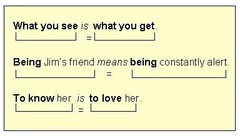
Parallel structure
Using the same word pattern in a sentence to show that two or more ideas have the same importance.
Ex:
Repitition
A literary and rhetorical device where a writer or speaker uses the same word, sound, phrase, or idea two or more times to add emphasis, create rhythm, or make a point stick.
Ex:"See no evil, hear no evil, speak no evil."
Colloquialism
An informal word or phrase used in everyday, casual conversation rather than in formal writing or professional speech.
Ex: Gonna, wanna, and gotta.
Jargon
A specialized or technical language used by a specific profession, trade, or group.
Ambiguity
A word, phrase, or sentence has more than one clear meaning.
Ex: "I saw the man with binoculars"
Did you or the man have the binoculars?
Ambivalence
The state of having mixed, simultaneous, and contradictory feelings or beliefs toward a person, object, or situation.
Anecdote
A very short, interesting, or amusing story about a real person or a past event. It can be used to prove a point, make an audience laugh, share an experience, or easily explain something complex.
Line of reasoning
The connected, logical sequence of claims, evidence, and commentary that a writer or speaker uses to support a central thesis or conclusion.
Transition word/phrase
Connecting tools that link sentences, ideas, and paragraphs together.