Dental Final Review
 Call Kai
 Learn
Learn Practice Test
 Spaced Repetition
 Match
Match Flashcards
 Knowt Play
1/117

There's no tags or description
Looks like no tags are added yet.
Name | Mastery | Learn | Test | Matching | Spaced | Call with Kai | Chat |
|---|
No analytics yet
Send a link to your students to track their progress
118 Terms
The puppy has ___________ teeth and the adult dog has ________ teeth
28 and 42
What is the hardest substance in the body? It is also fairly resistant to stains.
Enamel
Dentin is produced by...
odontoblasts
The tooth is held into the alveolus by the...
periodontal ligament
In the dental formulas, the primary teeth are indicated by...
lower case letters
A class ________ occlusion is said to occur when the mandible is shorter than normal.
II
Inflammation of the gingiva is called ____________.
gingivitis
Maxillary brachygnathism is caused by a ___________ maxilla
shortened
___________ will normally resist staining, but ___________ will stain easily due to it being porous.
enamel, dentin
A slab fracture is the most common fracture of the 4th premolar.
True
Select the choice that includes ONLY types of hand instruments....
explorers, periodontal probes, calculus removal forceps, curettes
Scalers have 2 sharp sides and a sharp tip.
False
Scalers should not be used __________ because they could damage the gingiva and the periodontal ligaments.
subgingivally
The cutting edge is the working portion of the scaler.
True
A _____________ blade will not reflect light, and a ____________ blade will reflect light.
sharp, dull
Used burs do not have to be treated as sharps.
False
This instrument is used for quick removal of large pieces of calculus.
calculus forceps
An acquired pellicle is classified as...
an acellular film composed of salivary glycoproteins that closely and firmly adheres to the oral cavity.
The amount of plaque and calculus will always correspond to the degree of periodontal disease that is present in a patient.
False
Stage 4 periodontal disease is classified by:
Probing and radiographic signs of attachment loss >50%, Severe pocket depth or recession, Bleeds easily on probing, Pus, bone loss, mobility, Advanced breakdown
This is a chronic granulomatous lesion on the lips of cats. It is usually found on the midline, or slightly to the side of the upper lip; and it is thought that licking may spread it to the limbs , base of tongue, oral cavity. The lesions will be red, well circumscribed and ulcerated; and they are usually treated with steroids.
Eosinophilic granuloma
What is the feline condition that causes inflammation of the oral mucosa, including the buccal mucosa, labial mucosa, palate, tongue, floor of the mouth, and gingiva?
Stomatitis
What percentage of the domestic feline population has Tooth Resorption?
50% to 75%
When treating stomatitis, antibiotics, steroids, NSAIDs, and pain medications are prescribed as rescue therapy.
True
What is the most common treatment for Tooth Resorption in cats?
Extraction
In this stage of tooth resorption, only the enamel is involved in the lesion.
I
The parallel radiographic technique is used when we want to evaluate the caudal mandibular teeth and the nasal cavity.
True
Which radiographic techniques is used when parallel projections cannot be used?
bisecting angle technique
When taking a radiograph, if the machine head is aimed too directly at the subject, the Xrays could miss the the film/sensor. When this happens, the image will be distorted by....
elongation
When taking a radiograph of the caudal maxillary teeth, the sensor/film must be placed ___________ to the hard palate.
parallel
Blurring of an image is caused movement of the patient or the Xray machine head.
True
____________ means lacking teeth.
edentulous
_____________ is abnormal angulation or curve in the root or crown of a tooth.
dilaceration
_____________ is when the tooth is formed, but it has not broken through the gum.
Embedded
In the rodent, there are two basic teeth types: aradicular hypsodont and brachydont.
True
What type of dentition does a rabbit have?
Diphyodont
If a rabbit has not ingested any food or water in the first ___________ hours after being under anesthesia, hand feeding should be started.
4
How long should food and water be withheld from a rodent prior to surgery?
there is no restriction required
In rabbits, the "peg teeth" are also known as...
Maxillary second incisors
What is the most common dental disease in pocket pets?
Malocclusion incisors
Why is epinephrine sometimes added to bupivicaine?
To decrease the chance of toxicity and counteract vasodilation
When talking about local anesthetic agents, Bupivicaine at a concentration of 0.5% is the drug of choice
True
As a rule of thumb, to avoid creating toxicity with a local anesthetic, one should not exceed _________ in cats and dogs.
2mg/kg
The site for a ___________________ block is dorsal to the distal root of the third maxillary premolar with the needle advanced into the infraorbital foramen.
Rostral maxillary
When administering a local anesthetic, you should...
always aspirate to ensure you are not in a vessel
What is the name of the instrument that is used to engage the teeth and raise them from their socket?
Dental elevators
These are used to grasp the tooth and remove it from its socket.
Extraction forceps
What type of motion should be used to remove a tooth?
rockin motion
The easiest method for removal of multirooted teeth is to split them prior to removal.
True
All of the following are single rooted teeth in the dog except...
maxillary 4th premolar
We use antibiotics as a part of periodontal therapy _________________
in stage 3, 4, and compromised patients
Periodontal therapy is performed on patients with healthy stage I or II periodontal disease, and prophylaxis is performed on patients with stage III or IV periodontal disease.
False
What is required prevent overheating of the teeth and damage to the pulp when using ultrasonic handpieces?
water flow
Radiographs should be taken as a part of the prophy to evaluate dental and bony structures for periodontal bone loss, root canal disease, and other conditions.
True
Client education on their pet's dental health should begin
before the procedure is performed
Plaque control is the most important strategy in preventing periodontal disease.
True
Ideally, how often should a client brush their pet's teeth?
everyday
Plaque can start to form ___________ after brushing.
6 to 8 hours
It is okay for clients to use human toothpaste to brush their pet's teeth.
False
When using ultrasonic instruments, tooth damage can occur by...
both thermal heating and mechanical etching
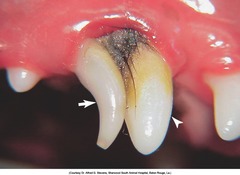
If you saw this on a dental record, what has been done to the tooth?
Crown fracture

If you saw this on a dental record, what has been done to the tooth?
retained deciduous tooth
The left lower is classified as?
309
You noted that there was furcation exposure on several teeth in your patient's mouth.
What abbreviation would you use to indicate this?
FE
If you noted that your patient was missing tooth 204, what abbreviation would you use to indicate that?
O
The left upper quadrant is referred to as...
204
The upper right quadrant is referred to as...
107
What abbreviation would you use for gingival recession
GR
This instrument is used to detect plaque, calculus, and pulp exposure.
explorer

The primary purpose of this instrument is to measure pocket/ sulcus depths around a tooth in order to check the health of the periodontium.
Peridontal probe
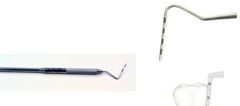
This instrument is used to remove calculus both supragingivally and subgingivally.
Curette

Pear shaped ultrasonic tip
cavity prep
Crosscut fissure bur
cutting teeth, root canal access
Beaver tail ultrasonic tip
Used for supragingival cleaning
Finishing burs
restoration
Perio Probe ultrasonic tip
Used for subgingival cleaning
IN pocket pets, these are used to level abnormally uneven occlusal surfaces.
Files and Rasps (floats)
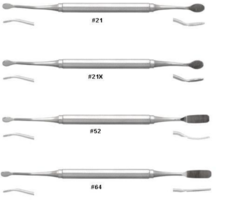
In pocet pets these are used to grasp teeth during extraction.
Angled root tip forceps
If you saw an X over tooth on dental record, what has been done to the tooth?
Extraction
What is the correct number of maxillary canine tooth of a dog?
104
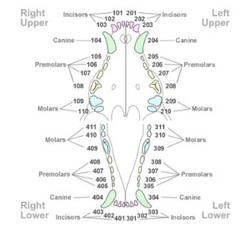
What is the correct number of first left mandibular premolar of the cat?
307
Scalers are used for ________ scaling.
Supergingival
of the two types o explorers, which is the most commonly seen?
Shepard's hook
Of the types of powered instruments below, which one is not recommended to use because it easily damages the tooth?
Rotary Scalers
In dental radiography, kVp and MA is usually adjustable. However, exposure times are fixed.
False
When imagining the caudal mandibular teeth and nasal cavity, which imagining technique do you use?
Parallel technique
This problem occurs when the Xray beam is aimed at the tooth. It causes the tooth root too long.
Elongation
This problem occurs when the Xray beam is aimed at the film. It causes the tooth root to look too short.
Foreshortening
This problem occurs when there is patient or Xray machine movement.
Blurring
When taking radiographs of the maxillary caudal teeth, what orientation should the film/sensor should be ________ to the hard palate.
parallel
When taking radiographs of the mandibular rostral teeth, the film is placed parallel to the mandible and the patient should be placed in ________ recumbency.
dorsal
The bisecting angle technique is used everywhere except in the _________.
Caudal mandible
When talking about intraoral film, a size 2 film is ________ than a size 4 film.
smaller
When performing dental radiography, there is no need for dosimeters or lead aprons, as the beam is directly focused on the oral cavity,
False
_________ means lacking teeth
edentulous
_________ means a tooth is formed, but has not broken through the gum.
embedded
When using intraoral film to take radiographs, the plastic side of the film should face the tube head.
True
The teeth of the anterior mandible can be radiographed using the parallel technique.
False
When using the Bisecting Angle technique, you must visualize a line that bisects the angle formed by the Xray film (or sensor) and the _________.
tooth
The SLOB rule is used on teeth that have _____
root(s).
3