Biological molecules
 Call Kai
 Learn
Learn Practice Test
 Spaced Repetition
 Match
Match Flashcards
 Knowt Play
1/51

There's no tags or description
Looks like no tags are added yet.
Name | Mastery | Learn | Test | Matching | Spaced | Call with Kai | Chat |
|---|
No analytics yet
Send a link to your students to track their progress
52 Terms
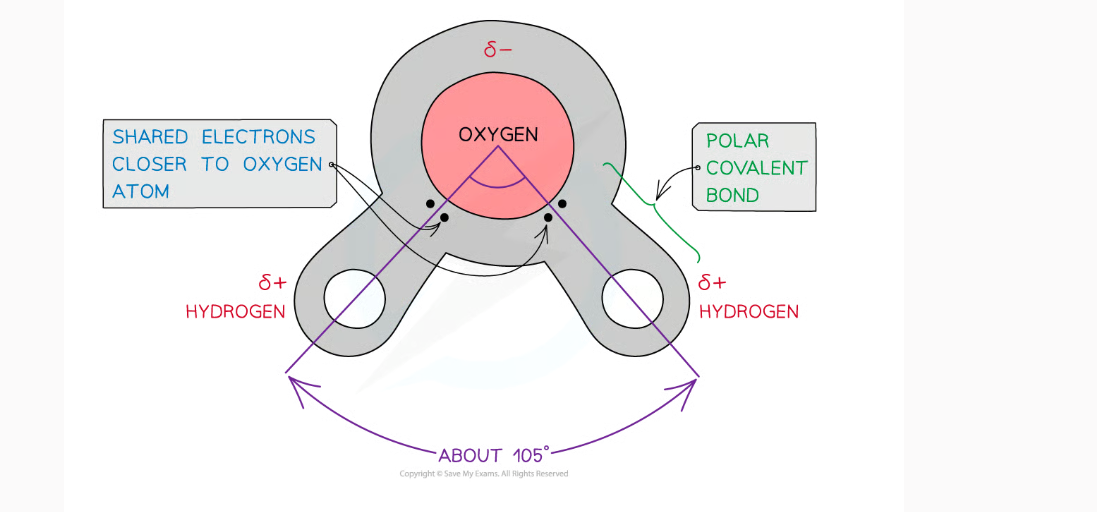
why is water a polar molecule?
Water is a polar molecule due to uneven distribution of charge within the molecule the oxygen atom attracts electrons a bit more strongly than the hydrogen atoms. The unequal sharing of electrons gives the water molecule a slightly negative charge near its oxygen atom and a slight positive charge near its hydrogen atoms.
how do hydrogen bonds form
1. Oxygen attracts the shared electrons more strongly than hydrogen.
So oxygen becomes slightly negative and hydrogen becomes slightly positive
The &+ hydrogen of one water molecule is attracted to the 8- oxygen of another
water molecule.
4. This attraction is called a hydrogen bond.
why are water molecules attracted to each other and also define hydrogen bonds?
because they have opposite charges that can attract to each other.
Hydrogen bond = Hydrogen bond = weak attraction between a slightly positive &+ hydrogen in one molecule and a negative - oxygen in another molecule.
hydrogen bond = weak bond individually but can form very strong structures if there is lots of them
outline the properties of water
very high specific heat capacity
ice is less dense than water
very high latent heat of vaporisation.
acts a solvent
cohesion
useful in metabolism
adhesion
Q: Why does water have a high specific heat capacity?
Q: What does this mean for aquatic environments?
A lot of energy is required to break hydrogen bonds between water molecules, so water's temperature
changes slowly.
Water acts as a temperature buffer, so its temperature doesn't change rapidly.
Q: How does high specific heat capacity help aquatic life?
lots of energy needed to change water temperature
water temperature changes slowly
aquatic environments have stable temperatures
this allows water act as a stable habitat to live in for aqauatic organisms
aquatic organisms are less affected by sudden temperature changes.
Q: How does ice being less dense than water benefit aquatic life?
ice floats on the surface
acts as a habitat for some organisms
ice also insulates the water below
prevents the water underneath from freezing
organisms can continue to live in the water under the ice.
Q: How does floating ice prevent water underneath from freezing?
The layer of ice insulates the water underneath, reducing heat loss.
The water below stays liquid
aquatic organisms can continue to survive.
Q: How does the large latent heat of vaporisation of water benefit organisms?
small amount of water requires a large amount of heat energy to evaporate
→ evaporation removes lots of heat
→ provides an effective cooling effect
→ organisms can cool themselves without losing a great deal of water.
Q: Why does evaporation of water provide a cooling effect?
Evaporation requires a large amount of heat energy.
Heat is taken from the organism
the organism cools down.
Roles/benefits of water as a solvent?
In cells: dissolved substances can take part in metabolic reactions.
In bodies of water: oxygen dissolves in water aquatic organisms can use the dissolved oxygen for respiration - water provides a habitat for these organisms.
In blood: dissolved substances such as glucose, amino acids, CO2 and mineral ions can be transported.
In plants: dissolved mineral ions can be transported in the xylem from roots to leaves.
Q: What is cohesion?
The attraction between water molecules caused by hydrogen bonds, causing water molecules to stick together.
Q: How does cohesion help water transport in plants?
Hydrogen bonds between water molecules
water molecules stick together (cohesion)
forms a continuous column of water
allows water to travel through the xylem from roots to leaves.
Q: How does cohesion benefit plants?
Water in the xylem contains dissolved mineral ions, such as magnesium ions.
Mineral ions such as magnesium ions are transported from the soil → roots → xylem → leaves.
Magnesium is used to make chlorophyll
Chlorophyll is needed for photosynthesis.
define surface tension
force required to break or stretch a surface
explain the concept of surface tension
Water molecules attract each other because of hydrogen bonds.
inside the water: each molecule is surrounded by other water molecules, so it is pulled in all directions.
At the surface: there are no water molecules above the surface because there is air.
Therefore, surface molecules are pulled mainly sideways and downwards by nearby water molecules.
This pulls the surface molecules tightly together.
This creates surface tension - the surface behaves like a thin, flexible layer.
How do insects walk on water?
This layer can provide an upward force that supports small organisms such as pond skaters.
The insect's weight pushes down, while surface tension pushes up → the insect can stay on the
surface.
Q:
What role does water play in metabolic reactions?
Water can act as a reactant in metabolic reactions, such as hydrolysis and photosynthesis, and can also be
produced as a product in reactions such as condensation and aerobic respiration.
"Draw a diagram showing hydrogen bonding between water molecules."

what is adhesion
Adhesion = attraction between water molecules and other substances.
how does adhesion help plants?
transport medium in plants
Water molecules are attracted to and stick to the xylem vessel walls.
As water moves upwards, adhesion helps keep the water column attached to the walls.
This helps water move upwards through the xylem from the roots towards the leaves.
Q: What is capillary action?
A: The movement of water up a narrow tube against gravity.
Q: How do cohesion and adhesion cause capillary action?
Cohesion water molecules stick to each other
Adhesion → water molecules stick to the xylem walls
Cohesion + adhesion water is pulled upwards through the narrow xylem - capillary action
Q: How does capillary action benefit plants?
A: Capillary action helps water move upwards through the xylem, from the roots towards the leaves.
individually, what are the atoms that make up carbohydrate, proteins, nucleic acids and lipids
carbohydrate = carbon, hydrogen and oxygen
proteins = carbon, hydrogen, oxygen, nitrogen and sulphur
nucleic acids = carbon, hydrogen, oxygen, nitrogen and phosphorus
lipids = carbon, hydrogen and oxygen
what is the monomer of carbohydrate, proteins, nucleic acids
carbohydrate = monosaccharide e.g glucose, fructose and galactose
proteins = amino acids
nucleic acids = nucleotide
what is the polymer of carbohydrate, proteins, nucleic acids
carbohydrate = polysaacharides e.g starch, glycogen, cellulose
protein = polypeptide and protein
nucleic acids = DNA and RNA
what is condensation
A condensation reaction forms a covalent bond between molecules and releases a molecule of water.
what is hydrolysis
A hydrolysis reaction uses a molecule of water to break a covalent bond.
what is a Monosaccharide, disaccharide and polysaccharide
Monosaccharide : single simple sugar molecule
Disaccharides are made of two monosaccharide molecules joined together.
Polysaccharides are polymers made up of a long chain of monosaccharides.
draw alpha glucose

draw beta glucose

properties of glucose
Glucose is a hexose sugar. This means it contains 6 carbon atoms.
Glucose is a reducing sugar. This means that when it is in solution it can reduce other chemicals.
hexose monosaccharide
what is the structural difference between a-glucose and ẞ-glucose?
a-glucose: OH on carbon 1 points down.
Beta -glucose: OH on carbon 1 points up.
difference between a hexose and pentose monosaccharide?
A hexose monosaccharide contains 6 carbon atoms.
A pentose monosaccharide contains 5 carbon atoms.
describe an example of a pentose sugar
5 carbon ring sugar or 5 carbon atoms
Ribose is an e.g of a pentose sugar and can be found in RNA
draw the structure of ribose


define a glycosidic bond and draw an alpha glucose reaction to show the bond
Glycosidic bond: a covalent bond formed between two monosaccharides in a condensation reaction, with
the removal of a molecule of water.
Disaccharides can be hydrolysed to form monosaccharides.
Q: How must two ẞ-glucose molecules be arranged to form a 1,4 glycosidic bond ans why
A: They must be rotated 180° to each other.
A: Rotation positions the -OH groups on C1 and C4 correctly so they can form the 1,4 glycosidic bond by
condensation
Q: What monosaccharides make up the common disaccharides maltose, lactose and sucrose?
Maltose = alpha glucose + alpha glucose (aka malt sugar)
Lactose = = Beta glucose + galactose aka milk sugar
Sucrose = alpha glucose + fructose aka table sugar
Q: What are the functions of glucose, starch, glycogen and cellulose aka uses of carbohydrates?
Glucose → respiratory substrate
Starch - energy storage in plants
Glycogen - energy storage in animals
Cellulose - structural support in plant cell walls
Pentose sugars (e.g. ribose/deoxyribose) used to make nucleotides, which form DNA and RNA.
Carbohydrates on cell surfaces - involved in cell signalling and cell recognition (usually attached to
proteins/lipids).
Hereditary information → DNA stores hereditary information; the carbohydrate in DNA is deoxyribose.
Q: What are isomers?
A: Compounds with the same molecular formula but different structural formulae.
e.g alpa and beta glucose are isomers of glucose
Q: What is the structure and function of starch?
Starch
Starch is a polysaccharide used as an energy store in plants.
Starch is made from a-glucose and consists of two polysaccharides: amylose and amylopectin.
Starch is insoluble in water so does not affect the water potential of cells.
Starch has a compact structure - allows lots of glucose to be stored in a relatively small space.
Starch molecules are large - cannot easily leave cells.
Q: What is the structure and function of amylose?
Amylose
Amylose is an unbranched chain of a-glucose molecules.
The glucose molecules are joined by 1,4-glycosidic bonds.
The unbranched chain coils into a compact helix.
The compact structure makes amylose suitable for energy storage.
Q: What is the structure and function of amylopectin?
Amylopectin
Amylopectin is a branched chain of a-glucose molecules.
It contains 1,4- and 1,6-glycosidic bonds.
1,6-glycosidic bonds form the branches.
The branches provide many ends where enzymes can add or remove glucose.
Having many ends allows enzymes to act simultaneously so glucose can be released rapidly when needed.
Q: What is the structure and function of glycogen?
Glycogen
Glycogen is a polysaccharide used as an energy store in animals.
It is made from a-glucose.
It contains 1,4- and 1,6-glycosidic bonds.
1,6-glycosidic bonds form the branches.
Glycogen is more highly branched than amylopectin.
The many branches provide many ends where enzymes can act, allowing rapid release of glucose when needed.
Glycogen is stored mainly in the liver and muscles
Q: What is the structure and function of cellulose?
Cellulose - structure and function
Cellulose is a polysaccharide made from Beta-glucose molecules and
provides strength to plant cell walls.
B-glucose molecules are joined by B-1,4-glycosidic bonds, forming
long, straight, unbranched chains.
Every other B-glucose molecule is inverted 180°, allowing the B-1,4-glycosidic bonds to form and producing a straight chain.
The straight cellulose chains lie parallel to each other, allowing many hydrogen bonds to form between adjacent chains.
The hydrogen bonds hold the chains firmly together, giving cellulose high tensile strength.
Many cellulose chains are held together by hydrogen bonds to form microfibrils.
Microfibrils provide strength and rigidity to plant cell walls, helping cells maintain their shape and withstand forces.
how to classify carbohydrates
simple sugars
complex carbohydrates
simple sugars can be further classified into and e.g of each?
monosaccharides e.g glucose, galactose, fructose
disaccharides e.g maltose, lactose, sucrose
complex carbohydrates can be further classified into and e.g of each?
polysaccharides e.g starch
non starch polysaccharides e.g cellulose
Q: Compare and contrast monosaccharides and disaccharides.
Similarities:
Both are small, soluble carbohydrate molecules that are easy to transport.
Differences:
Monosaccharides contain one sugar unit; e.g. glucose, fructose, galactose.
Disaccharides contain two sugar units; e.g. maltose, lactose, sucrose.
Disaccharides form when two monosaccharides join by a condensation reaction, forming a glycosidic
bond and releasing water.
Functions of carbohydrates in the diet?
Carbohydrates provide energy for respiration.
They provide energy for physical activity and body processes.
Some carbohydrates, such as fibre, help maintain a healthy digestive system.