Physics Space P6.5
 Call Kai
 Learn
Learn Practice Test
 Spaced Repetition
 Match
Match Flashcards
 Knowt Play
 Podcast
1/49

There's no tags or description
Looks like no tags are added yet.
Name | Mastery | Learn | Test | Matching | Spaced | Call with Kai | Chat |
|---|
No analytics yet
Send a link to your students to track their progress
50 Terms
What is a Star
A large and hot enough body for nuclear fusion to take place
Nuclear Energy is released from it as UV, Visible and Infared radiation
Made up of Hydrogen and Helium
Define the Doppler Effect
The change in frequency
Due to relative motion
Between the source of light and the observer
What is the universe
A collection of all the galaxies
2 properties affected by the Doppler effect
Frequency
Wavelength
What is a natural satellite orbiting a planet called
A moon
Explain how Cosmic Microwave Background Radiation is evidence of the Big Bang
The Origin: The Big Bang model states the Universe began from an extremely hot and dense point.
Initial Radiation: Because it was so hot, this early Universe released massive amounts of high-energy, short-wavelength radiation (like gamma rays).
Expansion and Stretching: As the Universe expanded over billions of years, space itself stretched.
Wavelength Change: This expansion stretched the wavelength of the original radiation, making it longer and lower in energy.
Current Observation: Today, we detect this stretched radiation as microwaves (CMBR) coming from all directions in space.
The Conclusion: Only the Big Bang model explains the existence of this uniform radiation left over from a hot, dense beginning.
How does the big bang theory describe the universe when it began
Very hot and dense
1 terameter in meters
1×10^12 (1 trillion meters)
explain the effects of Earths Gravitational force on a satellite orbiting the Earth
Gravitational force cause the Satellite to accelerate towards the Earth
Which changes the direction
So the velocity of the Satellite changes
Comparisons between what happens to Larger stars than the sun compared to what happens to the sun during different stages in its life cycle
• stars about the same size as the Sun expand to become a red giant, stars much bigger than the Sun expand to become a red super giant
• stars about the same size as the Sun contract (and temperature increases) to become a white dwarf, stars much bigger than the Sun explode in a supernova
• stars about the same size as the Sun (cool to) become a black dwarf, stars much bigger than the Sun become either a neutron star or black hole
What will happen during the end stages of a stars life cycle
The star will expand to become a red giant
(the star will) collapse to become a white dwarf
(the star will) cool to become a black dwarf
What events led to the formation of a neutron star
The explosion of a red super giant
What is a planet
Something that orbits the sun
Is large enough to be spherical
The largest object in its orbit
Order of planets and where the asteriod belt is
Mercury,Venus,Earth,Mars,|||Asteriod belt|||, Jupiter, Saturn, Uranus, Neptune
Name the rocky planets
Mercury, Venus, Earth, Mars
Name the Gas Giants
Jupiter, Saturn, Uranus, Neptune
What is a moon
an object that orbits a planet
What is an asteroid
Large chunk of rock 1km-1000km
Mostly in the asteroid belt
What is a Comet
Made of Ice and dust in a few key areas
Orbits the sun in an elliptical orbit
What is a dwarf planet?
An object that Orbits the Sun
Large enough to be spherical
Shares orbit with other dwarf planets/asteroids
Examples of dwarf planets
Pluto
Ceres
Makemake
Haumena
Eris
What is an artificial salelite
Man-made objects in orbit around
-Earth
-Other planets/moons
-Sun
What keeps the planets in an almost circular orbit around the Sun
The gravitational interaction between the planets and the Sun.
Diagram in circular motion where the gravity/weight is acting and where the velocity is acting

Why do planets closer to the sun have a shorter orbital period

Explain how for a stable orbit, the speed must change if the radius changes
Stronger Gravity at Smaller Radii: As an object gets closer to the central body (smaller orbital radius), the gravitational force pulling it inward becomes significantly stronger.
Higher Speed Needed for Balance: To maintain a stable orbit closer to the center and prevent being pulled inward by this stronger gravitational pull, the planet must move faster so its centripetal acceleration matches the higher gravitational acceleration.
IF the orbital speed increases what must happen orbital radius visa versa
If orbital speed increases, the orbital radius must decrease to remain stable.
If orbital speed decreases, the orbital radius must increase to remain stable.
What was the solar system formed from
Dust and gas drawn together by gravity
Explain how doing work on a gas can increase its temperature
Doing work on a gas transfers energy to its particles during collisions with a moving boundary or gravitational collapse, which increases their average kinetic energy and speed. Because temperature is a measure of the average kinetic energy of gas particles, this increased motion results in a rise in temperature.
How was the Sun formed
Gravitational Collapse: A nebula, mainly containing hydrogen, was pulled together by gravity. As it collapsed, the particles moved faster and collided more often, heating up to form a protostar.
Nuclear Fusion: When the temperature and pressure in the core became high enough, hydrogen nuclei began fusing together to form helium nuclei, releasing massive amounts of energy.
Stable Equilibrium (Main Sequence): The inward force of gravitational collapse was balanced by the outward thermal pressure caused by the energy released from nuclear fusion reactions, creating a stable star.
Explain the red-shift from galaxies which are receding
Stretched Wavelengths: Light emitted from distant galaxies travels toward us across expanding space. As the galaxy moves away (recedes), the light waves it emits get stretched out to longer wavelengths.
Shift to the Red End: On the visible spectrum, longer wavelengths correspond to the red end of the light spectrum. Therefore, the observed light appears shifted toward red ("red-shift").
Recession Indicator: The greater the observed red-shift of a galaxy's light, the faster that galaxy is moving away from us.
Explain that the relationship between the distance of each galaxy and its speed is evidence of an expanding universe model
Observations show that more distant galaxies exhibit greater red-shift, meaning they are moving away from us at higher speeds. This proportional relationship between distance and recession speed proves that space itself is uniformly expanding, rather than galaxies simply traveling through fixed space.
Explain how the evidence of an expanding universe leads to the Big Bang model
Rewinding Time: If the universe is currently expanding and galaxies are moving apart, rewinding time means everything in the universe must have been closer together in the past.
A Single Dense Point: Going back roughly 13.8 billion years suggests that all matter and energy in the universe originated from a single, extremely hot, and infinitely dense point (a singularity).
Initial Expansion: The 'Big Bang' theory proposes that the universe began from this point with a rapid expansion, and it has been expanding and cooling ever since.
What is the difference between a correlation and a cause-effect link?
: A correlation shows two factors change together, but a cause-effect link requires a plausible mechanism proving one factor directly produces/affects the outcome.
What is peer review and why is it important in science?
Scientific findings are evaluated and checked by other experts in the same field before publication to detect errors, prevent bias, and ensure results are reproducible.
How do scientific theories develop when new evidence contradicts them?
Theories are modified or replaced only when sufficient new evidence emerges and a better explanatory model becomes available.
What are the primary types of scientific models?
Representational/Spatial (analogies/visuals) Descriptive (explaining phenomena), Mathematical/Computational (using equations/data to predict behavior).
What are the advantages and limitations of using models in science?
Advantages: Allows safe, quick investigation without practical or ethical limits. Limitation: A model is only as accurate as its assumptions and may simplify the real world.
State the forms in which energy is released during a fusion reaction
Energy in the form of Gamma Rays
What is a nebula
A spinning cloud of dust and gas
What is a Protostar
A star in which nuclear fusion is just beginning to start
What is a main sequence star
A star which is undergoing nuclear fusion at a steady rate
What is a Red Giant
An old star which is beginning to run out of nuclear fuel
The order in which a star is produced
A spinning cloud of dust and gas
The forge of gravity causes particles to get closer together and speed up
Work done by gravity leads to increase in KE of particles
KE is large enough to overcome electrostatic repulsion between nuclei- nuclear fusion starts
Radiation pressure from nuclear fusion balances inward force of gravity
Explain how the solar system was formed from a spinning ball of dust and gas
Nebula Collapse: Gravity pulls a spinning cloud of dust and gas together, forcing particles closer and causing them to speed up.
Disk Formation & Work Done: Most mass collects at the center to form the Sun while the surrounding cloud flattens into a spinning disk; work done by gravity increases the kinetic energy (KE) of the particles.
Ignition of Nuclear Fusion: High KE allows hydrogen nuclei to overcome electrostatic repulsion so that, due to the high temperature, nuclear fusion begins.
Protoplanet Accretion: Dust and ice particles clump together over time to form protoplanets, which grow steadily larger by gathering more mass.
Inner Rocky Planets: High temperatures near the Sun allow only heavy, rocky materials to condense, forming the rocky inner planets.
Outer Gas Giants: Lighter, gaseous materials remain stable further away from the Sun where it is cooler, forming the giant gas planets that orbit the Sun in the same plane.
Explain why the centripetal force required increases with the increase in the speed of the object (at a constant radius)
At a higher speed, an object travels a greater distance along the curved path in a given time, requiring a larger change in its direction per second. Because acceleration is the rate of change of velocity, this sharper change in direction means the centripetal acceleration increases. According to Newton's Second Law ($F = ma$), a greater acceleration requires a larger net centripetal force to keep the object moving in that same radius.
Explain why the centripetal force required decreases with a larger radius of the circle (at a constant speed)
At a larger radius, the path is less curved, meaning the object's direction of motion changes more gradually over time. This smaller change in direction per second results in a lower rate of acceleration toward the center. Since force equals mass times acceleration ($F = ma$), a smaller acceleration requires a smaller centripetal force to hold the object in orbit.
State and Explain what will happen to the speed and the orbital radius of the ISS over time.
Effect on Orbital Radius: The orbital radius decreases over time (orbital decay).
Cause of Decay: Air resistance causes drag, which does work against the ISS and reduces its total mechanical energy.
Conversion of Energy: As the orbital radius drops, gravitational potential energy (GPE) is converted into kinetic energy (KE).
Effect on Orbital Speed: The orbital speed increases because the gravitational force is stronger at a smaller radius, requiring a higher speed to maintain a stable orbit at the lower altitude.
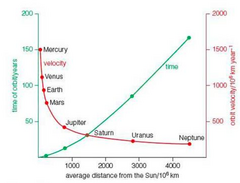
Describe how orbital speed varies with average distance from the sun
the orbital speed decreases significantly as the distance increases at a decreasing rate
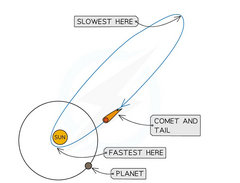
Use ideas about energy transfer to explain why the comet is fastest when it is closest to the Sun.
The GPE of the comet gets transferred to the KE of the comet. As the comet cmes closer to the sun the GPE decreases so the KE increases It speed is greatest when it is closest to the sun