Vaccines PY367
 Call Kai
 Learn
Learn Practice Test
 Spaced Repetition
 Match
Match Flashcards
 Knowt Play
1/139

There's no tags or description
Looks like no tags are added yet.
Name | Mastery | Learn | Test | Matching | Spaced | Call with Kai | Chat |
|---|
No analytics yet
Send a link to your students to track their progress
140 Terms
What is smallpox?
Variola virus
Highly contagious and plague causing
Blistering rash, blindness and arthritis
Mortality 30-50%
What is cowpox?
Vaccinia virus but causes milder infections
Edward Jenner noticed milkmaids who contracted it would not get smallpox
He inoculated a boy with it and that boy did not have a reaction afterwards when exposed to smallpox
What is individual protection?
Vaccinating an individual and protecting them from infectious diseases which cause significant harm
What is community protection?
Vaccinated individuals are less threat to other people so disease cannot spread = outbreaks reduced
More people vaccinated = higher likeliness of eradicating disease from that community = Herd protection
What does the % required to achieve herd immunity depend on?
How virulent the virus is
Why can’t we vaccinate everyone against infectious disease?
Countries may not be able to afford supplying everyone
There is not a vaccine for every disease
Vaccine hesitancy
What is the JCVI and what do they do?
Joint committee on vaccination and immunisation
Responsible for monitoring and updating vaccine schedule - triage system for vaccine order
Recommend to government about all matters regarding vaccination
Publish and update “green book”
How are groups targeted according to NHS schedule?
Susceptibility and risk to a disease
You may be susceptible to a disease but there may not be a risk to you if you get it
What 3 factors do the JCVI take into account when deciding?
Susceptible populations
Diseases themselves
Pharmaceutical issues and vaccine products
Explain susceptible population
Age - babies lack immunity, old people immunity declines
Risk category - some people have higher risk
Social changes - starting school or uni
Public/media campaigns/new research
Explain diseases themselves
Prevalence of organisms and environmental factors
Sudden outbreaks of disease
Desire to increase herd immunity
Prevention of other risks related to the disease
Explain Pharmaceutical issues and vaccines products
Cost of manufacturing vs. Effectiveness of vaccine programme
Antigenic shift/drift meaning new strains become prevalent
If vaccine product is able to be produced
Sometimes need to produce vaccine quickly due to outbreaks
What are vaccination risks?
Mild fever, illness, rash
Pain, swelling, tenderness at injection site
Small anaphylaxis risk
Can be related to excipients or antigen
What are vaccination benefits?
Saves lives
Herd immunity for those who cannot be vaccinated or are more vulnerable
Eliminates diseases in some cases
Better than contracting disease and treating it
What is the global situation?
WHO monitors vaccination use globally
Schedules may vary according to geographical area
Access to vaccination is a health inequality problem
How did Jenner’s method work?
First demonstration of cross protection using related, live virus
Antigen on cowpox induced memory cells
Upon future infection, memory cells secrete Ab which protect against both poxes
What is plan A of immune defence?
Block infection by utilising barriers to entry (tears, skin, stomach acids, mucus)
What is plan B of immune defence?
Destroy invaders with innate IS
Cellular factors, complement, NK cells, Phagocytic cells
If that fails, activate adaptive IS
APC’s with pathogen antigen fragments in MHC activate T helper cells which induce antigen specific CTL’s and B cells
What is active acquired immunity?
Produced by individuals own IS
Involves cellular responses and humoral responses or combo of both
Can be acquired by disease or vaccination
Vaccines provide immunity similar to that provided by natural infection without its complications
What do T helpers do?
Enable other immune responses such as CTL and B cells for Ab
What do B cells do?
Make Ab which can block virus from infecting cells as well as mark it for destruction
What do cytotoxic T cells do?
Identify and destroy virus infected cells
What do vaccines do to APC?
Replace displayed portion with vaccine to activate same mechanism without SE from actual disease
What is Ab mediated immunity?
Ab blocks binding of pathogens to cell surface receptors
Cytotoxic lymphocytes - CD8+ cells target infected cells (antibody dependent cellular cytotoxicity ADCC)
Pathogens are coated and tagged for phagocytosis
Ab-antigen complexes will activate classical complement cascade which leads to pathogen destruction by phagocytosis or bacterial membrane attack
What are 3 Ab subtypes?
IgM
IgG
IgA
What do each of the immunoglobulins do?
IgM - complement activation
Induced by vaccination
Limited role
IgG - systemic
All major roles like neutralisation, ADCC, opsonisation and complement activation
Primarily induced by vaccines and main ones we want to induce
IgA - principle isotope in secretions at mucosa
Strong viral neutraliser but weaker at the others
Can be induced by vaccines but needs special route
What is passive acquired immunity?
Protection by transfer of Ab from mother across placenta (IgG) and breast milk (IgA)
Baby immunisations take place after 3 months and before then get protection from mother
How to prevent pertussis before 3 months?
Mother should be vaccinated with MMR as Rubella can severely damage foetus - 1 month before pregnancy
Pregnant mothers have increased risk of death from Influenza
NHS schedule offers these vaccines
INFLUENZA + PERTUSSIS vaccine
Why is the MMR vaccine recommended before 1 month before pregnancy?
Few cases of foetal abnormalities when pregnant mothers are vaccinated with MMR
No proven direct link but guidelines suggest it 1 month before pregnancy and not during
What do vaccines induce?
Active acquired immunity and immunological memory
Immunological memory enables IS to recognise and respond rapidly to exposure
What should an effective vaccine trigger?
Proliferation of naïve T cells
Depends on whether Th1 and CTL responses are induced
Otherwise, Th2 Ab responses are induced
If you achieve both, that is best vaccine
What do memory cells do?
Naive T cells proliferate in response to antigen
Form effector cells
Also form memory cells which wait for infection as well as activating naive B cells
What are adjuvants and two groups of them?
They enhance immunogenicity of protein antigens as they are poorly immunogenic when used alone in vaccine
Particulate vaccine delivery systems
Immunostimulatory adjuvants
How do particulate vaccine delivery systems work?
Converts proteins to particles so they are more like bacteria/virus
APCs preferably recognise and process particles
How do immunostimulatory adjuvants work?
Directly activate APCs through specific toll-like receptors resulting in inflammatory responses which amplify innate immune response
What are the principles of safe and effective vaccination?
Search for or create attenuated organisms with reduced pathogenicity to stimulate protective immunity
Inactivate organisms so they do not cause lethal systemic infections in immunosuppressed pts.
Purified components of organism containing key antigens or nucleic acids which stimulate protective immunity are used now
8 requirements for an effective vaccination: PICODOSE
Depends on the organism
Intracellular organisms - CTL and Ab
Extracellular organisms - Ab
Provides defence at the point of entry
Stimulation of mucosal immunity may be required at specific mucosa
Pre-existing Ab may be required
Protection is optimised when specific epitopes are recognised
Immune responses are directed at multiple epitopes
Not all of these generate protective Ab or CTLs
Some may generate suppressor T cells
Therefore, correct epitopes must be targeted
Must be safe
SE reduce confidence in vaccines
Must protect most patients
Allows for rapid generation of herd immunity
Confidence
Must generate long-lived immunity
Booster immunisation is impractical
Cheaper and improves population health
Must be cheap
Will be administered to a large population
The benefit will be eroded if the cost per dose rises
What 3 categories impact the efficacy of a vaccine?
Features of vaccine itself
Immunogen design
Vaccine type
Formulation
Adjuvant
Dosing
Individual variations among recipients
Vaccine admin related factors
What do good vaccination schedules require?
Require a minimal number of doses and an optimal interval between immunisations
Complexity of vaccines types means no standard formula to determine appropriate vaccine strategy
Explain Parenteral Vaccination
IM, SC or ID inoculation
Relative immunogenicity of vaccines via these routes can vary depending on individual vaccines
ID immunisation generates greater immune responses than IM
May be because the dermis contains more dendritic cells which facilitate the capture of antigens and local inflammation can induce maturation of the dendritic cells and their migration draining lymph nodes,
May be difficult to administer, particularly in children.
SC and IM immunisation induce very similar responses in clinical studies
There is less toxicity and anaphylaxis in IM (especially is using adjuvants) and easier to admin than ID or SC
How does oral/nasal dosing overcome many issues associated with IM?
Less painful and expensive
Immunologically, stimulates optimal immune response whilst IM does not due to pathogens route of entry
What are the social determinants of health that impacts all child health globally?
Conditions of which people are born, grow, live, work and age
Shaped by distribution of money, power and resources globally
They are mostly responsible for health inequities
How is child health measured (mortality)?
Neonatal mortality rate - number of baby deaths under 28 days old who die per 1000 live births in a given time period
Infant mortality rate - Number of deaths in children under 1 year old per 1000 live births in a given time period
Under 5 mortality rate - same as above for under 5s
How many strains of rotavirus is there and how common is it?
28 strains
Common in infants under 5
Symptoms of Rotavirus and duration
Severe watery diarrhoea
Severe vomiting
Fever
Abdominal pain
Loss of appetite
Dehydration
3-8 days
How is it transmitted?
Faecal-oral transmission
What are the two vaccines available? Names
+ doses
Rotarix - 2 doses, 4 weeks apart before 24 weeks of age
Rotateq - 3 doses, 4 weeks apart before 26 weeks of age
Live attenuated
What is Strep. pneumoniae?
G+
Droplet transmission
Causes pneumonococcal pneumonia, meningitis, sepsis, otitis media and sinusitis
Exacerbated by
Crowding
Indoor air pollution
Tobacco smoke
Immunosuppression
Resistance to penicillin and other antibiotics
What is Haem. Influenzae?
Small G- bacteria
Type B is most virulent
Transmitted via respiratory droplets
Steps that have to be in place for a child to get vaccinated?
Parent knowledge of what’s required
HP and human resources available
Afford vaccine
Transport to clinic
Time to get to clinic
Sterile equipment
Parental consent
Funding
Infrastructure
Government and leadership
Regulation and research
Legislation
Barriers to vaccines
Vaccine beliefs
Weak healthcare systems
Increasing prices
Pandemics make children miss out on basic vaccines
Terrorism
Fake immunisation programmes for military operations
Solutions to barriers to vaccines
Healthcare system strengthening
Education
Ceasefires
Peace
Local manufacture of vaccines
Improved monitoring
Affordability
Collaboration
What are some vaccine considerations?
Biologically sourced materials include:
Bioactives
Bacterial polysaccharides
Proteins
Lipids
Purity and virulence issues are paramount
Unspecified trace contaminants
What do adjuvants do?
Drug/immunological agent that modifies effects of other agents
When added to vaccines they stimulate IS to respond to target antigen indirectly
They often act as a depot for the antigen, presenting the antigen to the body over a longer duration than IV admin
This maximises immune response
What are the 4 basic classes of adjuvants?
Water soluble/dispersible adjuvants
OM-174, soluble lipid derivative of E.coli - immunostimulant
O/W or W/O emulsion adjuvants
Mineral oil and snake venom peptide
Freund’s complete adjuvant - MPL - immunostimulant
Freund’s incomplete adjuvant
Entrapment of absorption agent adjuvants - particulate vaccine delivery system
Aluminium
Silica
Latex
Starch
Gelatine
Polymer particles and particulate adjuvants - particulate vaccine delivery system
Virosomes
Bacterial flagellin
Liposomes
Name 8 Formulation Stabilisers?
Freeze drying cryoprotectants
Buffers
Complexing and suspending agents
Relics
Delivery aids
Preservatives
Co-solvents
Emulsifiers
Why are antibiotic stabilisers used?
Multi-use vaccines require special formulation as antibiotics prevent fungal and bacterial infection as consecutive aliquots are removed from same bulk container
Process asepticity and hygiene - final product contain very low concentrations of antibiotics
What do chemical remnants often found in vaccines do?
Remove pathogenicity and act as disinfectant for inactivated vaccines
Formaldehyde remnant is used to inactivate viruses via cross-linking with amine groups in nucleotides
Give examples of inactivators?
Heat application
Low pH-acid denaturation
solvents and surfactants
Irradiation
Ethylene oxide
How are antigens purified?
Differential precipitation/solubilisation with ammonium sulphate and pH
Ultracentrifugation
Final purification
Ultrafiltration
Chromatography
Tested by ELIZA assay
What is the ELISA assay?
Colour indicating popular microtitre plate-type assay of a solution which uses a solid phase immobilised enzyme in an immunoassay to detect presence of vaccine antigen
Routine use for QC
Type of antigens in vaccines
Homotypic - one type of component
Heterotypic - Many types for various bacteria
Whole cell: live, killed etc.
Toxoid
Pathogen components
Valency - Number of strains used
Bivalent
Quadrivalent
MMR has 3 organisms or singles
Types of QC
Sterility - free of live microorganisms
Chemistry standpoint: correct adjuvant, preservative where required and pH
Content: uniformity of content and potency
Safety: overdosing would carry no effective risk - correct labelling
Efficacy: each antigen present meets regulatory requirements and satisfies key tests. No component interference
Virulence testing: via passaging in suitable model
Toxicity: no harm causing constituents
Environment: no risk or harm of spread of dissemination
Stability test: shelf life, optimal storage determination
Chemical QC: moisture content, headspace vacuum, pH
2 dosage issues
Variability: dose, response, maturity of IS
Constancy: Formulation injection properties
What is the premise that effective vaccine delivery is based on?
Efficient encapsulation of the active
Successful targeting of the active to a specific region of the body and pathogen
Successful release of the active in situ.
Principle routes of vaccine delivery?
IM
ID
SC
IN
Pulmonary
Oral
Topical
Biodegradable implant
Transdermal (needle free)
Patch
Liquid injection
Powder injection
Pre-filled reconstitution
Vaginal, cervical, anal, penile
4 steps to vaccine production
Growth
Virus grown on primary cells
Bacteria in bioreactors
Proteins or parts of the organism can be grown inside cells
Inactivation - heat and agents
Purification - filtration, chromatography
Formulation - Antigen + adjuvant + stabiliser + preservative
Sterilisation of vaccines
Z - value defines temperature
D - value defines number decrease at Z-value
F0 - define total effective sterilisation time
Sterilisation time/temp (e.g. 121º under pressured steam) for 6 minutes
QC and QA of vaccines
Potency
Safety
Cost
Preparation
Usage
Stability at 5ºC
Cold chain conditions
Manufacturing Needs
Safety reviewed by CHMP
Staff bio-specific training
cGMP
Finished goods: PCQ
Storage of vaccines
Cold chain has minimum and maximum
Temp has effect on potency
3ºC storage in cold-chain
Immunoglobulins can be stored at room temp for up to a week
Vaccines sensitive to light, heat and freezing
Handling of vaccines
Needs inventory management
Emergencies procedure
All attempts to reduce wastage which can account for up to 50% of all produced vaccines
Most vaccines are damaged at freezing temps producing agglomerates and precipitates
Data loggers and digital thermometers are needed
Antigenic evolution and new vaccinology
Antigenic shift
Antigenic drift and natural evolution
Same strain, different virulence in new variant
New exposure
New transmission routes e.g. water to air
Movement across the species
Avian - porcine - human
Ovine - bovine - human
Primate - simian - human
Canine - feline - human
This was the basis of the worry with the global pandemic - evidenced by COVID
Manufacture Capability
Ability to respond quickly to potential pandemic
Respond to calls from health department
Ability for biologicals manufacturers to collaborate (to effect mass manufacture)
Cold chain and distribution systems to be effective
Quarantine procedure if needed
Reasons for shortage of vaccines
Cold chain failures (e.g. HepB most susceptible to freezing damage)
Aggregation and degradation (poor storage)
Higher than normal demand
Production interruption
Lack of resources
US suffered a shortage of vaccines in last 15 years
Developing world even more marked. Due to mismanagement, trading corruption, natural disasters.
What is meningitis?
Inflammation of meninges (A membrane enclosing the brain and spinal cord)
Meningism refers to the signs and symptoms which accompany the inflammation
What pathogens can cause meningitis?
Bacteria
Viruses
Fungal
Protozoa
Drug induced
Who is at risk of meningitis?
Babies under 3 months old
Immunocompromised
Elderly
Toddlers
Young adults at uni due to close proximity and way disease spreads
Sub-suharan Africa has increased risk
How are microbial agents of meningitis acquired?
Droplet transmission
Usually by organisms already in our biome which colonise back of the nose
Neisseria meningitis
Strep. pneumoniae
Sometimes acquired from mother during birth
E.coli, group B streptococci
Through food
E.coli, Listeria
Airborne mucous transmission
What is viral meningitis?
Most common form
Not as severe as bacterial so cases go undetected
Benign and doesn’t require medical attention
Presents as flu-like illness
Symptoms of severe viral meningitis
Nuchal rigidity
Muscular pain
N&V
Diarrhoea
Photophobia
Requires hospital admission
Viruses implicated in viral meningitis
Enteroviruses
Mumps
Herpes virus
HIV
What is fungal meningitis caused by?
Cryptococcus neoformans
Associated with immune deficiency
Symptoms appear more gradually, over days or weeks
Headache
Fever
N&V
Stiff neck
Candida
Coccidiodes immitis
Histoplasma
Requires antifungal treatment indefinitely
Explain bacterial meningitis
Usually more serious than viral
High fatality rate unless treated immediately
Very quick progression of disease
Even after antibiotic therapy, pts. are left with disorders
Most common bacteria:
Strep pneumoniae
Neisseria meningitis
What is the progression to meningitis from nasopharyngeal colonisation?
Nasopharyngeal colonisation
Invasion of bloodstream or direct contact with meninges through head trauma
Bacteraemia
Meningeal invasion
Multiplication in subarachnoid space
Release of bacterial products and cytokines
Explain Neisseria meningitis
Lives at back of throat but doesn’t mean you will get meningitis
Type 4 pilus interact with CD46 receptor on host cell → Helps Neisseria transcytose across BB and get into subarachnoid
G- organism have LPS presence and this can cause issues with temperature control resulting in high fever
Explain Streptococcus Pneumoniae
Produces pneumolysin as virulence factor
Why is it resistant to phagocytosis?
Most of these organisms are encapsulated making them resistant to phagocytosis
What is meningococcal septicaemia?
Results when bacteria enters blood and multiplies uncontrollably
G- also release endotoxin which will activate IS and damage blood vessels making them leaky
Lower blood volume which is insufficient to carry O2 to all parts of body
This reduced blood flow to extremities = induces heavy breathing
Blood leakage presents as non-blanching rash
Clots may form in skin/muscle tissue which can result in amputation
Out of Men W, Y B and C which is most common cause?
B
What are other bacterial causes of meningitis?
Strep pneumoniae (2nd biggest cause)
Produces pneumolysin which can cause lots of neurological damage
Group A and B strep
Type B haemophilus influenzae
E.coli
Listeria
M. Tuberculosis
What are the early signs of meningitis?
Fever
Headache
Vomiting
Muscle pain
Fever with cold hands and feet
KEY: Rash NOT always present
What is the tumbler test?
Someone who becomes ill rapidly should be carefully examined for meningococcal septicaemia rash
Press glass tumbler against rash and if it doesn’t fade = possible infection
On dark skin, check for rash on lighter areas of body like finger tips and feet soles
Keep checking as rash may fade and come back
How quickly can meningitis kill?
4 hours
Diagnosis of Meningitis
CSF may be taken, provided its not contraindicated
Visual inspection
Cell count is performed on an un-spun sample
Protein is analysed
Glucose levels are analysed
A centrifuged depot is gram stained and then inoculated onto range of media to support main pathogens
These are usually done before antibiotics are given
But may need to start on broad spec to be safe and then narrow down
Why may lumbar puncture be contraindicated?
Risk of herniation from increased inter-cranial pressure
Treatment of fungal meningitis
Amphotecerin B
Flucytosine
Fluconazole
Treatment of viral
No specific unless HSV - Aciclovir
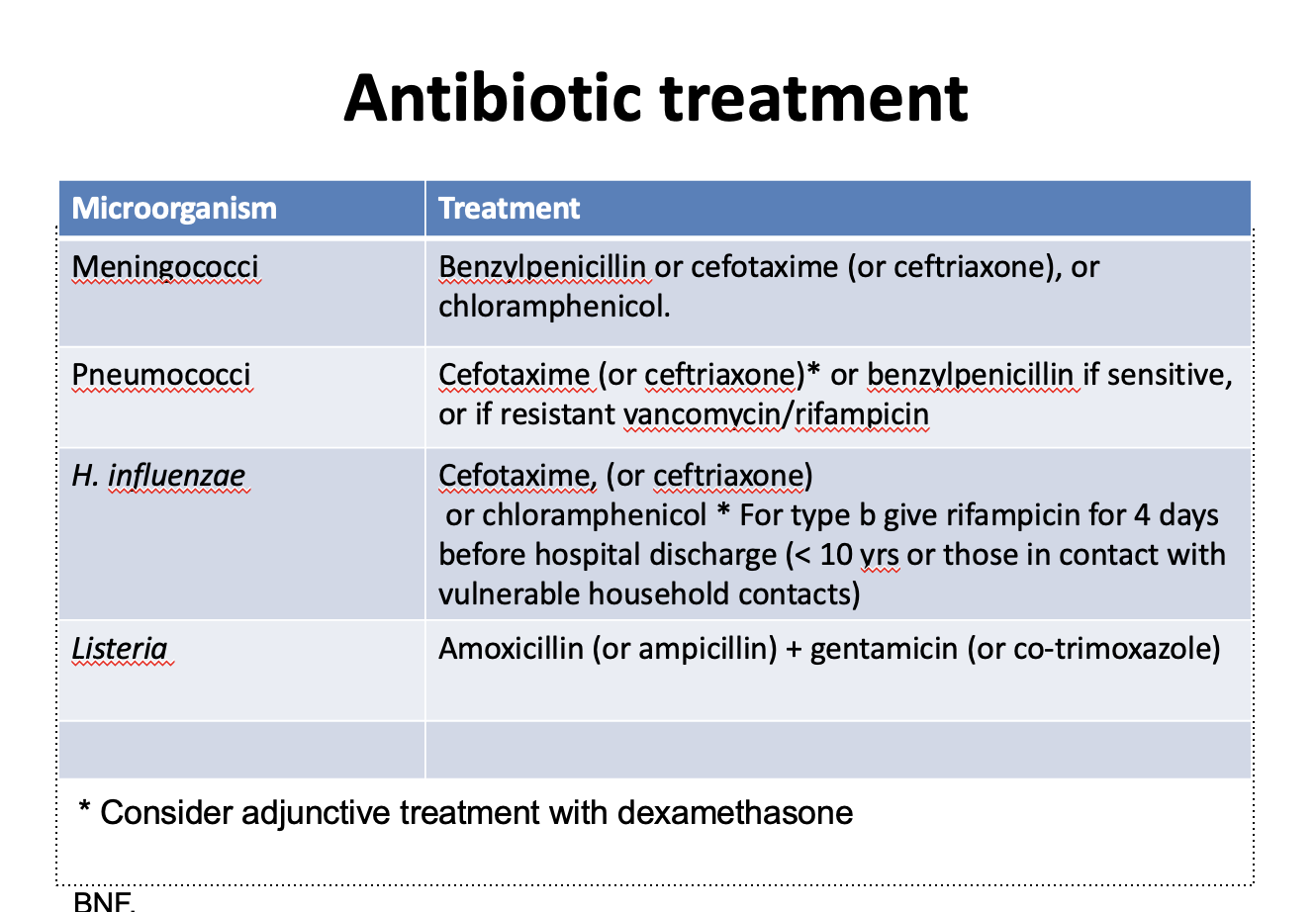
Treatment of bacterial
Transfer to hospital
If meningococcal is suspected, benzylpenicillin given prior to hospital transfer
Want to prevent endotoxins spreading
Consider adjuntive treatment with dexamethasone - shown to reduce neurological SE but not appropriate in all pts.
Life after meningitis bacteria vs viral
Viral - barely any long-term issues
Bacterial:
May fully recover if treated early enough
Can result in long term issues like:
Hearing or vision loss
Memory or epilepsy
Co-ordination, movement and balance issues
Loss of limbs