Endocrine [A&P II]
 Call Kai
 Learn
Learn Practice Test
 Spaced Repetition
 Match
Match Flashcards
 Knowt Play
1/47

There's no tags or description
Looks like no tags are added yet.
Name | Mastery | Learn | Test | Matching | Spaced | Call with Kai | Chat |
|---|
No analytics yet
Send a link to your students to track their progress
48 Terms
The endocrine system
Regulates long term processes like growth, development & reproduction using hormones as messengers
Target cells
Specific cells with receptors needed to bind and “read" hormonal messages
Hormones
Chemical messengers in blood that attach to receptors in target cells and produce a response
Three classes of hormones
Amino acid derivates, peptide hormones, lipid derivatives
Properties of amino acid hormones
Building blocks of proteins
Water soluble, polar
Cannot pass through cell membrane in most cases (thyroid hormone is the exception)
Two types of amino acid hormones & examples of each
Tyrosine: thyroid hormone, epinephrine, norepinephrine, dopamine
Tryptophan: serotonin, melatonin
Peptide hormone properties
Chains of amino acids
Synthesized as prohormones (precursors), stored inside secretory vesicles until trigger for release
Water soluble, cannot pass through cell membrane
3 types of peptide hormones & examples
Short chain polypeptides: antidiuretic/vasopressin (ADH), oxytocin (OXT)
Small proteins: growth hormone (GH), prolactin (PRL)
Glycoproteins: thyroid stim (TSH), luteinizing (LH), follicle stim (FSH)
**classified based on amount of amino acid chains: short chain < small proteins < glycoproteins
Lipid hormone properties
Hydrophobic, can cross phospholipid cell membrane & bind w/ receptor in cytoplasm or nucleus
2 types of lipid hormones
Steroid hormones (cholesterol derived)
Eicosanoids (arachidonic acid derived)
Steroid hormones properties & examples
Cholesterol derived (lipid)
Circulating steroid hormones in blood plasma are bound to transport proteins, meaning they remain in circulation longer
Crosses cell membrane → direct gene activation
Ex: testosterone, estrogen, progestins, corticosteroids, calcitriol
Eicosanoids properties & examples
Arachidonic acid derived (lipid)
Paracrine factors that affect extracellular fluids
Remains in circulation very briefly
ex: leukotrienes, prostaglandins
In a second messenger system, what is the first messenger?
A hormone that cannot cross the cell membrane & binds to a receptor on the surface
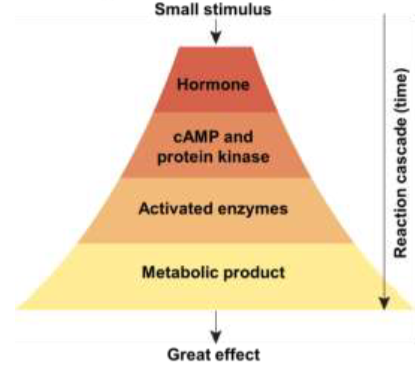
Amplification
Magnification of hormone effect in target cell
Small number of hormone molecules → thousands of second messengers
Down-regulation
Hormone presence → hormone receptors decrease → cell becomes less sensitive to it
Up-regulation
Absence of a hormone → increase in hormone receptors → cell becomes more sensitive to it
3 types of hormone-hormone interaction
Synergism: combined effect of multiple hormones with the same effect magnifies this effect (ex. epinephrine & norepinephrine)
Antagonism: two hormones have opposite effects (ex. insulin & glucagon)
Permissiveness: 1 hormone is necessary for another hormone to have an effect (ex. cortisol & glucagon)
3 types of endocrine stimuli
Humoral stimuli: changes in composition of extracellular fluid (ex. blood glucose)
Hormonal stimuli: arrival or removal of specific hormone (ex. TRH → TSH → T3/T4)
Neural stimuli: arrival of neurotransmitters at neuroglandular junctions (ex. hypothalamus signals → posterior pituitary gland)
In the cAMP & Ca+ second messenger process, what happens directly after the hormone binds to the receptor?
GDP is released → opens up receptor so GTP (a charged molecule) can attach

In the cAMP & Ca+ second messenger process, what happens directly after GTP attaches to the receptor?
The G protein is activated and separates from the receptor
In the cAMP second messenger process, what happens to the G protein directly after detaching from the receptor?
It attaches to and activates the enzyme adenylate cyclase
In the cAMP second messenger process, what occurs directly after adenylate cyclase is activated?
It breaks down ATP → cAMP

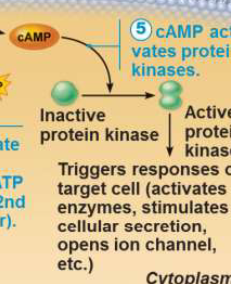
In the cAMP second messenger process, what occurs once cAMP levels rise?
Protein kinases are activated, triggering the response of the target cell
In the Ca+ (calcium) second messenger system, what occurs directly after the G protein is activated?
The G protein activates the enzyme phospholipase C (PLC)
In the Ca+ (calcium) second messenger system, what two things does phospholipase C (PLC) trigger?
DAG & IP3 (from breaking down cell membrane phospholipids)
In the Ca+ (calcium) second messenger system, what does DAG do?
Stays in cell membrane (not a real 2nd messenger) → activates enzymes like protein kinase → various metabolic effects

In the Ca+ (calcium) second messenger system, what two things does IP3 do?
opens calcium channels → Ca+ flows in
→ ER/SR (endoplasmic/sarcoplasmic reticulum) → release of Ca+ from ER/SR
Both lead to various metabolic effects

Which hormones result in direct gene activation?
Steroids (lipid soluble) and thyroid hormones (not lipid soluble but small enough to pass through cell membrane)
Pituitary gland (hypophysis) location
Sella turcica, a depression in the sphenoid bone of the skull; inferior to hypothalamus
Two lobes of the pituitary gland and how they communicate with the hypothalamus
Anterior: hormonal stimuli
Posterior: neural stimuli
Which lobe of the pituitary gland does NOT produce its own hormones?
Posterior pituitary
How does the anterior pituitary lobe communicate with the hypothalamus?
Hypothalamal-hypopheseal portal system (blood vessels)
Which hormones does the anterior pituitary gland produce & their targets? (Mnemonic: FLAT PeG)
FSH: follicle stim → testes/ovaries
LH: luteinizing → testes/ovaries
ACTH: adrenocorticotropic → adrenal medulla
TSH: thyroid stim → thyroid
PRL: prolactin → mammary glands
Endorphins
GH: growth → liver

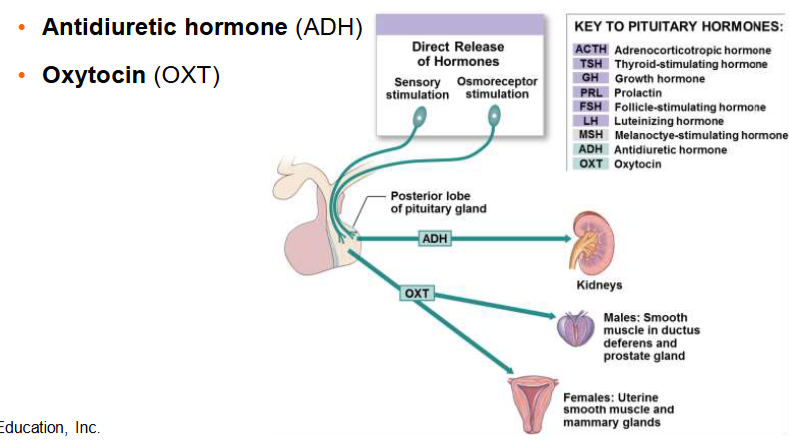
Which 2 hormones are released by the posterior pituitary gland (not produced there)
ADH: antidiuretic
OXT: oxytocin
Thyroid location and gross structure
Anterior to thyroid cartilage of larynx, consists of 2 lobes connected by isthmus
Thyroid follicles structure
Hollow spheres, follicle cavity containing viscous colloid, walls consist of simple cuboidal epithelium
Follicular cells (thyroid) produce the hormones:
T3/T4, differentiated by 3 vs 4 iodine
C cells/parafollicular cells (thyroid) produce the hormone…
Calcitonin, decreases blood calcium
Parathyroid glands produce the hormone:
PTH (parathyroid hormone), increases blood calcium
Layers of the adrenal cortex (superficial → deep)
Zona glomerulosa
Zona fasciculata
Zona reticularis

The zona glomerulosa of the adrenal cortex produces:
Mineralocorticoids ex. aldosterone
→ kidneys, regulating minerals/salts
The zona fasciculata of the adrenal cortex produces:
Glucocorticoids ex. cortisol
→ breaks down non-carbs (proteins/lipids) via gluconeogenesis (as opposed to glucogenesis, which breaks down carbs)
The zona reticularis of the adrenal cortex produces:
Gonadocorticoids ex. testosterone, estrogen
(not as much as the actual gonads)
The adrenal medulla is stimulated by ____ and releases ____ (ex: ___, ___)
Sympathetic nervous system
Catecholamines
Epinephrine & norepinephrine
Pineal gland location
Epithalamus (above thalamus)
The pineal gland contains _____ (cells) which produce _____ (hormone)
Pinealocytes
Melatonin
Areas of pancreas responsible for endocrine functions
Pancreatic islets/islets of langherhans
2 main types of pancreatic cells and the hormones they produce
Alpha cells: glucagon (raises blood sugar)
Beta cells: insulin (lowers blood sugar)