Rad 130 - structure of matter part 2
 Call Kai
 Learn
Learn Practice Test
 Spaced Repetition
 Match
Match Flashcards
 Knowt Play
1/58

There's no tags or description
Looks like no tags are added yet.
Name | Mastery | Learn | Test | Matching | Spaced | Call with Kai | Chat |
|---|
No analytics yet
Send a link to your students to track their progress
59 Terms
complexity
The periodic table placed elements based on
1
The smallest / simplest atom has an atomic number of
valence (outermost) shell can only have 8 electrons
What is the octet rule?
8
How many groups are in the periodic table?
# electrons in the outermost (valence) shell
In the periodic table, groups indicate the number of what?
top/columns
In the periodic table, groups are labeled how? (top/columns, or left/rows)
left/rows
In the periodic table, periods are labeled how? (top/columns, or left/rows)
# of electron shells
In the periodic table, what does the period number indicate?
2
How many electron shells will oxygen have?

6
How many electrons will oxygen have in the valence shell?

2
How many electrons will oxygen have in the K shell?
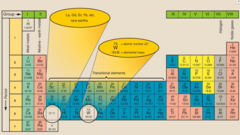
L
Which shell will be the outermost shell for oxygen?

6
How many shells will Lead have?

4
How many valence electrons will lead have?

electrons are not added to the next outermost shell, they are added to an inner shell
How is the 4th period different?
2n^2
How are the max number of electrons in any shell calculated?
the shell number
in 2n^2, what is the n?
3
Shell M is which number?
2n^2
M=3
2(3)^2
2(9)
=18
In an atom with 7 shells, how many electrons can the M shell hold?
strength of attachment of electron to nucleus
What is electron binding energy?
higher
Do electrons closer to the nucleus have higher or lower binding energy?
K
Which shell has the highest binding energy?
more
Higher total number of electrons are more or less tightly bound?
more
Does it take more or less energy to ionize a large atom?
center seeking force
keeps electrons in orbit, attracting electron to nucleus
What is centripetal force?
flying out form the center
allows electrons to maintain their distance from the nucleus
What is centrifugal force?
excess energy is released
After ionization, when electron moves from outer shell to inner, what happens?
the difference in energy levels of the two shells
When an electron moves to an inner shell and excess energy is released, what determines the amount of energy released?
Characteristic xray photons
When excess energy is released from electrons moving to an inner shell from an outer shell, what does this create?
K shell
Which shell has the highest binding energy?
outermost
Which shell has the lowest binding energy?
protons
The number of ___ in an atom determines what element it is
atomic mass number
What is the A#
number of protons
What is the Z#
same
what does iso mean?
atoms with the same number of protons (Z#) but different number of neutrons and different atomic mass A#
What is an isotoPe?
protons stay the same
Why would an isotope element not change if the atomic mass (a#) changes?
atoms with the same number of atomic mass (a#), but different number of protons (z#) and neutrons
What is an isobAr?
the number of protons changed
Why does an isobar element change if the atomic mass doesn't change?
atoms with the same number of neutrons , but different number of protons (a#) and different z#
What is an isotoNe?
isotope
different a#
same z#
same number of Protons
different number of neutrons
=
isobar
same A#
different z#
different number of protons
different number of neutrons
isotone
Different a#
Different z#
Different number of protons
Same number of Neutrons
3 (superscript)
Which is the A# (atomic mass)?
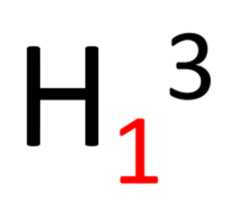
1 (subscript)
Which is the atomic number?
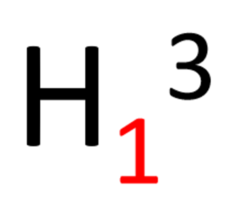
isotope (number of protons stays the same)
Is this an isotope, isobar, or isotone?

isobAr (atomic mass stays the same)
Is this an isotope, isobar, or isotone?
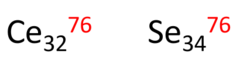
isotone (atomic mass changes, number of protons changes, Neutrons stay the same)
Is this an isotope, isobar, or isotone?
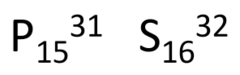
atoms with the same atomic number (z#), same atomic mass (a#), but different Energy states
What is an isomEr?
nucleon arrangement
Identical atoms exist at different energy states due to differences in
substance consisting of atoms which all have the same number of protons and same chemical properties
What is an element?
2 or more atoms of elements combined
What is a molecule?
smallest part of an element that has the properties of that element
What is an atom?
2 atoms share the outer shell electron
What is a covalent bond?
one atom gives up it's electron to another
What is an ionic bond?
one atom is negative and one is positive,
they are electrically attracted to each other
What happens to the charge of ionically bonded atoms?
isotoPe (protons stayed the same)
Is this an isotope, isobar, or isotone?

IsotoNe (neutrons the same)
Is this an isotope, isobar, or isotone?

IsobAr (atomic mass the same)
Is this an isotope, isobar, or isotone?
