B2 : Organisation
 Call Kai
 Learn
Learn Practice Test
 Spaced Repetition
 Match
Match Flashcards
 Knowt Play
1/139

Earn XP
Description and Tags
Name | Mastery | Learn | Test | Matching | Spaced | Call with Kai |
|---|
No analytics yet
Send a link to your students to track their progress
140 Terms
What is the organ system made up of? (in order)
Cells, tissues, organs, organ systems
What is a cell?
The building blocks to life
What is a tissue?
A group of more than one similar cell that works together to carry out a specific function
What is an organ?
A group of different tissues that work together to carry out a certain function
What is an organ system?
A group of organs that work together to carry out a specific function
What is an enzyme?
A biological catalyst
What is a catalyst?
A substance which increases the speed of a reaction without being changed or used up in the reaction
What are enzymes made up of?
Amino acids → so they are a large protein
What 2 things do chemical reaction involve?
Breaking apart or joining things together
What is a substrate?
The substance and enzyme acts on
What does an enzyme have that is specific to a substrate?
Active site
Describe the lock and key theory (4)
An enzyme has an active site which is specific to a substrate
So when the substrate binds to the active site, it fits perfectly into the enzyme (like a lock and key) as the active site is complementary to the shape of the substrate
The enzyme then catalyses (speeds up) the reaction and breaks down the substrate without being changed or used up
A product is made at the end of the reaction
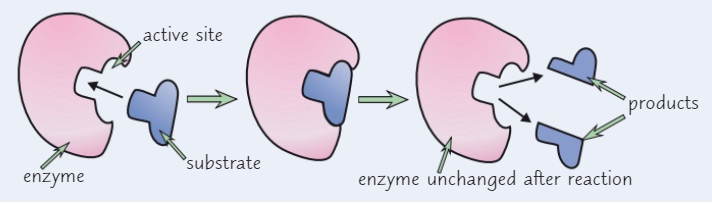
What is the induced fit model?
When the active site changes shape as the substrate binds to it to get a tighter fit (known as the induced fit)
What 2 factors effect enzyme-catalytic reactions?
Temperature
pH
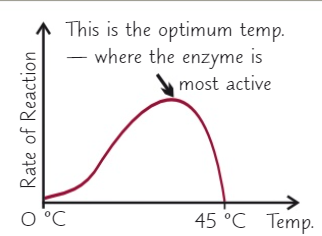
Explain how changing temperature affects enzymes-catalytic reactions (4)
As temperature increases there are more successful collisions per second between the active site and the substrate which quickens the reaction
Then the enzyme will reach its optimum temperature which is the temperature it works best at
If the temperature increases any further the enzyme’s active site changes and the substrate no longer fits + causing the enzyme to denature
The activity of the enzyme rapidly decreases to 0
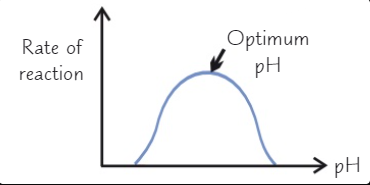
Explain how changing pH affects enzymes-catalytic reactions (2)
Enzymes have an optimum pH which if altered can cause the active site to change shape and denature
Enzymes can have different pHs
What enzyme is used in the investigation for effect of pH on enzyme activity + why?
Amylase
because it catalyses the breakdown of starch → easily detected using iodine solution (changes from a browny-orange colour to a blue-black colour if starch is present)
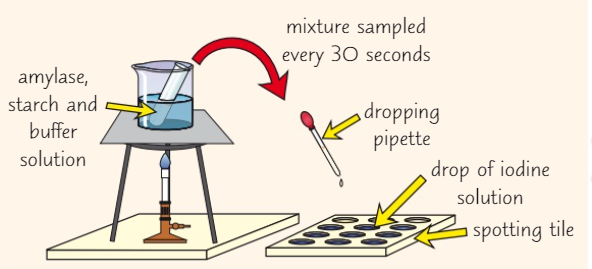
Explain how you investigate the effect of temperature/pH on enzyme activity (8)
Put a drop of iodine solution into every well of a spotting tile
Use a bunsen burner and heat the water till it is 35°C (use a thermometer to check + try to keep temperature constant throughout)
Use a syringe and add 1cm³ of amylase solution + 1cm³ of a buffer solution that has a pH of 2 to a test tube.
Using test tube holders put the tubes into a test tube holder + put the tube into a beaker with water + wait for 5 minutes
Next, use a different syringe + add 5cm³ of starch into a boiling tube
Immediately mix the contents of the boiling tube + start a clock
Record how long it takes for the amylase to break down all the starch by placing a spot of starch + buffer solution into a spotting tile every 30 seconds which can be seen when iodine solution changes back to browny-orange
Repeat the whole experiment with buffer solutions of different pH values to see how pH affects the time taken for the starch to be broken down
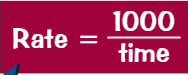
How do you measure the rate of reaction?
Rate = 1000/time
What is the job of digestive enzymes?
To break down big molecules into smaller ones so they can be easily absorbed into the bloodstream
What 3 big molecules are broken down by digestive enzymes?
Starch
Protein
Lipids (fats)
What are the 3 digestive enzymes?
Amylase
Protease
Lipase
What is amylase an example of?
A carbohydrase
What does amylase convert starch into?
Maltose
Where is amylase made in? (3)
Salivary glands
Pancreas
Small intestine
What does protease covert proteins into?
Amino acids
Where is protease made? (3)
Stomach
Pancreas
Small intestine
What is protease known as in the stomach?
Pepsin
What is a lipid molecule?
A molecule of glycerol attached to 3 molecules of fatty acids
What does lipase convert lipids into?
1 Glycerol molecule + 3 fatty acids
Where is lipase found? (2)
Pancreas
Small intestine
Explain what the job of bile is (2)
Emulsifies fats (breaks them down + gives them a larger surface area for the enzyme lipase to work on so digestion happens faster)
Neutralises acids in the stomach to make them more alkaline as the enzymes (lipase) in the stomach work best in alkaline conditions
Where is bile produced?
In the liver
Where is bile stored?
In the gall bladder
Where is bile released into?
Small intestine
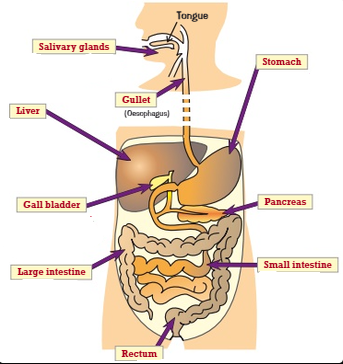
Name the parts of the digestive system (9)
Salivary glands
Gullet (oesophagus)
Liver
Gall bladder
Stomach
Pancreas
Small intestine
Large intestine
Rectum
What is the function of the salivary glands?
They produce the amylase enzyme in the saliva
What is the function of the gullet (oesophagus)?
Where food is swallowed
What is the function of the liver?
Where bile is produced
What is the function of the gall bladder?
Where bile is stored before its released into the small intestine
What is the function of the stomach? (3)
It pummels the food with its muscular walls
Produced the protease enzyme pepsin
Produces hydrochloric acid which
Kills bacteria
gives the right pH for the enzyme protease to work (pH 2 - acidic)
What is the function of the pancreas?
Produces protease, lipase + amylase which it later releases into the small intestine
What is the function of the small intestine? (2)
Produced protease, lipase and amylase enzymes to complete digestion
Where the digested food is absorbed into the blood
What is the function of the large intestine?
Where excess water is absorbed
What is the function of the rectum?
Where your poo is stored before it is released by the anus
How do you prepare food sample? (4)
Get the piece of food and grind it up with a pestle and mortar
Transfer the food into a beaker and add distilled water
Stir it with a rod to dissolve some of the food
Filter the solution using a funnel lined with filter paper to get rid of solid bits
What are the 4 food tests?
Sugars → Benedict solution
Starch → Iodine solution
Protein → Buiret
Fats → Sudan (III)
Explain the test for sugars (5)
Prepare the food sample + add 5cm³ to a test tube
Prepare a water bath at 75°C
Add some benedict solution to the test tube
Leave it for 5 minutes
If the food sample contains sugars + depending on how much it will turn green (least sugars) or yellow or brick red (most sugars)
Explain the test for starch (3)
Prepare the food sample + add 5cm³ to a test tube
Then add a few drops of iodine solution + gently shake
If starch is present the solution will change from a browny-orange colour to a blue/black colour
Explain the test for proteins (3)
Prepare the food sample + add 5cm³ to a test tube
Add 2cm³ of biuret solution to the sample + gently shake
If proteins are present solution will change from blue to purple
Explain the test for fats (lipids) (3)
Prepare the food sample + add 5cm³ to a test tube
Use a pipette and add 3 drops of sudan (III) + gently shake
If the sample contains lipids it will separate the layers and a brick-red layer will form on top of the liquid
What system is lungs a part of?
Respiratory system
Why do you need to get oxygen into your bloodstream?
To supply oxygen to your cells for respiration
What do you need to get out of your lungs?
Carbon dioxide
What are the lungs protected by?
The ribcage
Explain the structure of the lungs (4)
The air breathed in goes through the trachea.
This splits into 2 tubes called bronchi (one is called a bronchus)
The bronchi splits into smaller tubes called bronchioles
The bronchioles end at small bags called alveoli where gas exchange takes place
What are the alveoli surrounded by?
A network of blood capillaries
What takes place in the lungs + the capillaries?
Gas exchange
Where have the capillaries that neighbour the alveoli been around + what would they contain?
They have been around the body + contain a lot of carbon dioxide but not enough oxygen
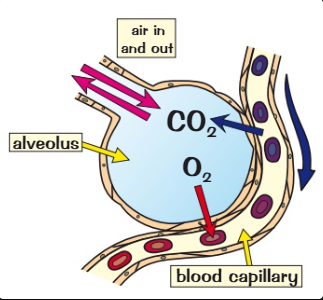
Explain what gas exchanges from the alveoli into the capillaries(+ at what concentration) + Explain what gas exchanges from the capillaries into the alveoli (2)
Oxygen diffuses out of the alveoli (area of high concentration) into the capillaries (area of low concentration)
At the same time
Carbon dioxide diffuses out of the capillaries (area of high concentration) into the alveoli (area of low concentration)
Explain what happens to the newly exchanged oxygen and carbon dioxide (+ at what concentration) (2)
When the blood reaches the body cells, oxygen is released from the red blood cells (high concentration) and diffuses into the body cells (low concentration)
At the same rime
Carbon dioxide diffuses out of the body cells (high concentration) into the blood (low concentration). It then carried back to the lungs
How do you calculate the rate of breaths per minute?
Breaths per minute = number of breaths/number of minutes
What does the circulatory system carry? (3)
Food
Oxygen
Waste products
What is the double circulatory system made up of? (3)
Heart
Blood vessels
Blood
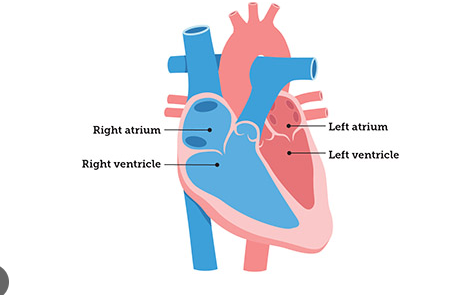
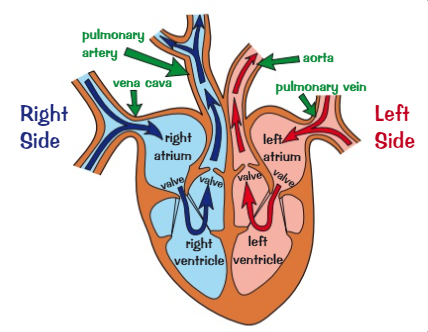
What are the 4 chambers in the heart?
Right atrium (upper chamber)
Left atrium (upper chamber)
Right ventricle (lower chamber)
Left ventricle (lower chamber)
What happens to the blood flow in terms of the 4 chambers? (2)
The atrium receive blood
The ventricles pump away blood
What are the 4 blood vessels?
Vena cava
Pulmonary artery
Aorta
Pulmonary vein
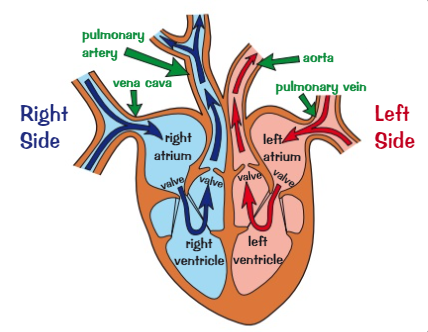
Describe the path the blood takes in terms of the heart (5)
Blood flows into the two atria (plural version of atrium) from the vena cava(deoxygenated) and the pulmonary vein (oxygenated)
The atria both contract, pushing the blood into the ventricles
The ventricles contract, forcing the blood into the pulmonary vein and the aorta + out of the heart
The blood flows to the organs through the arteries + returns through the veins
The atria fill up and the cycle starts again
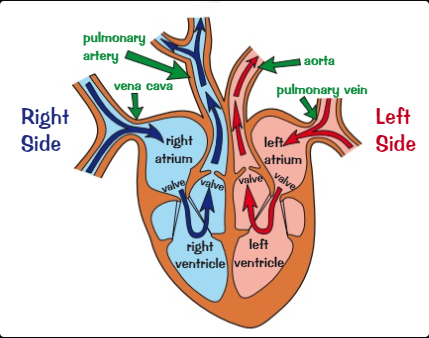
Why does the left side of the heart have a thicker, more muscular wall than the right?
This is because the left ventricle pumps blood around the whole body + needs to execute a large force
What is the job of coronary arteries + why?
They surround the heart + make sure that it gets all oxygenated blood as the oxygen in that blood would be needed for respiration to supply energy to the contracting muscles
What is the resting heart rate controlled by?
A group of cells called pacemakers
Where are pacemakers located?
Right atrium
What is the job of the pacemakers?
To produce a small electrical impulse which causes the surrounding muscle cells to contract
What is used when a pacemaker stops working + what do they do?
An artificial pacemaker which create an electrical current to keep the heart beating regularly
What are the 3 types of blood vessels + their functions?
Arteries → carry blood away from the heart
Capillaries → involved in the exchange of materials at the tissues
Veins → carry blood to the heart
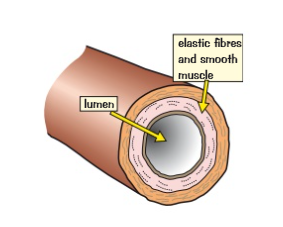
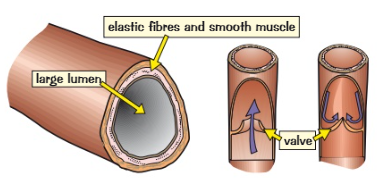
Describe the structure of arteries + why? (3)
Thick muscular walls make them strong so they can withstand high-pressure blood
Contain elastic fibres to allow them to stretch and spring back
Have a small lumen (hole)
What do arteries branch into?
Capillaries
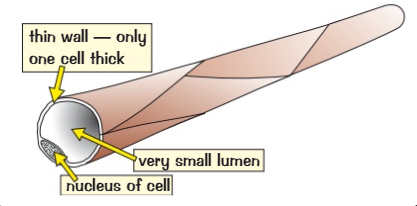
Describe the structure of capillaries + why? (4)
Capillaries are really tiny
They carry blood close to every cell in the body to exchange substances
Have permeable walls that are one cell thick (short diffusion pathways) so substances can diffuse in + out
They supply food and oxygen + take away water products like CO2
Capillaries eventually join up to form what?
Veins
Describe the structure of veins + why? (3)
Veins don’t have thick walls because the blood is at a lower pressure
They have bigger lumens to help blood flow
They have valves to help keep the blood flowing in the right direction
What do the valves do?
Stop the blood flowing backwards into the atria when the ventricles contract
How do you calculate the rate of blood flow?
Rate of blood flow = volume of blood/number of minutes
What are the 4 main things that blood consists of? (4)
Red blood cells
White blood cells
Platelets
Plasma
What is the function of the red blood cells?
They carry oxygen from the lungs to all the cells
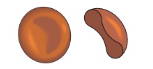
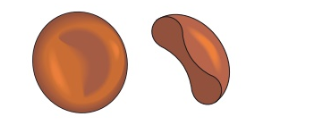
How are red blood cells adapted for their function? (3)
They have a biconcave shape → gives them a large surface area for absorbing oxygen
Don’t have a nucleus → allows them to carry more oxygen
Contain a red pigment called haemoglobin which binds with oxygen to form oxyhaemoglobin (but splits up later to release the oxygen to the cells)
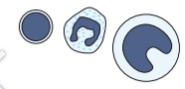
What is the function of white blood cells?
To get rid of pathogens
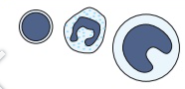
How are white blood cells adapted for their function? (3)
Produce antibodies
Produce antitoxins
Eat pathogens (phagocytosis)
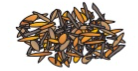
What is the function of platelets?
Help blood clot
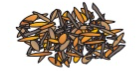
How are platelets adapted for their function? (4)
Platelets are tiny fragments of cells
Have no nucleus
Help blood clot a wound so blood doesn’t pour out + pathogens don’t get it
Lack of platelets causes excessive bleeding + bruising
What is the function of plasma?
The liquid that carries everything in blood
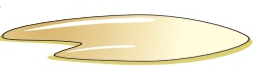
What do plasma carry? (include the obvious)
Red blood cells
White blood cells
Platelets
Antibodies + Antitoxins
Proteins
Hormones
Urea
Nutrients
Glucose
Amino acids
Carbon dioxide
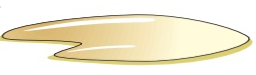
What part of the body is cardiovascular disease in reference to? (2)
The heart
The blood vessels
Give an example of cardiovascular disease
Coronary heart disease
What happens to the coronary arteries when someone has coronary heart disease + what does it lead to?
They get blocked by a layer of fatty material building up + causes the arteries to become narrow → leads to blood flow being restricted + lack of oxygen.
What fatal event could happen to someone who has coronary heart disease?
A heart attack
What can be used to keep arteries open when someone has coronary heart disease?
Stents
What are stents + what is their function?
Stents are tubes that are inserted inside the arteries
They keep them open allowing blood to pass through to the heart muscles which keeps the person alive
What are the pros + cons for stents? (4)
Stents lower the risk of heart attack
Stents are effective for a long time + recovery time from surgery is quick
However there are risks of complications involving surgery + infection
Also a risk of patient developing a blood clot near the stent (known as thrombosis)
What is cholesterol + what happens if you have too much of the “bad” type of cholesterol?
Cholesterol is a natural + essential lipid produced by the body
The bad cholesterol is known as LDL cholesterol + too much causes fatty deposits to build up in the arteries
What are statins + what do they do?
A drug that someone takes to reduce LDL cholesterol in the bloodstream which slows the build-up of fatty deposits