Chap 27D - Transition metals
 Call Kai
 Learn
Learn Practice Test
 Spaced Repetition
 Match
Match Flashcards
 Knowt Play
1/12

There's no tags or description
Looks like no tags are added yet.
Name | Mastery | Learn | Test | Matching | Spaced | Call with Kai | Chat |
|---|
No analytics yet
Send a link to your students to track their progress
13 Terms
Describe heterogeous catalysts mechanism
Transition metal atoms use their partially filled 3d subshell to form weak bonds with reactant molecules
Adsorption of reactant molecules on the catalyst’s surface increases rate of reaction as adsorption weakens the covalent bonds within the reactant molecules -> reducing the Ea
Adsorption also increases the concentration of reactant molecules at the catalyst surface allowing reactant molecules to come into close contact with proper orientation for reaction.
Products formed desorb from the catalyst surface
Describe general equations in catalytic converters
2NOx → xO2 + N2
2CxHy + (4x + y)NO -> 2xCO2 + yH2O + (2x + y/2 )N2
Oxides of nitrogen combine with unburnt hydrocarbons to form photochemical smog -> respiratory problems
Explanation using Eo between H2O2 and Cr2+ (Cr2+ → Cr3+)
Transfer of electrons from H2O2 to Cr2+, Cr2+ is oxidised to Cr3+ and H2O2 is reduced to H2O
Eo = (+1.77) - (+0.41) = +1.36V
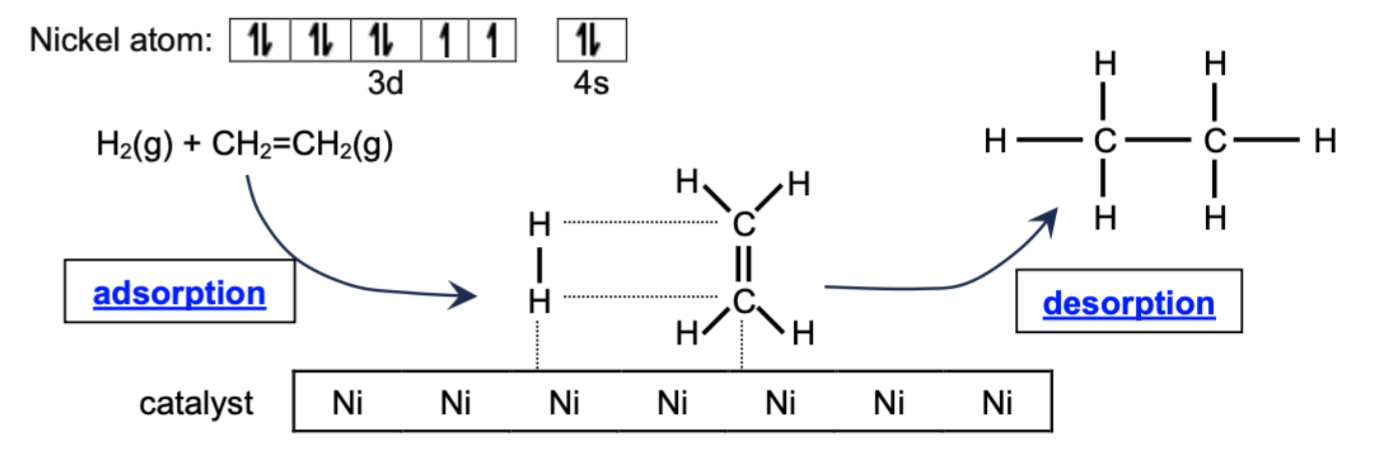
Describe the hydrogenation of ethene can be catalysed using nickel, Ni, giving ethane
Nickel has a partially filled 3d subshell which can be used for forming weak chemical bonds with hydrogen and ethene molecules by adsorption
Hydrogen and ethene are brought close together and the bonds within them are weakened, enabling them to react quickly to form ethane, which then desorbs from the catalyst surface
Draw mechanism of the hydrogenation of ethene can be catalysed using nickel, Ni, giving ethane
State reactions of ligands
Ligand-exchange reaction
Redox reaction
Precipitation reaction
Acid-base reaction
Hydrolysis with water
Describe and explain this ligand-exchange reaction
Observation: [Cu(H2O)6]2+ + 4Cl– ⇌ [CuCl4]2– + 6H2O
blue yellow
Forming a mixture with higher concentration of the more stable complex
Explanation: Water molecules in [Cu(H2O)6]2+ are replaced by Cl– ions to form [CuCl4]2–
When concentrated HCl is added to the blue solution of [Cu(H2O)6]2+, the solution looks green as a mixture of blue [Cu(H2O)6]2+ and yellow [CuCl4]2– is formed. As concentration of [CuCl4]2– increases, solution gradually turns yellow
Describe ligand redox reaction + explanation
Forming a mixture with higher concentration of the more stable complex
Occurs when the reaction has a positive E⦵cell
Use ⟶ arrow
Explanation: Cu2+(aq) is reduced by I– to CuI(s), a white precipitate, while I– is oxidised to I2, which reacts with iodide to form a brown solution of I3–(aq).
Describe precipitation reaction of Cr3+(aq) + NaOH(aq)
On adding NaOH(aq) to Cr3+(aq), a grey-green ppt. of Cr(OH)3(s) is formed when its ionic product exceeded its Ksp value
This reaction is an acid-base since hydroxide is a strong base OR precipitation since a precipitate is formed
[Cr(H2O)6]3+(aq) + 3OH–(aq) ⇌ Cr(OH)3(H2O)3(s) + 3H2O(l) --- [1] [acid-base] OR
Cr3+(aq) + 3OH–(aq) ⇌ Cr(OH)3(s) + 3H2O(l) [precipitation]
In this example: Cr3+ = [Cr(H2O)6]3+
Describe precipitation of Cr3+(aq) + NH3(aq)
This reaction is NOT regarded as acid-base since ammonia, which is a weak base, is not strong enough to abstract H+ from [Cr(H2O)6]3+(aq).
It is a precipitation since NH3(aq) contains hydroxide ions which can form precipitate with Cr3+
NH3 + H2O ⇌ NH4+ + OH– [acid-base or base dissociation]
Cr3+(aq) + 3OH–(aq) ⇌ Cr(OH)3(s) + 3H2O(l) [precipitation]
Describe acid-base reaction + explanation
Depends on relative stability of ions at different pH
Explanation: Red-brown precipitate of Fe(OH)3 was formed as carbonate is basic with production of effervescence of CO2
Describe hydrolysis with H2O reaction + explanation
Causes splitting of H2O
Occurs for ions with acidic properties such as highly polarising Cr3+(aq) or Fe3+(aq) ions
Explanation: Hydrolysis takes place as Fe3+ is a highly polarising ion due to its high charge density, giving an acidic solution
Describe and explain this:
When concentrated HCl is added to aqueous solution of CuSO4, the solution changes colour from blue to green to yellow.
Upon addition of concentrated HCl, [Cu(H2O)6]2+ + 4Cl– ⇌ [CuCl4]2– + 6H2O
blue yellowLigand exchange takes place
Water molecules in [Cu(H2O)6]2+ are replaced by Cl– ions to form [CuCl4]2–
Initially, a mixture of blue [Cu(H2O)6]2+ and yellow [CuCl4]2– appears green.
Eventually, green mixture turns completely into yellow solution of [CuCl4]2– in excess Cl–