Chemistry Final Review
 Call Kai
 Learn
Learn Practice Test
 Spaced Repetition
 Match
Match Flashcards
 Knowt Play
1/47

There's no tags or description
Looks like no tags are added yet.
Name | Mastery | Learn | Test | Matching | Spaced | Call with Kai | Chat |
|---|
No analytics yet
Send a link to your students to track their progress
48 Terms
Macroscopic domain
Everyday things that are large enough to be sensed directly by human sight or touch. The macroscopic domain includes everyday and laboratory chemistry, where we observe and measure physical and chemical properties such as density, solubility, and flammability.
Microscopic domain
Often visited in the imagination. Some aspects of the microscopic domain are visible through standard optical microscopes, but some things are far too small to see.
Symbolic domain
Specialized language used to represent components of the macroscopic and microscopic domains. Chemical symbols (such as those used in the periodic table), chemical formulas, and chemical equations are part of the symbolic domain, as are graphs, drawings, and calculations.
Scientific Notation
A number larger than one will have a positive exponent.
A number smaller than one will have a negative exponent.
Uncertainty
Estimate of amount by which measurement differs from true value
Significant Figures
All of the digits in a measurement, including the uncertain last digit
Significant Figure Rule for Subtraction and Addition
When we add or subtract numbers, we should round the result to the same number of decimal places as the number with the least number of decimal places (the least precise value in terms of addition and subtraction)
Significant Figure Rule for Multiplication and Division
When we multiply or divide numbers, we should round the result to the same number of digits as the number with the least number of significant figures (the least precise value in terms of multiplication and division).
Mass
Measure of the amount of matter in it
Law of conservation of matter
There is no detectable change in the total quantity of matter present when matter converts from one type to another (a chemical change) or changes among solid, liquid, or gaseous states (a physical change).
Pure substance
Has a constant composition. All specimens of a pure substance have exactly the same makeup and properties.
Element
Pure substances that cannot be broken down into simpler substances by chemical changes
Compounds
Pure substances that are comprised of two or more elements. Compounds may be broken down by chemical changes to yield either elements or other compounds, or both
Mixture
Composed of two or more types of matter that can be present in varying amounts and can be separated by physical changes
Homogeneous mixture/Solution
Exhibits a uniform composition and appears visually the same throughout
Heterogeneous mixture
A mixture that is not completely uniform in composition, varying from point to point
Physical property
A characteristic of matter that is not associated with a change in its chemical composition. Familiar examples of physical properties include density, color, hardness, melting and boiling points, and electrical conductivity.
Physical change
A change in the state or properties of matter without any accompanying change in the chemical identities of the substances contained in the matter. Physical changes are observed when wax melts, when sugar dissolves in coffee, and when steam condenses into liquid water.
Chemical property
The change of one type of matter into another type (or the inability to change). Examples of chemical properties include flammability, toxicity, acidity, and many other types of reactivity
Chemical change
Always produces one or more types of matter that differ from the matter present before the change
Extensive property
Property depends on the amount of matter present. The value of an extensive property is directly proportional to the amount of matter in question
Intensive property
Property of a sample of matter does not depend on the amount of matter present.
Isotopes
Atoms of the same element that differ in mass
Atomic number (Z)
The number of protons in the nucleus of an atom. The atomic number is the defining trait of an element: Its value determines the identity of the atom.
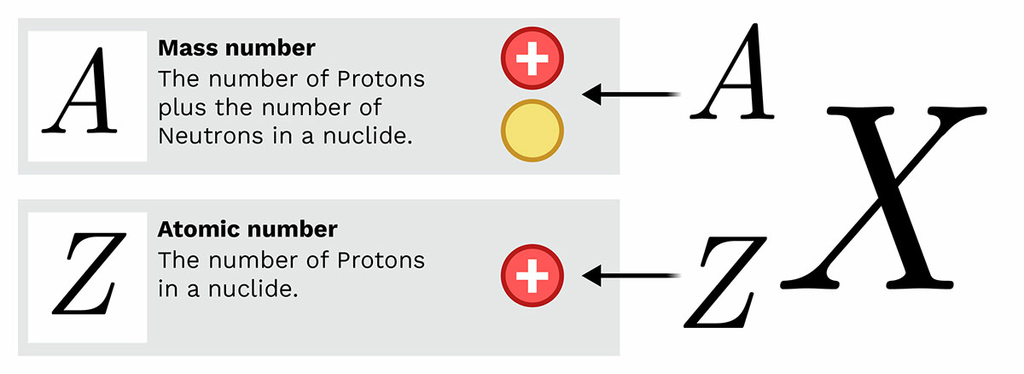
Number of Electrons
A neutral atom must contain the same number of positive and negative charges, so the atomic number also indicates the number of electrons in an atom.
Mass Number (A)
The total number of protons and neutrons in an atom
Number of Neutrons
The difference between the mass number and the atomic number: A – Z = number of neutrons
Atomic charge
Atomic charge = Number of protons - number of electrons
Bohr Model
Showed the hydrogen atom electron’s energy decreases with increasing distance from the nucleus
Principal quantum number
n, defines the general size and energy of the orbital. Another name for the principal quantum number is the shell number
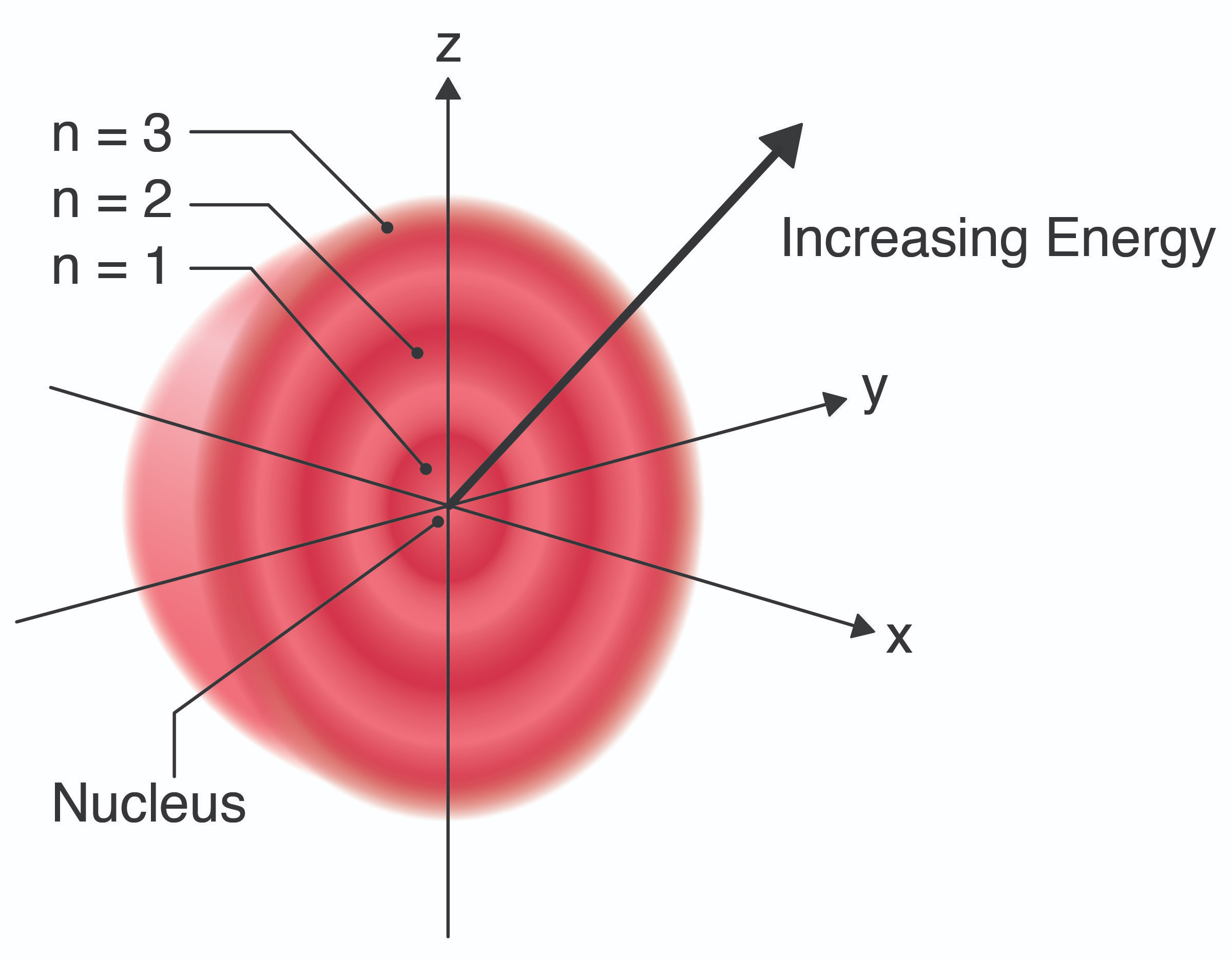
Shells
The shells of an atom can be thought of as concentric spheres radiating out from the nucleus. The electrons that belong to a specific shell are most likely to be found within the corresponding spherical area. The further we proceed from the nucleus, the higher the shell number, and so the higher the energy level.
Atomic orbital
is a general region in an atom within which an electron is most probable to reside.
Secondary (angular momentum) quantum number (l)
l specifies the shape of the orbital
It is an integer that may take the values, l = 0, 1, 2, …, n – 1. The highest possible value of l is one less than the principal quantum number.
This means that an orbital with n = 1 can have only one value of l, l = 0, whereas n = 2 permits l = 0 and l = 1, and so on
S Orbitals
They make up the s subshells. l = 0
P orbitals
l=1
D orbitals
The orbitals with l = 2
F Orbitals
l = 3
Magnetic quantum number ml
Specifies the relative spatial orientation of a particular orbital
Generally speaking, ml can equal all integers from –l to +l. The total number of possible orbitals with the same value of l (that is, in the same subshell) is 2l + 1.
Spin quantum number ms
Specifies the orientation of the spin of an electron
ms can only have a value of +1/2 or -1/2
Pauli exclusion principle
No two electrons in the same atom can have exactly the same set of all the four quantum numbers.
No more than two electrons can occupy the same orbital 2n2 (and if two electrons are located in the same orbital, they must have opposite spins)
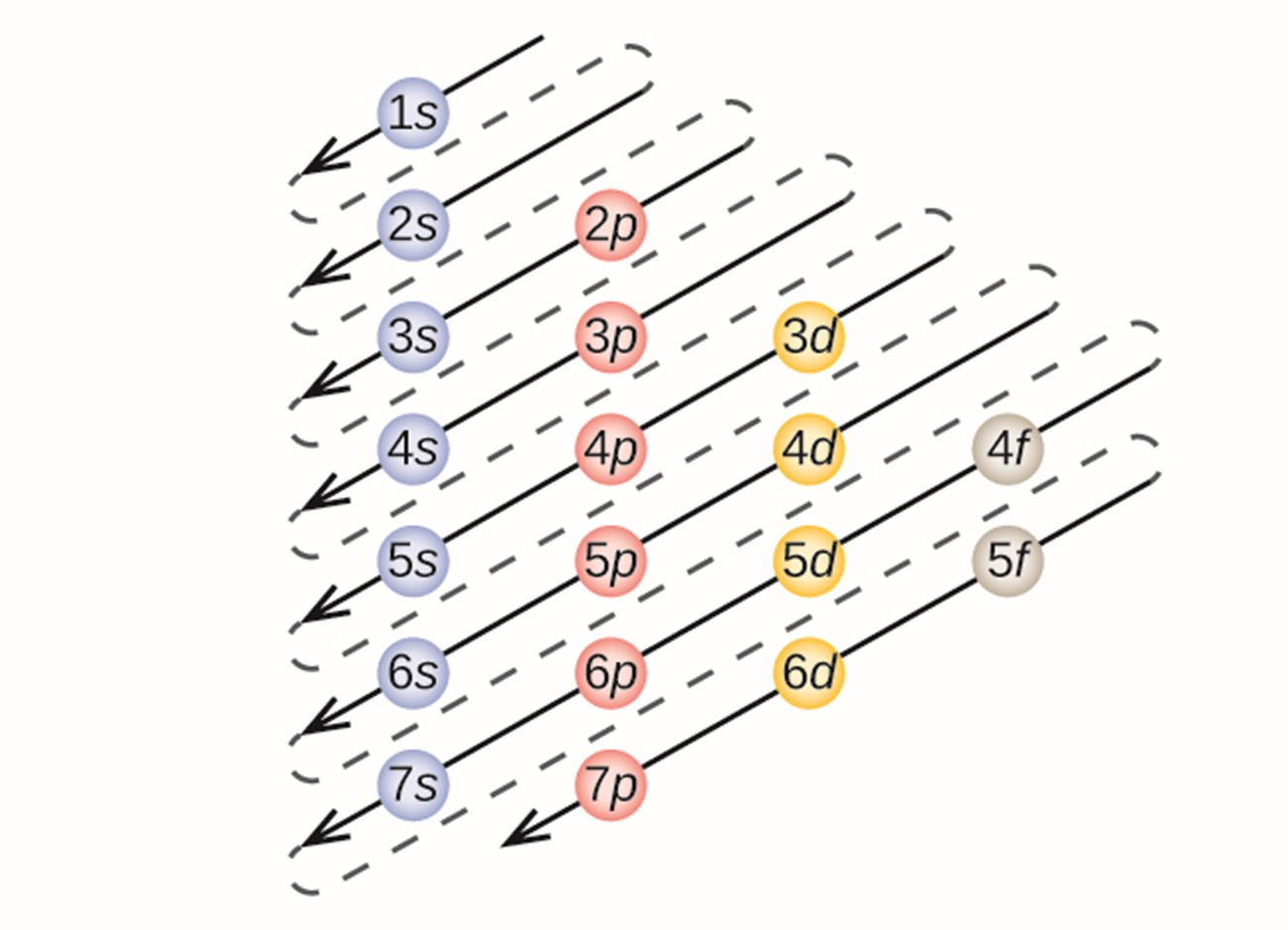
The Aufbau Principle
Each added electron occupies the subshell of lowest energy available, subject to the limitations imposed by the allowed quantum numbers according to the Pauli exclusion principle. Electrons enter higher-energy subshells only after lower-energy subshells have been filled to capacity.
Hund's Rule
When you're filling orbitals of the same energy, electrons spread out before pairing.
C = 1s² 2s² 2p²
The 2p orbitals are:
↑ ↑ _
NOT:
↑↓ _ _
Hund's rule says the lowest-energy arrangement has the maximum number of unpaired electrons.
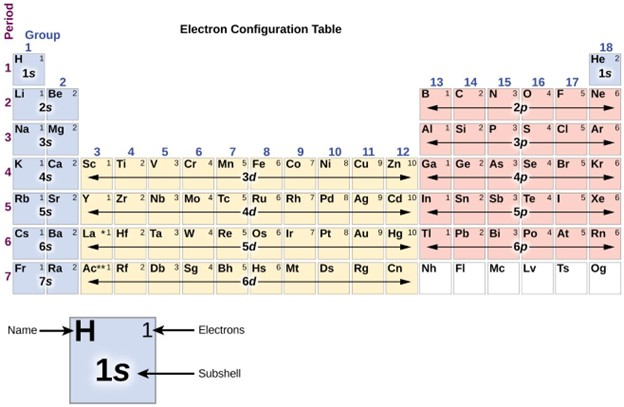
Electron Configuration Table
This partial periodic table shows electron configurations for the valence subshells of atoms. By “building up” from hydrogen, this table can be used to determine the electron configuration for atoms of most elements in the periodic table.