CHAPTER 6: FUNDAMENTAL PRINCIPLES OF PEDIATRIC PHYSIOLOGY & ANATOMY
 Call Kai
 Learn
Learn Practice Test
 Spaced Repetition
 Match
Match Flashcards
 Knowt Play
1/29

There's no tags or description
Looks like no tags are added yet.
Name | Mastery | Learn | Test | Matching | Spaced | Call with Kai | Chat |
|---|
No analytics yet
Send a link to your students to track their progress
30 Terms
3 consequences of child’s lung due to high ventilation
pneumothorax
air-trapping
lung collapse
readily absorbable
lipid / fat soluble drug
basic + basic / acidic + acidic → same composition
less absorbable
water soluble drug
acidic + basic → not the same composition
Neonates
a baby within 44 weeks of age from the date of conception
Infants
a child of up to 12 months of age
Child
1 to 12 years
Adolescent
13 to 16 years
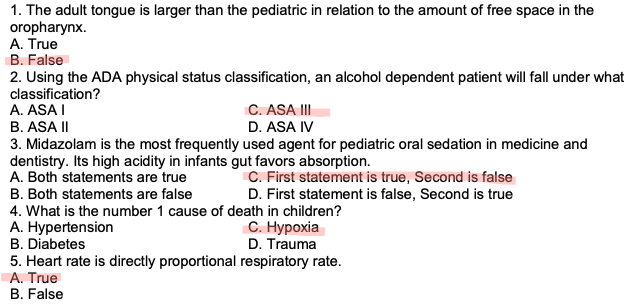
pediatric tongue
One of the most obvious anatomical differences between an adult and child
is larger than the adult in relation to the amount of free space in the oropharynx
large tongue creates a significant probability for airway occlusion and leaves little room for airway swelling
The size of the tongue is thought to be one explanation for why children are obligate nose-breathers: breathing through the nose is easier because it provides a direct path for airflow without concern for any obstruction that the tongue may cause
infant larynx
resides superior to that of an adult (C4 to C5) and the epiglottis is proportionally larger
child’s chest wall
l is more elastic than that of an adult, requiring lower ventilation pressure to expand the lungs
child’s sternum
is less rigid, which means that ribs and intercostal muscles have less support.
respiratory physiology
The considerable differences in this between infants and adults explain why infants and young children have a higher susceptibility to more severe manifestations of respiratory diseases, and why respiratory failure is common problem in neonatal and pediatric intensive care units.
The appreciation of the peculiarities of pediatric respiratory physiology is not only essential for correct assessment of any ill child, but also for correct interpretation of any pulmonary function test performed in this population
hypoxia
The No. 1 cause of death in children
Lack of a patent airway or breathing adequacy → most common reason for its development
between 6 and 8 years of age
development of frontal and sphenoid sinus
present at birth
ethmoid and maxillary sinus
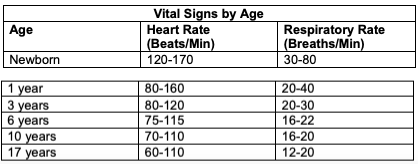
Heart rate of infants
is higher and decreases gradually over the first 5 years of life near to adult levels
immagure gastric mucosa
secretes low levels of acid
Low acidity of infants gut favors absorption of weakly acidic drugs:
penicillins
cephalosporins
whereas the absorption of weakly basic drugs:
benzodiazepines
Mefenamic Acid
should not be given in patients 13 years old and below
due to its increased risk of stomach problems, such as bleeding or peptic ulcers
Liver function
is initially immature with decreased function of hepatic enzymes.
Barbiturates and opioids for example have a longer duration of action due to the slower metabolism
ASA I
A normal healthy patient and no risk during dental treatment
ex: Healthy, nonsmoking, no or minimal alcohol use
ASA II
A patient with mild to moderate systemic disease and minimal risk during dental treatment
ex: Mild to moderate systemic disease without substantive functional limitations or healthy with extreme anxiety and fear toward dentistry Example: Current smoker, social alcohol drinker, pregnancy, obesity, well-controlled Diabetes Mellitus and hypertension, mild lung disease
ASA III
A patient with moderate to severe systemic disease and increased risk during dental treatment
ex: Poorly controlled Diabetes of hypertension, Alcohol dependence or abuse, Implanted pacemaker
ASA IV
A patient with severe systemic disease that is a constant threat to life and significantly increased risk during dental treatment
ex: Recent (less than 3 months) Myocardial infarction
ASA V
A moribund patient who is not expected to survive without the operation
ex: Ruptured abdominal/thoracic aneurysm
ASA VI
Patient declared brain-dead whose organs are being harvested for donor purpose
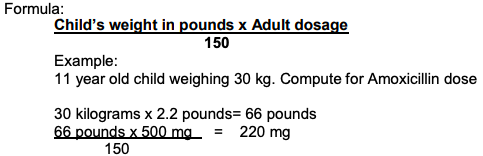
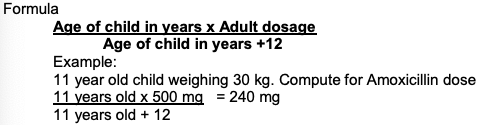
2 ways in computing pediatric dosage
Clark’s rule → weight in pounds
Fried’s rule → age in months
Young’s rule → age in years
Cowling’s rule → age in next bday
Clark’s rule → weight in pounds
Young’s rule → age of the child in years
vital signs by age
practice question in sas