Maxillofacial Embryology - Basic Science Core
 Call Kai
 Learn
Learn Practice Test
 Spaced Repetition
 Match
Match Flashcards
 Knowt Play
1/21

Earn XP
Description and Tags
Embryology Exam 1
Name | Mastery | Learn | Test | Matching | Spaced | Call with Kai | Chat |
|---|
No analytics yet
Send a link to your students to track their progress
22 Terms
Human Face Prominences
The human face develops from 5 elevated “prominences”, note that different references may use “swelling” or “process” they’re referring to the same thing
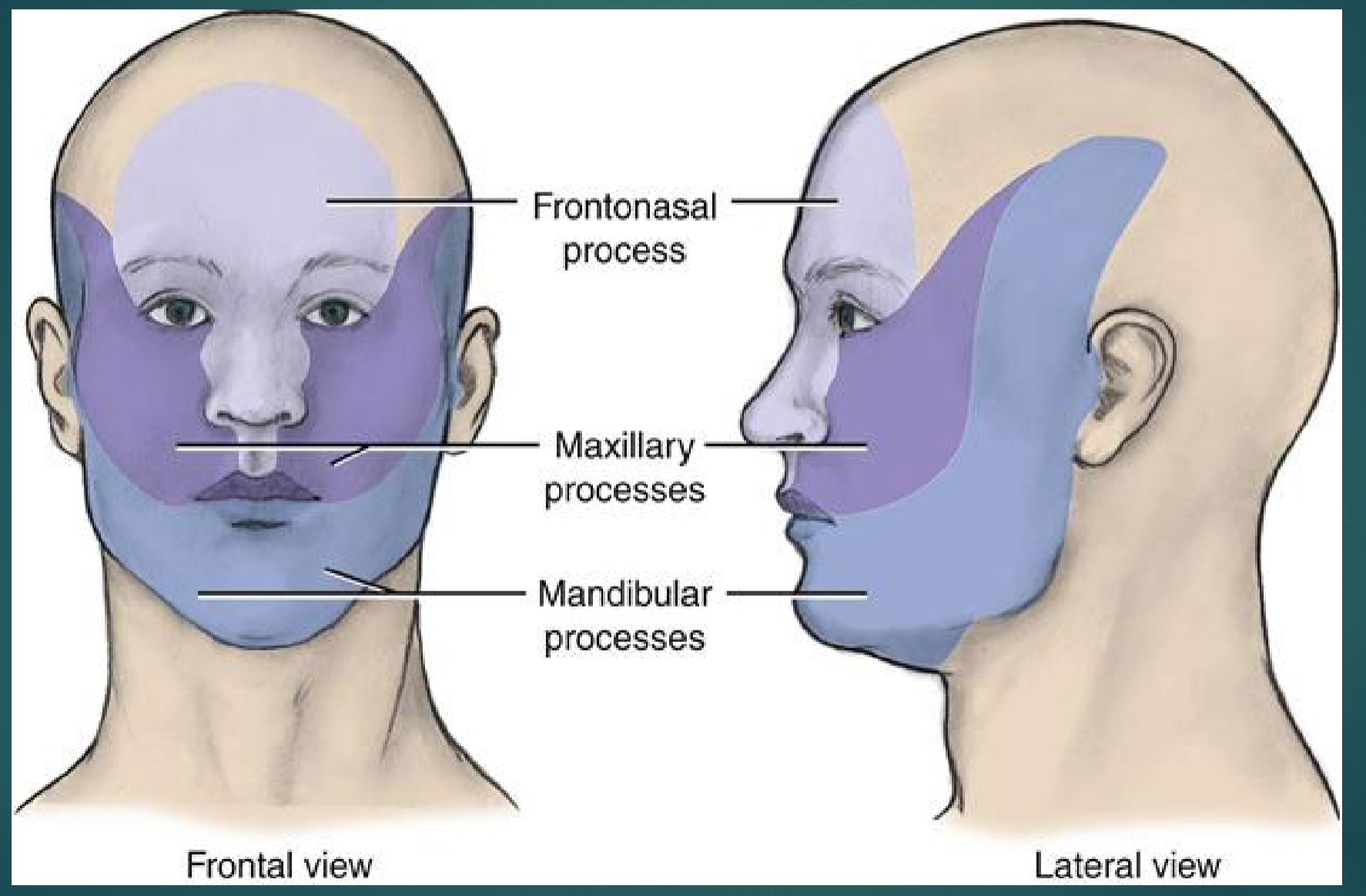
Facial prominences consist predominantly of:
neural crest derived mesenchyme from first pharyngeal arches
At week 4, the 5 prominences surround the stomodeum:
Prominences 1&2:
Maxillary prominences
LATERAL to the stomodeum
Prominences 3&4:
Mandibular prominences
CAUDAL to the stomodeum
Prominence 5
Frontonasal prominence
Bucco-pharyngeal membrane
Bucco-pharyngeal membrane will rupture to allow
continuity between oral and pharyngeal cavity
During week 5 …
Nasal placodes invaginate form
nasal pits
Nasal prominences
A new ridge of tissue forms on each side of the pits
This forms the:
1) Medial Nasal Prominence
2) Lateral nasal prominence
Nasal prominences formed in week 5 (2)
Nasal prominences
A new ridge of tissue forms on each side of the pits
This forms the:
1) Medial Nasal Prominence
2) Lateral nasal prominence
In Weeks 6 to 10:
Let’s start with the lips
Maxillary prominences increase in size and grow
medially compressing the medial nasal prominences
toward the midline
The CLEFT between the medial nasal prominence and
the maxillary prominence is LOST (or should be) and the
two structures fuse
The UPPER LIP is formed by
WO MEDIAL NASAL PROMINENCES and the TWO
MAXILLARY PROMINENCES
The LOWER LIP & MANDIBLE are formed by
MANDIBULAR prominences that merge across the
midline
The UPPER LIP is formed by
TWO MEDIAL NASAL PROMINENCES and the TWO
MAXILLARY PROMINENCES
The LOWER LIP & MANDIBLE are formed by
MANDIBULAR prominences that merge across the midline
Nasolacrimal groove
deep furrow separating maxillary and lateral nasal prominences
Weeks 6-10
nasolacrimal duct
Ectoderm forms a canal at the base of the groove
Nasolacrimal sac
Upper end of the duct forms the nasolacrimal sac
Once the nasolacrimal duct is formed
the maxillary and lateral nasal prominences merge (or they’re
supposed to…)
The nose development
The NOSE is formed from 5 facial
prominences
Frontonasal prominence forms the
bridge
Merged medial prominences form
the crest and tip
Lateral nasal prominences form
the alae
INTERMAXILLARY SEGMENT (I.S)
By week 7, merging of the maxillary prominences and the
medial nasal prominences creates the INTERMAXILLARY
SEGMENT(I.S.)
The I.S. is continuous with the rostral portion of the nasal
septum which is formed by the frontal prominence
INTERMAXILLARY SEGMENT(I.S.) Three Components
Labial component = philtrum of the upper lip
Upper jaw component = four incisor teeth
Palatal component = triangular primary palate
Also around weeks 6-7 the Secondary Palate begins to fuse
The primary palate is relatively small compared to
the secondary, but the secondary becomes the
main part of the definitive palate
○ Formed by two shelf-like outgrowths from the
maxillary prominences called the palatine shelves
○ Fusion of the palatal shelves begins in the
anterior palate and progresses posteriorly
○ The shelves also ascend to horizontally position
above the tongue and fuse
○ The nasal septum grows down and joins the newly
formed palate
Incisive Foramen
Anteriorly, the palatal shelves fuse with the triangular
primary palate and the incisive foramen is the midline
landmark between the primary and secondary plates
Nasal Cavity, weeks 6 through 9 (Nasal pits deepen)
Growth of surrounding tissue
Penetration into the underlying mesenchyme
Oronasal membrane
Separates the pits from the primitive oral cavity via the foramina named primitive choanae
Choana (“ko-eh-na”) = funnel in Greek
Choanae lie on each side of the midline immediately behind the primary palate
Definitive choanae once the palate forms and the nasal chambers develop
- they lie at the junction of the nasal cavity
and pharynx
Paranasal air sinuses develop as
diverticula of the lateral nasal wall and extend into the maxilla, ethmoid, frontal, and sphenoid bones, reaching definitive size at puberty