L23b: surgical approach to abdomen (large animals) not finished *
 Call Kai
 Learn
Learn Practice Test
 Spaced Repetition
 Match
Match Flashcards
 Knowt Play
1/45

There's no tags or description
Looks like no tags are added yet.
Name | Mastery | Learn | Test | Matching | Spaced | Call with Kai | Chat |
|---|
No analytics yet
Send a link to your students to track their progress
46 Terms
MCQ: A dairy cow presents with symptoms consistent with hardware
disease (traumatic reticuloperitonitis). A rumenotomy will be
performed to remove the foreign body. Where should the
laparotomy incision be performed?
left paralumbar
What suture pattern will be used to close the skin incision?
forward interlocking
what types of surgeries require antimicrobials?
enterotomy
cesarean
foot/joint infection
what would be considered a clean surgical wound?
uninfected operative wounds without inflammation
respiratory, ailmentary, genital, or uninfected urinary tracts are not entered
what would be considered clean/contaminated surgical wound?
operative wounds in the respiratory, ailmentary, genital, or unifected urinary tracts are electively entered
what would be considered contaminated surgical wound?
open, fresh, accidental wounds with major breaks in sterility
what would be considered dirty surgical wound?
old traumatic wounds with retained devitalized tissue or those that involve existing clinical infection or perforated viscera
MCQ: What laparotomy approach has the highest risk of wound infection?
paramedian
ventral midline
what antibiotics can you use for pre-op and post-op?
oxytetracycline
penicillin
ceftiofur
what NSAIDs are liscensed for use in cattle in the US?
flunixin meglumine
ketoprofen
what cattle can we not administer ketoprofen in?
dairy cattle over 1 year
what cattle can we not administer flunixin meglumine in?
veal calves
what NSAID in the US can we administer in cattle for pain?
none officially but there are different loopholes
what needle type do you want for suturing inside the large animal body?
round body needle
what needle type do you want for suturing skin in large animals?
cutting needle
when can you use an everting suture pattern?
skin
when can you use an inverting suture pattern?
hollow viscera (ex: uterus)
tension sutures
minimize movement, strangulation, and marginal necrosis
walking sutures
buried tension sutures
reduce dead space
what are anesthesia techiques for standing anesthesia?
restraint
line block
inverted L block
paravertebral
who would a paravertebral block not be good for?
overweight animals
what are anesthesia techniques for when the animal will be recumbent for the procedure?
cast and sedation
cranial epidural
general anesthesia
how will the animal be positioned for a flank surgical approach?
standing
how will the animal be positioned for a paracostal surgical approach?
standing
when may you use a paracostal oblique surgical approach?
c-section
how will the animal be positioned for a ventral midline surgical approach?
dorsal recumbency
how will the animal be positioned for a paramedian surgical approach?
dorsal recumbency
how will the animal be positioned for a ventrolateral surgical approach?
lateral recumbency
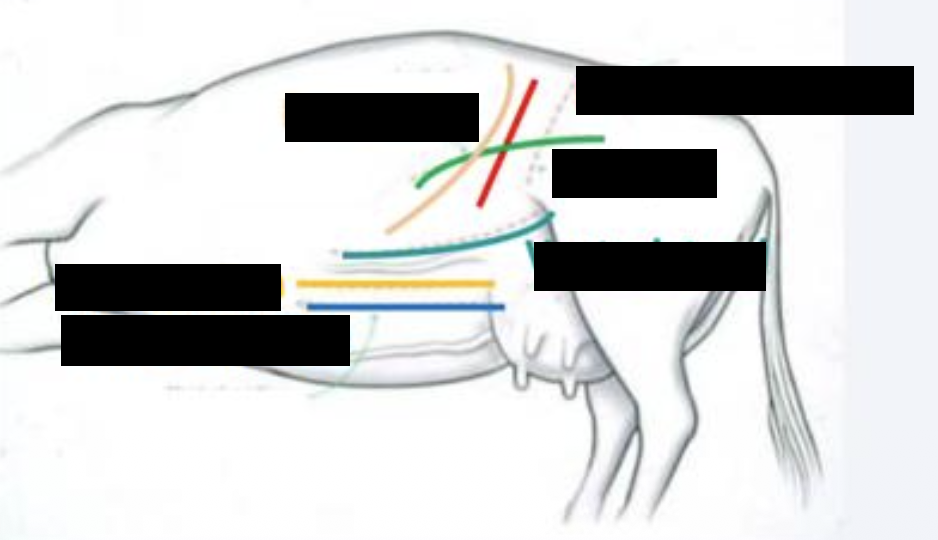
what surgical approach is the red line?
paralumbar fossa
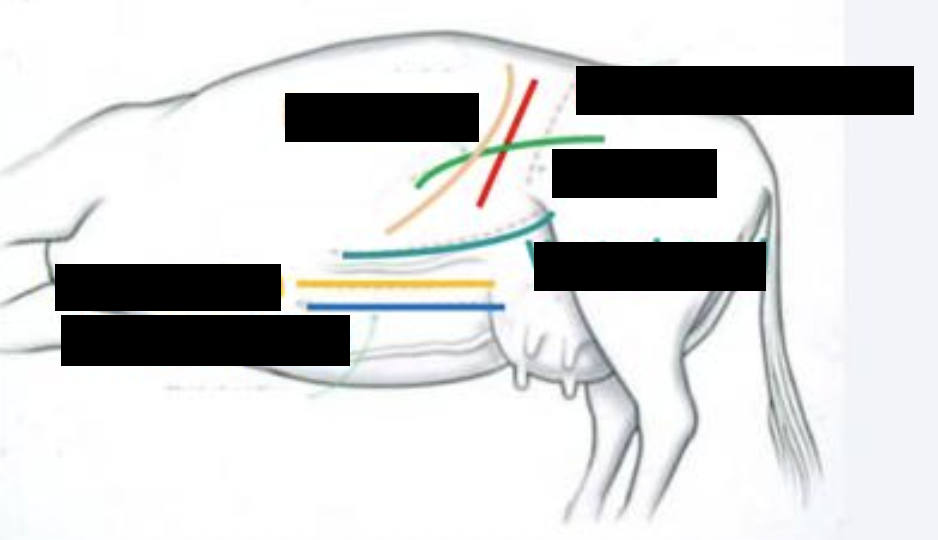
what surgical approach is the green line?
oblique
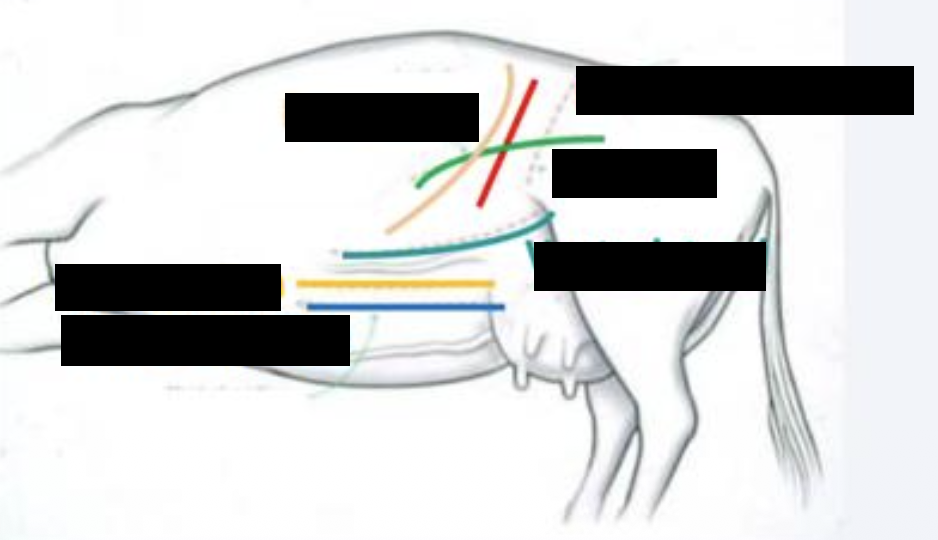
what surgical approach is the teal line?
ventrolateral
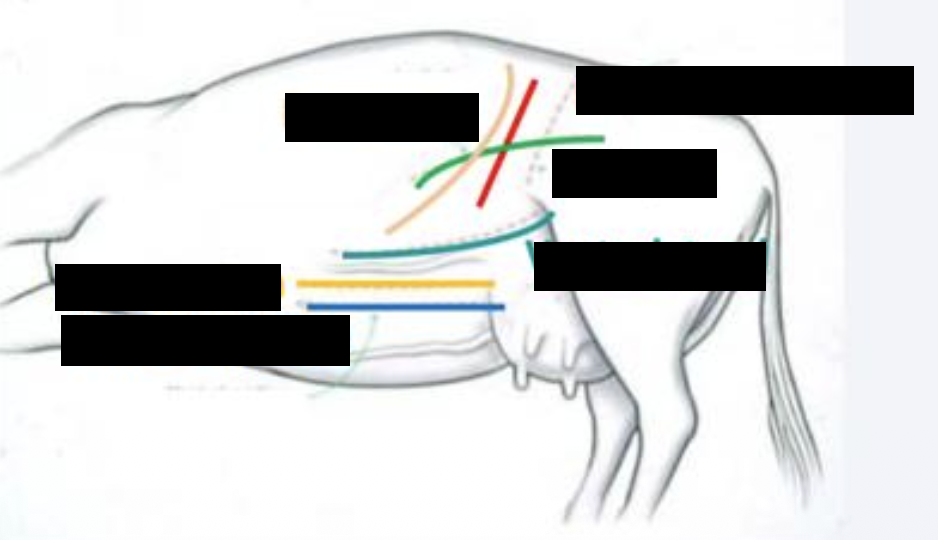
what surgical approach is the dark blue line?
ventral midline

what surgical approach is the yellow line?
paramedian

what surgical approach is the peach/tan line?
paracostal
MCQ: An exploratory laparotomy is performed on a cow with
metabolic alkalosis. What surgical approach is most
appropriate?
right paralumbar
what structures are on the left of the cow?
■ Rumen, reticulum
■ Spleen, left kidney, caudate lobe and gallbladder, diaphragm
■ Omental bursa contents
what structures are on the right of the cow?
■ Duodenum, pylorum, abomasum
■ Small intestine, caecum, colon
■ Kidneys, liver, gallbladder and diaphragm
how should you close the transverse abdominis and peritoneum to retain the intestines?
close ventral to dorsal
how long do sutures need to stay post-surgery in large animals?
2-3 weeks
what structure do you need to be aware of when doing a paramedian surgical approach in cattle?
milk veins
what order do you close the layers for a paramedian surgical approach?
rectus abdominis muscle
external rectus sheath
skin
what order do you close the layers for a ventral midline surgical approach?
linea alba
subcutaneous
skin
MCQ: An exploratory laparotomy is to be performed on a cow
with a suspected caecal dilation or torsion. What
surgical approach is most appropriate?
right paralumbar
how long before the procedure should you give antimicrobials pre-op in equine?
60 minutes
what antimicrobials do you give in equine before surgery?
aminoglycosides (gram +)
penicillin (gram -)
when do you remove a wound stent in equine after surgery?
12 hours