intro to cognition — exam 1
 Call Kai
 Learn
Learn Practice Test
 Spaced Repetition
 Match
Match Flashcards
 Knowt Play
1/203

Earn XP
Description and Tags
chapters 1-4 in the textbook + 2 lectures about study habits
Name | Mastery | Learn | Test | Matching | Spaced | Call with Kai | Chat |
|---|
No analytics yet
Send a link to your students to track their progress
204 Terms
how to best organize your time
1.) use a physical calendar
2.) put all claims of time in your calendar —> YOU put dates in your calendar! do NOT rely on others!
3.) break down tasks into smaller/more managable pieces
why is learning so hard for students?
1.) cognitive responsibility expectations on students increase over time (material gets harder, you have to study more, use your brain more, etc)
2.) studying is an invisible curriculum (it is never explicitly laught)
3.) most students use inefficient study strategies
planning fallacy
extreme disconnect/overconfidence in how long you have to complete a task
you assume faults/obstacles won’t happen, but in actuality, the likelihood of obstacles when studying is pretty high
how do you overcome the planning fallacy?
double your planning time
(ex: if you think a task is going to take 20 minutes to complete, allocate 40 minutes to that task)
why should you plan by time rather than by task?
1.) you’ll be ahead of the game
2.) planning by time helps with procrastination (planning by time makes work habitual rather than a choice)
what’s the purpose of taking notes?
to help memorize information and return to the state of mind you were in when you took those notes originally
if you want good notes…
write down what you’re thinking, NOT what the professor is saying verbatim
transfer-appropriate processing
“recall is best when the mental operations used during learning match the operations required during a test or real-world use”
you remember better when you replicate the state you were in when initially learning the material
in the 1960s, researchers had subjects either
1.) memorize the minerals when they were randomly organized
2.) memorize the minerals when they were organized by type
what did the results prove?
organized notes lead to better understanding of material
why take organized notes?
1.) organized notes help you remember material better
2.) memory loves meaning → the process of organizing your notes not only creates meaning but it is studying
why are hierarchical notes more effective than linear notes?
hierarchical notes naturally create meaning and make it easier to draw conclusions from the material
after you take notes, what should you do?
reorganize them
why star key conclusions?
1.) key conclusions should have most information on that subject matter relate back to it
2.) good professors make key conclusions asy to decipher
Glenburg et al Study:
subjects at UW-Madison were asked to read and point out the errors. they were more likely to find spelling/grammar errors within a sentence rather than find information that directly contradicted what they just learned.
what does this show?
students tend to comprehend by sentence, rather than across paragraphs
how do you solve the issue of comprehending by sentence rather than across paragraphs?
1.) preview the text, then at the end of each section look away and try to explain the material
2.) take away the expectation that the reading is going to be enjoyable. it’s hard!
3.) note that when taking notes from a reading, laptops are fine because you can edit the information a lot easier
are people paying less attention nowadays than before?
not necessarily; rather, people are less willing to pay attention now
people’s threshold for boredom is now decreasing over time
how do you best avoid distraction?
in a distraction free space.
it’s much harder to will yourself to pay attention than it is to simply bar yourself from getting distracted in the first place
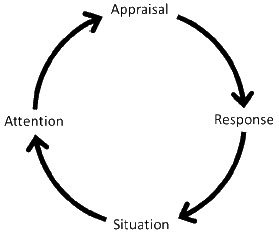
what does the self-control circle mean in the context of focusing?
getting back on task is harder as you move around the circle
putting yourself in a distraction free situation is the easiest way to help you focus
what does eliminating digital distractions mean?
put your phone in a different room
does this include music? kinda. music is a stimulant— it gives you energy but could also serve as a distraction
are kids responsible for their own learning as preschoolers?
no, they are taught explicitly. but, expectations for students increase over time
jogging study. what does it show?
1.) we should trick ourselves into starting a task
2.) we overestimate our own discomfort — things sometimes are easier than they seem
does wanting to learn have an impact on memory?
no
highlighting is stupid. why?
1.) you’re a beginner at this information. beginners don’t know what information is considered the most important yet
2.) highlighting doesn’t account for relationships between information
study where subjects are assigned words and decide whether they are pleasant/not, or have an A/Q in them. the results were about the same. what does this prove?
wanting to learn has little impact on actual retaining of information
if you don’t remember what you intend to, then how/what do you actually remember?
memory is the residue of thought. so, repeating certainly helps
study where subjects must remember an all caps word. subjects were split into two groups. one group was given a hint related to the word within the context of the original sentence (ex: heavy —> piano falling down stairs), and the other was given a hint just related to the word (ex: music —> piano falling down the stairs). subjects were 3x more likely to remember the word/get it correct if the hint matched the context of the sentence. what does this show?
this proves memory loves meaning —> the cognitive process you are doing depends on your experience/the context
is repetition a guarantee of remembering something?
no. (ex: penny from class) repetition alone is not enough. you must repeat the meaning in order to remember better
spaced repetition
small chunks of studying repeated over a long period of time
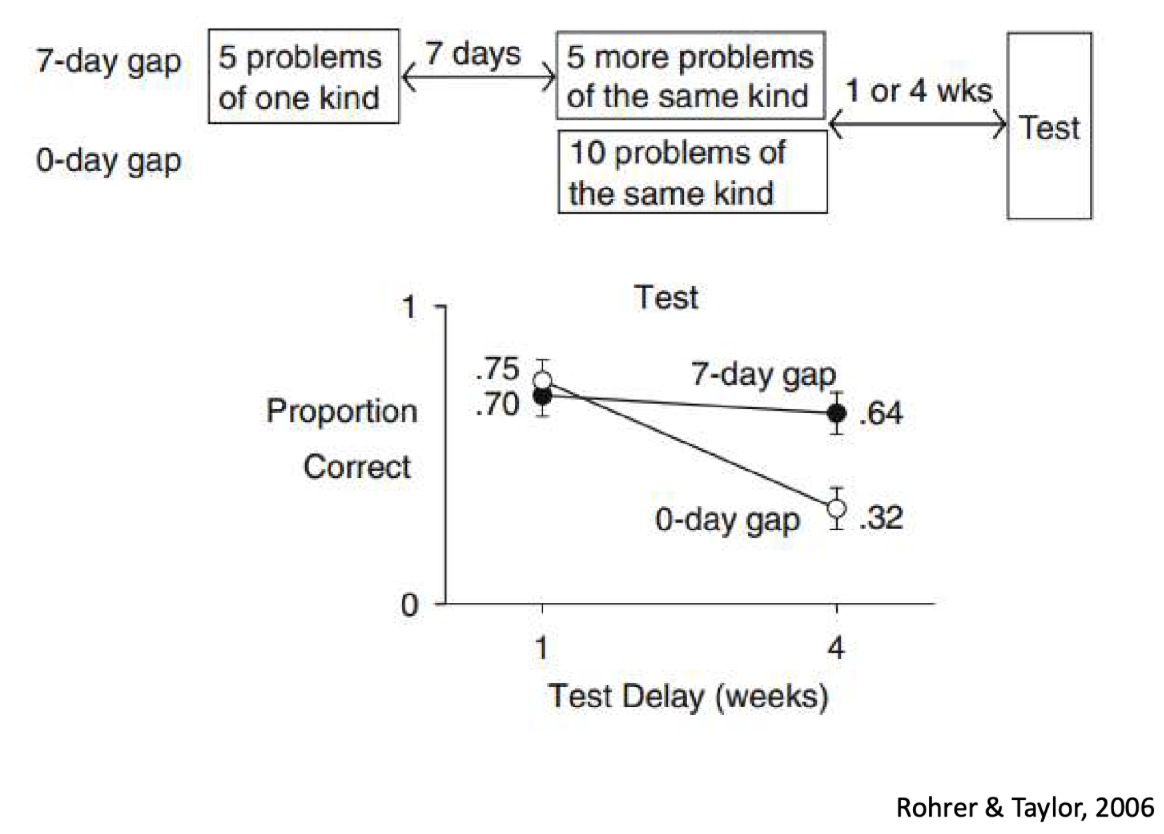
spacing gap vs test delay study. what does this mean?
when you distribute practice, your learning increases
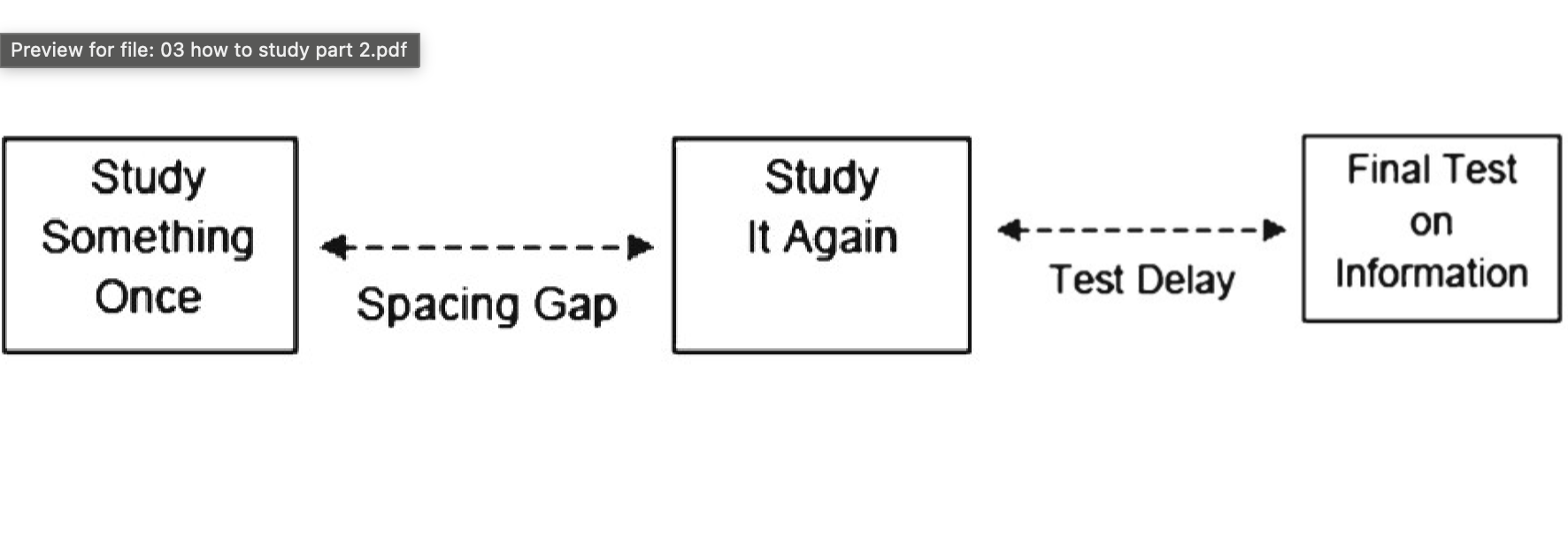
study: subjects either
1.) study → study some more → take a test
2.) study → take a test → take a test
what do the results show?
immediately there is no difference, but repeatedly taking a test is more helpful if you space out your studying
how information gets in
1.) memory is the residue of thought
2.) spaced repetition
3.) repetition, but of the meaning and deep thinking
4.) probing your memory (ie: taking tests) helps cement info
what to do when studying
1.) think about the meaning (deep processing = mind maps of the info
2.) spaced repetition
3.) self-test
how to study for exam based classes
1.) flashcards
2.) develop your own study guide
3.) notice details
how to study for essay tests
1.) generate essay questions you might be asked
2.) answer these questions in bullet points with examples
how to study for problem based exams
solve the problem, but self-explain (at each step, explain what the right move is)
how to know when you can stop studying
study time is influenced by your perception of what you know. it’s better to be more prepared and think you don’t know enough. study more than you think!!
toilet study:
subjects put a check mark next to object they think they can explain its function. result?
overconfidence in knowledge
why is the feeling of knowing unreliable?
1.) people make judgments based on familiarity (just because you know of something doesn’t mean you actually know it for real) rather than recollection (recollection actually leads to a deeper understanding)
2.) partial access
3.) feeling of knowing is derived at the wrong time
familiarity
knowing you have seen a stimulus, but having little other information
recollection
richer associations with the stimulus/target
study on the effect of familiarity: subjects see either addition or multiplication & must decide whether to answer immediately or wait
subjects get the answer wrong when they see the same equation twice but with a different operand
what does this show?
people confuse familiarity with recollection
partial access
you know some, or even a lot, of the information, so you falsely assume you must know everything
study: subjects are asked difficult trivia questions, if they don’t know the answer, they make a feeling of knowing judgment
(ex: who choreographed swan lake?)
what does this demonstrate?
how common partial access is
criterion of knowing
1.) i know it if someone else is explains it
2.) i can explain it
3.) i can apply it to new contexts
considerations when evaluating your own knowledge of the material:
1.) make sure you know the criterion for knowledge for that class
2.) don’t look at your materials for 30 min before taking a practice test
3.) practice tests are not a good guide for whether or not you know the content
4.) 20% of the studying should be done after you know the content cold
the goal of cognitive psychology
account for human behavior and perhaps predict it
was psych part of the scientific revolution?
no. concerns about religion inhibited studying the mind
when was the start of the study of the mind scientifically?
1879
so late b/c studying the mind means that perhaps the mind is material rather than theological
when was introspectionism?
around 1879-1913 (late 19th-early 20th century)
what made it less dangerous to study the mind?
darwin’s “the origin of the species” (1859)
who led to introspectionism?
fechner
how did fechner study the mind?
he would increase the intensity of a stimulus, and then measure how the force/intensity was perceived
what kind of relationship and impact did fechner’s studies show?
1.) studies showed a reliable, logarithmic relationship between intensity & perception
2.) impact: showed an objective relationship between tangible things and what is happening in the mind
both of these made it easier to understand the relationship between the mind and reality
who is the founder of introspectionism? and the inventor of experimental psychology?
wilhelm wundt
were wundt/introspectionist’s research valid?
wundt built the infrastructure for the field of psychology (research labs, phd students, etc), but his research was mainly bs — same with most introspectionists
what were introspectionists interested in studying?
1.) wundt applied the scientific method to thought
2.) introspectionists were interested in studying human consciousness
problems with introspectionism
1.) data is inherently inconclusive (imageless thought controversy)
2.) poor reliability between subjects
3.) the fact that you’re trying to be introspective is not the same as a concrete mental process
imageless thought controversy
do thoughts occur with or without sensory images? how do we even interpret subject’s subjective report?
what came after introspectionism?
behaviorism (started by john watson in 1913)
dominated western psychology from 1913-late 1950s
three tenets of behaviorism
1.) introspectionism isn’t working because private thoughts are not observable — make science observable and objective
2.) theory should be parsimonious (simple)
3.) break fields down into irreducible concepts (ex: bio→cell, chem→elements), for psych this is behavior
pavlovian experiment
if: unconditioned stimulus (food) → unconditioned response (salivation)
then: conditioned stimulus (bell) → unconditioned stimulus (food)
then: conditioned stimulus (bell) → conditioned respones (salivation)
what is the result of the pavlovian experiment? what is it an example of?
classical conditioning
problem with classical conditioning
building on something that already exists
operant conditioning
we can generate responses from subjects that lead to consequences
your behavior changes as a result of the consequences
you act first then you’re rewarded/punished
learning strength=what you originally did + reward error
results of operant conditioning
revolutionized animal training
research shows rewards have more of an impact than punishments do
classical vs operant conditioning
classical conditioning pairs an involuntary reflex with a neutral stimulus, while operant conditioning pairs a voluntary behavior with consequences like reinforcement or punishment
problems with behaviorism:
1.) behaviorists studied on animals not humans… and their studies were… something!!
2.) issues