Aggression
 Studied by 0 people
 Call with Kai
 Learn
Learn Practice Test
 Spaced Repetition
 Match
Match Flashcards
 Knowt Play
1/106

There's no tags or description
Looks like no tags are added yet.
Name | Mastery | Learn | Test | Matching | Spaced | Call with Kai |
|---|
No study sessions yet.
107 Terms
define aggression:
qggression is any form of behaviour that is intended to harm or injure another living being who is motivated to avoid such treatment
(Baron & Richardson, 1994)
what are three defining features of aggression?
- the aggressor must intend to harm or injure another person
- the aggressor must have awareness of the adverse effects of the behaviour
- the target of the aggression must want to avoid the harm
the aggressor must intend to harm or injure another person:
example
aggression → shot fired from a gun but misses its target
not aggression → dentist causes pain whilst trying to treat a patient
the aggressor must have awareness of the adverse effects of the behaviour: example
- if someone lacks the cognitive capacity to know that their actions are going to cause harm, their actions can't be called aggressive.
e.g. someone is drink driving → this isn’t classed as aggressive as carelessness or incompetence doesn't reflect on the intention to harm
the target of the aggression must want to avoid the harm: example
e.g. BDSM doesn't count when asked form
violence & aggression
violence and aggression are very much interlinked.
though they're related they are also conceptually distinct
define violence:
violence is carried out with the intention / threat of causing serious physical harm.
it involves the threat of or the use of actual physical force
how does aggression differ from violence specifically?
aggression doesn't necessarily involve the threat of use of physical force. screaming at someone without threatening to physically harm them is aggressive.
- all acts of violence are aggression
- not all instances of aggression are violence (e.g. shouting at someone is aggressive not violent)
examples of human aggression include…
- shouting
- gossiping
- road rage
examples of human aggression that are more likely to include physical attacks are…
- terrorism
- child abuse
- domestic violence
- football hooliganism
what are the two types of aggression?
- hostile aggression
- instrumental aggression
what is hostile aggression?
aggressive behaviour that is motivated by the an overwhelming, uncontrollable desire to express anger and hostile feelings towards someone that has angered you in the moment
what is the motivation behind hostile aggression?
to harm the target and release pent-up anger
what is instrumental aggression?
aggressive behaviour that is carried out to reach some kind of goal (as a means to an end).
aggression is a side effect of attempting to reach the goal, the actions aren't motivated by violence itself.
what is the motive behind instrumental aggression?
to reach a goal (harm is a side effect)
what is an example of instrumental aggression?
terrorism - the goal isn't to harm the victim but to reach a goal, e.g. forcing the Government into a particular action
what is a complication with measuring aggression in the lab?
there are many ethical issues, e.g….
- it wouldn't be appropriate to induce high states of aggression in a participant
→ it could make them a risk to the experimenter, or even cause them to leave the lab and be a risk to themself or others in the public
limitation with measuring aggression in the lab:
it would be unethical to set up an experiment in which participants are
(1) put into a very high state of aggression and
(2) are allowed to inflict genuine harm on another person or themselves
what are the methods of measuring aggression both inside and outside the lab?
1) experiments that use 'trivial', non-serious acts of harm
2) archival data
what are experiments that use 'trivial', non-serious acts of harm?
they allow participants to do things that lead to non-permanent harm (use aversive stimuli)
how could you investigate whether violent video games lead to more aggressive or violent behaviour using trivial harm?
randomly assign participants to one of two conditions
1) a game with relatively low levels of violence (e.g. Mario kart)
2) a violent video game (e.g. Carmageddon)
after playing for a set amount of time, (e.g. 30 minutes), you could then ask participants to deliver safe but aversive stimuli to another person
for example, time trials where 2 people who have taken part in different conditions take part in a reaction time test, the one who hits the buzzer first wins.
→ (the game would be rigged so that 50% of the time, the ppt from condition 1 wins and 50% of the time, the ppt from condition 2 wins)
whoever won would be told they must punish the other person
- e.g. loser has an aversive stimuli like a baby crying blasted into their ears when using headphones
- the winner would be allowed to choose the intensity (volume) and duration of this punishment
→ the winner would be told that they are allowed to choose volume from a scale from 1 - 10, but that levels 9 and 10 could cause permanent hearing damage (a lie)
what are the typical results of an investigation into whether violent video games lead to more aggressive or violent behaviour (using trivial harm)?
it is generally found that those who play the violent video games are significantly more likely to choose higher volume ratings and punish the loser in a more severe way than those who played the non-violent games
how is aggression usually measured in experiments that use aversive stimuli?
the extent to which participants deliver aversive stimuli to another person - the willingness to inflict nastier experiences than necessary is taken as a measure of aggression
what types of aversive stimuli can be used?
- electric shocks (mild vs moderate vs severe)
- ice bucket (intensity through duration)
- spicy sauce paradigm (prepare a drink for the loser, amount of spicy sauce is the DV)
- quiet obnoxious noise vs loud obnoxious noise
limitation of using aversive stimuli:
lack realism / ecological validity
aversive stimuli - lack realism / ecological validity
though those who have consumed more violent media are more likely to inflict more extreme punishments, this only tells us that they:
a) behave aggressively immediately after playing a violent game
b) behave aggressively on an abstract task where they are given direct power over a loser
this is different than saying that these games cause aggression
strengths of experiments using aversive stimuli:
we know that people who have been most aggressive outside of a lab (criminals, people who have been in trouble for violent offences, people who have anger management issues) do score more highly on lab measures
→ indicates good construct validity
what is archival data?
data that has been collected by an organisation (charities, police, home office) and is available to the public through websites.
what can archival data measure?
- the frequency of violence and aggressive acts
- the types of violent crime by area
what does archival data allow us to look at?
how aggression changes over time and how it changes by region → from this we can calculate the incidence of particular forms of aggression
what types of aggression does archival data allow us to get insight into?
- intimate partner violence (domestic violence)
- child sexual abuse
- murder
- grievous bodily harm
- hate crimes
what can be done with archival data about incidence?
correlations can be run and patterns in the data can be discovered
problems with archival data:
- not always in the right format
- set up by external, non-research agencies, can be limited
- archival data does not explain why things occur
what are the issues with archival data not explaining why things occur?
for example, archival data tells us that domestic violence is highest around Christmas and New Year. Why?
archival does not explain why things occur, but hypotheses can be formed (e.g. increased financial stress, increased contact, excess alcohol consumption)
with these hypotheses, researchers can think about different ways to design studies and investigate hypotheses further
what is the main split for theories of aggression?
- biological approaches
- psychological approaches
what are the biological explanations of aggression?
- the genetic explanation
- the hormonal explanation
what is behaviour geneticists?
behavioural genetics is a subsection of biology that asks to what extent is our behaviour determined by our genes
(in the context of aggression the question could be: to what extent do our genes lead us to behave aggressively)
what evidence from nature suggests that aggression is caused by genetics?
- certain dogs are naturally more aggressive than others
- certain breeds of dog have been bred for aggression → there may be a series of genes underpinning violent or aggressive behaviour
Lagerspetz (1979) - Mice Aggression
took normal mice and bred the most aggressive ones together and the least aggressive ones together
twenty-six generations later, she had one set of 'fierce' mice and on set of 'placid' mice.
- the 'fierce' set of mice were called warrior mice and were so aggressive that they had to be kept separately as they'd engage in fighting, even to the point of killing each other
Huesmann et al, 2003 - child aggression
a child who is non-aggressive at the age of 8 is significantly less likely to be aggressive at age 48 than a child who us aggressive at 8
how are twin studies used to determine the role of genetics in aggression?
If identical twins have significantly more similar levels of aggression than non-identical twins, this could be taken as evidence for the role of genes
how are adoption studies used to determine the role of genetics in aggression?
in adoption studies, levels of aggression are compared between the adopted person and the biological and adopted parents
- If the level of aggression between the adopted person and their biological parents (e.g. genetics) is more similar than the level of aggression between the adopted person and their non-biological parents (e.g. environment), this is evidence for the role of genes
Rhee and Waldman's (2002) - twin & adoption studies & aggression
Rhee and Waldman's (2002) meta-analysis of twin and adoption studies found that…
- genes explain 41% of the variance, but the environment explains 59%
what is the hormonal explanation of aggression?
testosterone appears to be linked to violence.
males are much more likely to engage in physical violence than women, which has led researchers to focus on the male sex hormone testosterone as a possible cause of aggression
male criminal statistics:
- 99% of convicted rapists are male
- 95% of murderers are male
- 92% of people arrested for burglary are male
- 87% of people arrested for aggravated assault are male
men as victims of crime:
men are also overwhelmingly the victims of crime.
men are 20x more likely to kill other men than women (Daly & Wilson, 1998)
do the statistics of male crime directly prove the hormonal explanation?
no, his is all correlational, other factors such as cultural reasons and ideas about how to be a man could contribute
do women produce testosterone?
though both men and women produce testosterone, men produce larger quantities of it
real world evidence in support of the hormone explanation:
If men take more testosterone, they're more likely to engage in violent or aggressive acts.
the peak age of murderers tends to be the mid-twenties, the likelihood of a man committing a murder tends to decrease with age, alongside the decrease in production of testosterone
Archer, Buring and Wu (1988) - findings about testosterone
Highly aggressive men have higher levels of testosterone
Dabbs et al, 2001 - findings about criminals and testosterone
when looking at prisoners, men who have committed a crime, irrespective of whether it was planned or unplanned tend to have higher levels of testosterone
Klinesmith, Kasser and McAndrew (2006) - Hormone Influences and the Weapons Effect
Klinesmith, Kasser and McAndrew (2006) measured male participants' testosterone levels (by taking a saliva swab)
Participants were then randomly assigned to one of two conditions
- Condition 1: participants were asked to handle a gun for 15 minutes
- Condition 2: participants were asked to handle a child's toy for 15 minutes (mouse trap game)
Men were then told to make a drink for another participant and to add as much hot sauce as they wanted. Their testosterone levels were measured again
Klinesmith, Kasser and McAndrew (2006) - Hormone Influences and the Weapons Effect
(RESULTS)
1) Men who handled the gun added significantly more hot sauce to the water (13.61g) than those who interacted with the children's toy (4.23g)
1) Men who handled the gun had significantly higher levels of testosterone than they had at the start of the experiment (62.05 pg/ml more testosterone)
Take home message: just being exposed to an aggressive cue can increase testosterone and make people more aggressive. Finding that people behave in a more aggressive way when cued by a violent cue is the weapon effect.
what do psychological approaches to aggression focus on?
affective and cognitive reactions to aggression-eliciting stimuli
what are the psychological explanations for aggression?
1) frustration-aggression hypothesis
2) excitation transfer model
who thought of the frustration-aggression hypothesis?
it was initially put forward by Freud (1971) & then in other guises by later researchers (Dollard, Doob, Miller, Mowrer & Sears (1939), Miller (1941)
what does the frustration-aggression hypothesis propose?
- this theory argues that people are like pressure cookers: as we go through the world, events frustrate us and frustration builds and builds relentlessly unless its released → this leads to an outburst
- the theory argues that all frustration leads to aggression
- according to the theory, whenever we feel frustrated, we're more likely to aggress
what are the three main parts of the frustration-aggression hypothesis?
1) all frustration leads to aggression. all aggression comes from frustration.
2) frustration is caused by a blockage of a goal-directed activity.
3) aggression is driven by a goal to overcome / neutralise the feeling of aggression. this is called catharsis
what happens when we engage in aggression according to the frustration-aggression hypothesis?
by engaging in aggression, we reach a neutral state, this neutralisation is called catharsis
Bushman, 2002 - evidence about the result of engaging in aggression
[PART 1]
participants were asked to write an essay, (e.g. about their stance on abortion) the essay was then given to and graded by another student in a different room (the student actually didn't exist)
- shortly later, the experimenter would bring the essays back with comments ostensibly made by the other participant.
- all of the participants received bad evaluations, consisting of negative ratings on organisation, originality, writings style, clarity of expression, persuasiveness of arguments, and overall quality
- a note stating "This is one of the worst essays I have ever read" was also included
Bushman, 2002 - evidence about the result of engaging in aggression
[PART 2]
all of the participants felt angered
- some were allowed to vent anger: hit pillows or a punching bag or shout.
- another group were told to sit quietly for 2 minutes.
after this the participants were asked to fill out a scale that measured how angry they currently felt
- the venting group actually had increased anger levels and increased subsequent aggressive behaviour
what does Bushman’s research suggest about the idea of aggression leading to catharsis?
research shows that doing nothing (sitting quietly) is actually more effective in reducing anger than venting
- this means there is little evidence of venting leading to catharsis.
what does the excitation transfer model/ theory build on?
Schachter and Singer's two-factor theory of emotion
what does the excitation transfer model/ theory propose?
emotion is seen as dependent on (1) physiological arousal and (2) cognitive label
example of how cognitive labels can differ with the same physiological state:
the physiological sensations before bungee jumping and before taking an exam (heart racing, butterflies, sweating) are the same, however they would likely be labelled differently - excitement vs fear
- sometimes, depending on context, the exact same physiological sensations are given very different cognitive labels → researchers have speculated that these labels change the way these sensations are experienced
what does Schachter's theory state about emotion?
according to Schachter's (1964) theory of emotion, our emotional state depends upon attributing cognitive labels to our emotions
what does the excitation transfer theory state? (zillman, 1978)
if a person is already highly physiologically aroused there's a risk that they will misattribute their already high physiological responses, their feelings will be magnified and their feelings will be interpreted as evidence of anger → this will increase the probability of aggression /
increased physiological arousal can lead to an increase in aggression if someone encounters an anger-eliciting stimulus
situations that could make a person highly physiologically aroused:
just been for a run, just been to the gym
what happens once anger-eliciting stimuli has been experienced?
there are two pathways…
1) if there is conscious awareness that the anger and arousal is due to the previous event that heightened physical arousal, then you can stay calm and acknowledge that the stimulus isn't responsible for your feelings
2) if you've forgotten the previous event, then you will misattribute your heightened physiological arousal and be much more likely to aggress
excitation transfer theory in other terms:
when physiological arousal from a neutral activity is still present, when a person encounters an anger-eliciting situation, the earlier arousal (excitation) is transferred onto the anger-related arousal and falsely attributed as anger → this leads to an increase in the likelihood that the individual will behave aggressively
real life example of excitation transfer theory:
aggression on a football pitch → if a football player just sprinted across a pitch and was tackled unfairly and fell, the anger related arousal based on the foul could be magnified by the physiological arousal left over from the sprint and cause the footballer to lash out
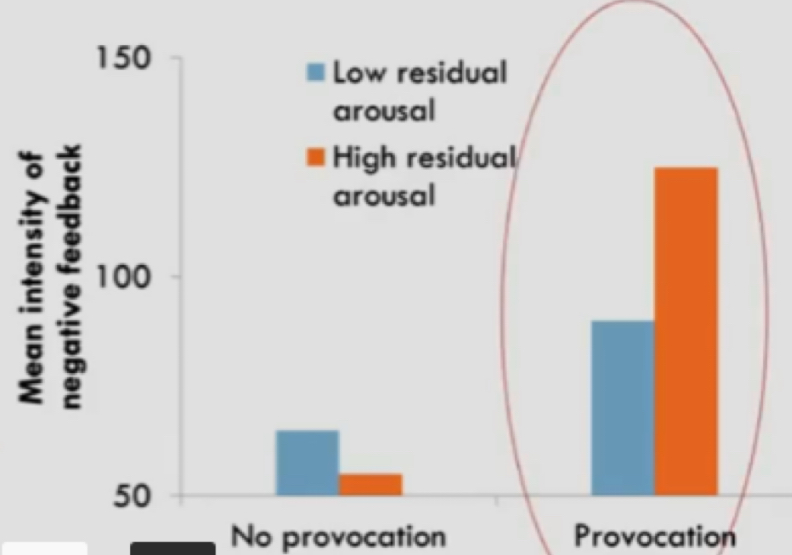
Zilman & Bryant (1974) - empirical evidence of the excitation transfer theory:
participants were split into 2 conditions:
- condition 1: participants had to perform a physically non-arousing task (threading CDs on a wire)
- condition 2: participants had to perform an arousing task (pedal a bike as fast as possible for a minute)
two minutes later all participants were provoked with an aversive noise, that was claimed to have come from another participant
six minutes later, the participants were given the opportunity to administer blasts of loud noise to the person who had supposedly made the loud aversive noise.
RESULTS:
participants in the arousal condition administered louder noise blasts than those in the non-arousal condition
violent behaviour in…
in and around pubs and clubs presents a significant public health problem (Smith and Allen, 2004)
when is the peak time and what is the peak location for violence?
research consistently shows that the peak time for violent offending is weekend nights and the peak location is in and around pubs and clubs (Allen et al, 2003)
which injuries usually result from violence around pubs and clubs?
research consistently shows that the peak time for violent offending is weekend nights and the peak location is in and around pubs and clubs (Allen et al, 2003)
what do most incidents of violence around pubs and clubs involve?
most incidents involve drinking by the offender, victim, or both (Murdoch at al, 1990)
which factors that contribute to aggression in and around pub & club environments?
- alcohol
- misogynistic music
- high temperature
what effect does alcohol have on aggressive behaviour?
(simple)
- alcohol plays an important role in aggressive behaviour.
- approximately, 80% of people who were arrested for violent crimes had been drinking alcohol before committing their crimes. (Murdoch, Phil & Ross, 1990)
what are the issues of concluding that alcohol leads to aggression based on this sort of information (statistics)?
it's only a correlation and doesn't tell us about causality, e.g.
- aggressive people may just be more attractive to alcohol
- there could be a third variable (e.g. difficulties in life could cause people to be more likely to turn to alcohol and to also generally be more aggressive)
experimental test of the alcohol-aggression link:
(METHODOLOGY)
METHODOLOGY:
randomly allocated participants to…
- An alcohol condition
- A non-alcohol condition (placebo)
and compare the delivery of aversive stimuli
after this, the two groups of participants are given the chance to compete in a task like a reaction speed task → this is rigged so that the real participant appears to win
- the winner is given the chance to punish the loser by delivering aversive stimuli (e.g. loud stimuli, hot drinks, electric shock)
- the aggression of the participants' responses are then compared across the two conditions
experimental test of the alcohol-aggression link:
(RESULTS)
there is a causal link between alcohol intake and aggression
- meta-analytic reviews support alcohol as a significant predictor of aggressive behaviour with moderate effect sizes (Foran & O'Leary, 2008; Bushman & Cooper, 1960)
why is a placebo used?
[simple]
we control for psychological effects by providing fake alcohol
why is a placebo used?
[detailed]
many of us hold expectancy beliefs about alcohol based on our previous experiences with alcohol and with what we know about it.
- these beliefs can be positive (e.g. alcohol gives a buzz, relaxes them or helps them to express themselves more)
- these beliefs can be negative (e.g. alcohol gives them a hangover, makes them more obnoxious or rude, alcohol makes them more aggressive)
Because of this, there are two ways that alcohol can affect behaviour…
1) Pharmacologically
2) Psychological
how does alcohol affect people pharmacologically?
ethanol affects the brain
how does alcohol affect people psychologically?
depending on people's expectations of alcohol, they may behave in certain ways if they believe that they have drunk it
do most participants realise that a placebo has been used?
- in this condition, around 70% of participants don't notice the placebo, they also report feeling drunk
- even when told afterwards that this was a placebo, they are surprised
limitations of experiments with provide evidence for the alcohol-aggression link:
there are major individual differences…
- the alcohol-aggression link is highest for people who show high levels of dispositional aggressivity, irritability, hostile rumination style (people prone to angry thinking patterns)
- AND / OR low levels of anger control, self-control, empathy and executive cognition functioning
(Krahw 2003)
what is the mechanism of alcohol?
the ethanol in alcohol binds to a common brain receptor - GABA
→ this slows down the communication between different neurones in the brain by altering how easily different ions can move into and change certain cells
what does alcohol lead to psychologically?
alcohol keeps us present in the moment, but leads to alcohol myopia
define alcohol myopia:
a narrowing of cognitive or intellectual focus
what does alcohol myopia do?
(detailed)
- people become mentally / cognitively short sighted and can only pay attention to what's happening in the moment → they lack anticipatory regret.
in other words, people's cognitive capacity to process and think about the long term consequences of their actions is impeded
drunk people tend to only be sensitive to the most immediate or salient environmental cues
what does alcohol myopia do in short?
- decreases self-regulation
- reduces anticipatory regret
- increases reactivity
- increases sensitivity to immediate environmental cues
what does alcohol prevent?
a comprehensive appraisal of situational cues
this means that intoxicated people are more likely to misinterpret what someone is saying or respond aggressively to provocation
Fischer & Greitemeyer (2006) - effects of misogynistic music on behaviour
(METHOLDOLOGY)
Fischer & Greitemeyer (2006) wanted to see if music makes people more aggressive
male and female participants were recruited to take part in two, apparently unrelated studies about market research and people's preferences
in study 1, participants were randomly allocated to either a misogynistic, aggressive song (Eminem's Superman) or a neutral song of the same style (Bon Jovi's It's my life) - 50% in each condition
After listening, participants sat in a room with the experimenter. Participants were asked to rate the song on different dimensions (lyrics, style etc) → this data wasn't the purpose of the study.
Next, a confederate (fake participant) entered the room. Half the time, the confederate was male, half the time, the confederate was female.
The confederate explained that they were there for the next part of the study (to rate preferences for chilli sauce) and explained that they liked sweet but not hot chilli.
The confederate was then told to sit in a separate room and wait.
The experimenter then told the original participant that they could make a sauce for the confederate and that they could choose whether to add chilli or sweet as well as the amount of sauce.
They were also told that the participant would have to drink the whole of the other sample and then rate it. The experimenter then said that this would be done blind and left the room.
Fischer & Greitemeyer (2006) - effects of misogynistic music on behaviour
(RESULTS)
FINDINGS:
men who listened to misogynistic song lyrics acted more aggressively if the confederate was female than male
- female participants weren't any more aggressive to male or female participants when they heard the misogynistic song
- males who heard the misogynistic song added 10.43 grams more hot chilli sauce to female participants' drinks than males
it was also found that male participants showed more aggressive cognitions / thinking if they had heard Eminem rather than bon Jovi
on a word completion task…
- when given words with the beginning missing, e.g. -un, men who heard the misogynistic song were more likely to generate words like 'gun' than 'fun', this didn't occur with the neutral song
ISSUES: Fischer & Greitemeyer (2006) - effects of misogynistic music on behaviour
- we know nothing about the effects of long-term exposure to misogynistic music
the styles of song are quite different (rhythm, beat, pitch, artist)
- we can't be sure that the lyrics cause aggression, could be another aspect of the song
- Eminem and Bon Jovi are well known - perceptions of the artist could drive the effect
IMPROVEMENTS: Fischer & Greitemeyer (2006) - effects of misogynistic music on behaviour
How could the study be improved?
Find a relatively unknown artist and commission them to write a new song but sing it in two versions (no other changes)
- A neutral version
- A version with aggressive, misogynistic lyrics
Then if differences were found, this evidence would be more compelling!
what is the heat hypothesis?
aggression and heat are positively correlated (Anderson, 2001)
what are the two paradigms (approaches) to test the heat hypothesis under naturalistic conditions?
1) geographic regions approach
what is the geographic regions approach?
compares violent crime rates in hotter and cooler regions using archival data
(typically in same country or neighbouring countries)