Praxis Elementary Education: Science 5005
 Call Kai
 Learn
Learn Practice Test
 Spaced Repetition
 Match
Match Flashcards
 Knowt Play
1/37

There's no tags or description
Looks like no tags are added yet.
Name | Mastery | Learn | Test | Matching | Spaced | Call with Kai | Chat |
|---|
No analytics yet
Send a link to your students to track their progress
38 Terms
Crust
The thin, solid layer that we can see.
Mantle
A rock that behaves similarly to modeling clay.
Outer Core
Very hot liquid iron and nickle.
Inner Core
Very hot solid, mostly iron.
Crust can be either ______ or _________.
Oceanic & Continental
Nuclear Fusions
Two atomic nuclei combine to form a larger nucleus.
Convection Currents
When a portion of fluid is heated, causing it to expand and become less heated.
Convection currents can occur in both _______ and ________.
Liquid and gasses.
Mineral
Naturally occurring, inorganic solid.
Color
The color of the mineral.
Odor
The smell of the mineral.
Taste
The mineral’s taste.
Streak
The color of the mineral in powder form.
How is the streak of the mineral obtained?
Dragging a piece of the mineral across a piece of unglazed porcelain.
Luster
The ability to of the mineral's surface to reflect light.
What are the three luster types?
Metallic, submetallic, or nonmetallic.
Hardness
The mineral’s resistance to scratching; measured in the Mohs scale.
Cleavage
The pattern along which the mineral breaks.
Crystalline Structure
The degree to which the mineral is arranged in a crystal lattice structure; the more crystalline the mineral is, the harder that lattice is to see with the naked eye.
Diaphaneity
The transparency of the mineral or the ability of light to pass through it.
Tenacity
The mineral's ability to resist separation or breaking when subjected to stress.
Magnetism
The response of a mineral when exposed to magnetic materials.
An accumulation of one or more minerals is a ____.
Rock
Igneous
Forms when magma cools; properties vary greatly based on how long the substance takes to cool.
Examples: Granite, Obsidian, Basalt, Pumice, and Porphyry.
Sedimentary
Forms when sediments like clay build up and become cemented together. Due to their formation, they are layered and grainy.
Examples: Sandstone, Limestone, Shale, Chalk, Anthracite, and Siltstone.
Metamorphic
Form when igneous or sedimentary rock gets pulled toward the mantle and is subjected to heat and pressure.
Examples: Slate, Schist, Gneiss, Jadeite, and Marble.
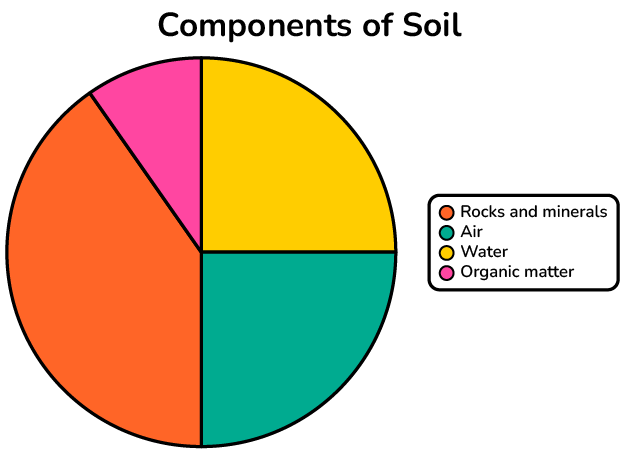
Soil
Upper portion of Earth’s surface; formed by weathering of rocks. The weathering process takes years—thousands of them—but can be sped up by some organisms (like lichens).
What are the four main components of minerals?
I. Rocks and Minerals
II. Water
III. Air (different gasses)
IV. Organic Material (including living and dead organisms).
Constructive Process
Add new land to the surface of the Earth.
Desctructive Process
Break down or destroy landforms.
the constructive process creates:
volcanoes, deposition, and mountain building.
The destructive process creates
Weathering and erosion.
Weathering
A destructive process that wears away rocks and creates soil.
Mechanical Weathering
Where physical forces break rocks down into smaller pieces without changing their chemical structure.
Chemical Weathering
Where chemical reactions occur and force rocks to break down into smaller pieces.
Convergent Boundary
Two plates move toward each other and create crust at divergent boundaries.
Destructive Boundary
Two plates move away from each other and destroy crust at convergent boundaries.