MCB 2000 CH 3: Amino Acids
 Call Kai
 Learn
Learn Practice Test
 Spaced Repetition
 Match
Match Flashcards
 Knowt Play
1/48

There's no tags or description
Looks like no tags are added yet.
Name | Mastery | Learn | Test | Matching | Spaced | Call with Kai | Chat |
|---|
No analytics yet
Send a link to your students to track their progress
49 Terms
What are the 5 major components of an amino acid?
Amino group (NH2) = basic end
Carboxyl group (COOH) = acidic end
Alpha Carbon (α) = next to carboxyl group
Hydrogen
R group (side chain) = variable position
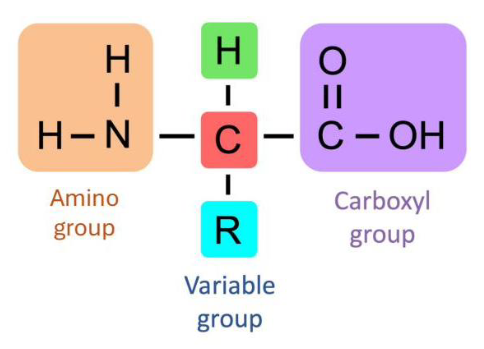
Amino acids are chiral: True/False
Which amino acid is the exception?
True
Glycine, R = H
What are the 2 isomers that amino acids exist in?
Which isomer is found in proteins?
L & D isomers = enantiomers
Only L isomers = found in proteins
What are the 4 major groups of amino acids + characteristics?
How many are there in each one?
What do the different groupings indicate?
Nonpolar → 9
Hydrophobic
Hydrocarbons → Neutral
Polar → 6
Hydrophilic
Neutral + H-bond
Positive → 3
(+) charge @ pH = 7
Negative → 2
(-) charge @ pH = 7
Groups = indicate side chain behavior @ pH = 7
Δ pH → Δ charge (sometimes)
What are the 3 major categories of amino acids that depend on your body?
How many of them are in each?
Essential amino acids = must come from food
9 → His Ile Leu Lys Met Phe Thr Trp Val
Nonessential amino acids = built from body’s cells
11 → Ala Arg Asn Asp Cys Gln Glu Gly Pro Ser Tyr
Conditionally essential amino acids = built from cells when pathway works (can be blocked)
2 → Phe → Tyr, Met → Cys
What are the pH values of stomach lumen, lysosome, and mitochondrial matrix?
Stomach Lumen → pH = 2
Lysosome → pH = 4.5
Mitochondrial matrix → pH = 8
How many amino acids carry a ring?
Which group(s) is/are they a part of?
Nonpolar = Phe Trp
Polar = Tyr
Positive = His
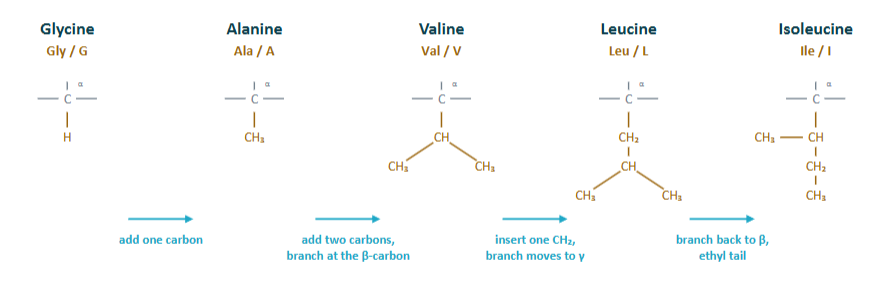
What are the 5 nonpolar amino acids with hydrocarbon side chains? Use 3-letter code + 1 letter abbreviations.
Draw them
Glycine → Gly/G
R = H
Alanine → Ala/A
R = CH3
Valine → Val/V
R = CH(CH3)2
Leucine → Leu/L
R = CH2CH(CH3)2
Isoleucine → Ile/I
R = CH(CH3)CH2CH3
What are the 2 amino acids with sulfur in side chains? Draw them.
What families are they part of?
What is their H-bonding ability + how do you know?
What important covalent crosslink can 1 of the 2 amino acids form?
Methionine → Met/M
Nonpolar
R = CH2CH2SCH3 = Thioether
NOT an H-bond donor (No H on Sulfur)
Cysteine → Cys/C
Polar
R = CH2SH = Thiol/Sulfhydryl
H on Sulfur → H-bond donor
Sulfur → H-bond acceptor (LPs on S)
Disulfide bridge = strong covalent bond b/w sulfur atoms of 2 cysteine amino acids
What is special to note about proline? Draw it.
What happens to the H-bonding ability of the amino group?
Proline → Pro/P
R = CH2CH2CH2
Loops back to covalently bond w/ backbond amino
Forms 5-membered ring → restricted rotation
Nitrogen of amino no longer donate H-bond (No free H)

What is collagen + its structure? What fits at crowded center?
What is the three amino-acid pattern in collagen?
Collagen = most abundant protein in body
Three chains → triple helix
Hydrogen
Gly - Pro - Y, Y = hydroxyproline
What is the importance of hydroxyproline in collagen peptide chain?
What element is necessary for the function of enzyme that forms hydroxyproline?
What vitamin ensures that element keeps working?
Enzyme adds hydroxy (-OH) group to proline after chain = built
Hydroxyproline → Locks helix → desired shape
Iron
Vitamin C = ensures iron stays working
What is scurvy + symptoms?
How does the absence of vitamin C affect the structure of collagen?
How many mg of vitamin C a day is enough to prevent it?
Scurvy = disease caused by severe lack of vitamin C (ascorbic acid) in diet
Bleeding gums
Loose teeth
Non-healing wounds
No vitamin C → no iron → no enzyme to add hydroxy group → no hydroxyproline
Collagen triple helix does not hold together @ body temperature → tissues unable to be held together
10 mg Vitamin C/day → prevents scurvy
What amino acid swap in collagen peptide pattern leads to osteogenesis imperfecta or brittle bone disease + why?
Glycine = smallest amino acid (R = H)
Replacement to bigger amino acid → triple helix cannot close → bones break easily
What are the 3 amino acids with aromatic rings in side chains? Draw them.
Identify:
Abbreviations
Group
Essentiality
Phenylalanine → Phe/F
Nonpolar
Essential
Tyrosine → Tyr/Y
Polar
Nonessential
Tryptophan → Trp/W
Nonpolar
Essential
Indole = largest side chain → resonance delocalization

What enzyme converts phenylalanine to tyrosine?
What is the name of the disorder that results when that enzyme is nonfunctional?
Phenylalanine hydroxylase = adds hydroxy (-OH) group to phenylalanine → tyrosine
Phenylketonuria = metabolic disorder → body CANNOT break down phenylalanine → toxic buildup in blood + brain
What amino acid is Tyrosine structurally similar to and how?
How does this affect polarity?
Tyrosine = Phenylalanine + hydroxyl
Tyrosine = polar
Phenylalanine = nonpolar

What are the 2 amino acids with hydroxyl groups? Draw them.
Serine → Ser/S
Polar neutral
Threonine → Thr/T
Polar neutral

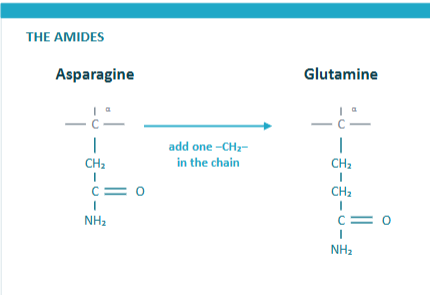
What are the 2 amino acids with amide groups? Draw them.
Why is the amide nitrogen of side chain NOT protonated @ pH = 7?
Amide = -CO-NR2 = carboxylic acid derivative
Asparagine → Asn/N
Polar neutral
Glutamine → Gln/Q
Polar neutral
Carbonyl = EWG → resonance → does NOT allow amide nitrogen to be protonated @ pH = 7
What are the 2 negative amino acids? Draw them.
What 2 other amino acids are they similar to?
Aspartate → Asp/D
Negative
Glutamate → Glu/E
Negative
Similar relationship to Asn and Gln → Difference of 1 CH2 in chain

What is the difference between aspartic or glutamic acid and aspartate or glutamate? What is the charge?
Aspartic acid/Glutamic acid = carboxylic acid form = neutral
Aspartate/Glutamate = carboxylate form = (-) charge
What amino acid is involved in MSG or umami flavor?
MSG = Monosodium Glutamate = sodium salt form of glutamic acid → umami flavor
What is glutamate’s role in central nervous system?
What barrier prevents the dietary glutamate out?
Glutamate = main excitatory neurotransmitter → must be tightly regulated to avoid neuroinflammation or oxidative stress
Blood-brain barrier = semi-permeable border of cells b/w circulating blood from brain & CNS extracellular fluid
What is aspartame?
Which amino acid(s) make up aspartame?
People with what condition must be weary of diet sodas with warnings of aspartame?
Aspartame = artificial, low-calorie sweetener = 200x sweeter than sugar
Dipeptide = aspartate + phenylalanine + CH3
PKU Phenylketonuria = phenylalanine buildup → neurological issues
What are the 3 positive amino acids? Draw them.
List important characteristics for each
Which amino acid has a guanidinium and an imidazole?
Lysine → Lys/K
R = 4 CH2 + NH3+
Arginine → Arg/R
3 CH2 + Guanidinium
Guanidium = holds (+) charge very tightly
Histidine → His/H
Imidazole = 5-membered ring w/ 2 N
*Partial charge @ pH = 7
1 N LP → resonance
1 N LP → protonated
What are the 4 questions to identify each amino acid?
Ring?
Phe = 1 ring
Tyr = 1 ring + OH
Trp = 2 fused rings
His = 5-membered ring + 2 N
Charge?
NH3+ → Lys
3 N on 1 carbon → Arg
-COO-
Short → Asp
Long → Glu
O, N, or S in side chain?
-OH → Ser or Thr
-SH → Cys
S in chain → Met
Amide
Short → Asn
Long → Gln
Only C and H?
Count #C’s → find branch
Gly, Ala, Val, Leu, Ile
Ring → backbone → Pro
What is the relationship between protonation state and actual charge? Same or different?
THEY ARE NOT THE SAME
Protonation state = protonated/deprotonated
Actual charge = depends on pKa of α-amino, α-carboxyl, and side chain
What is a zwitterion?
Why are most free amino acids zwitterions in body?
Zwitterion = molecule with both ± charge @ same time & net 0 charge
Neutral conditions, pH = 7:
α-amino (basic) → protonated → +1
α-carboxyl (acidic) → deprotonated -1
What is the net charge of free amino acid @ low pH? Why?
What is the net charge of free amino acid @ high pH? Why?
Low pH → ↑[H+]
α-amino (basic) → protonated → +1
α-carboxyl (acidic) → protonated → 0
Net charge = +1
High pH
α-amino (basic) → deprotonated → 0
α-carboxyl (acidic) → deprotonated → -1
Net charge = -1
![<p>Low pH → ↑[H<sup>+</sup>] </p><ul><li><p><strong>α-amino (basic)</strong> → protonated → +1</p></li><li><p><strong>α-carboxyl (acidic) </strong>→ protonated → 0</p></li><li><p><strong>Net charge</strong> = +1</p></li></ul><p>High pH</p><ul><li><p><strong>α-amino (basic)</strong> → deprotonated → 0</p></li><li><p><strong>α-carboxyl (acidic) </strong>→ deprotonated → -1</p></li><li><p><strong>Net charge</strong> = -1</p></li></ul><p></p>](https://assets.knowt.com/user-attachments/fc001df5-9360-4040-aae7-57f60cb307d2.png)
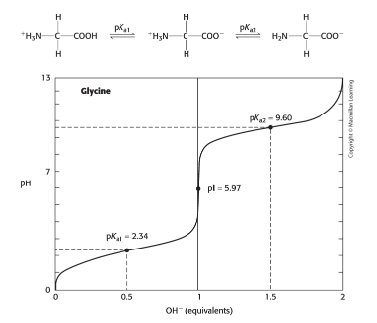
What is pKa?
How can you determine pKa on a titration curve? (3 steps)
Why are there flat regions on a titration curve?
pKa = pH @ which ½ molecules = deprotonated, ½ molecules = protonated
Find equivalence point → find sharp, vertical jump on graph & find total volume on x-axis
Half volume
Read pH following ½ volume on x-axis and pH on y-axis
Buffer regions = nearly flat section where pH changes very slowly despite more acid/base
Absorbs added ions → resistance = buffer
What is the pH and pKa rule?
pKa > pH by 1 or MORE → protonated
pKa = pKa → ½ charge
Acidic → -½
Basic → +½
pKa < pH by 1 or MORE → deprotonated
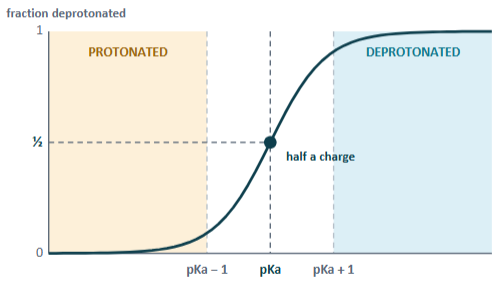
1 unit difference b/w pKa and pH is truly 1 unit away (True/False)
What is 1 unit and 2 units away equivalent to?
False → 1 unit away = 90/10, 2 units away 99/1
What is the alpha group and 4 amino acids that act as acid groups?
α-carboxyl
Aspartate (Asp)
R = -CH2-COOH
Glutamate (Glu)
R = -CH2-CH2-COOH
Cysteine (Cys)
R = -CH2-SH
Tyrosine (Tyr)
R = CH2-C6H4-OH
What is the alpha group and 3 amino acids that act as basic groups?
α-amino
Lysine (Lys)
R = -(CH2)4-NH2
Arginine (Arg)
R = -(CH2)3-NH-C(=NH)-NH2
Histidine (His)
R = -CH2-C3H3N2
What is the charge of deprotonated and protonated forms of acid groups?
What is the charge of deprotonated and protonated forms of basic groups?
ACIDS
Protonated → 0
Deprotonated → -1
BASES
Protonated → +1
Deprotonated → 0
What is the pKa of an α-amino and α-carboxyl groups of free amino acid?
α-amino (basic) → pKa = 9.5
α-carboxyl (acidic) → pKa = 2.2
What are the 3 steps to determine net charge?
List ionizable groups
pKa vs. pH
pKa > pH (by more than 1) → protonated
pKa = pH → +/- ½
pKa < pH (by more than 1) → deprotonated
Convert state to charge → add total
Free amino acid cannot be more than +2 or less than -2
What are the 4 acidic ionizable amino acids?
What are the protonated forms and charges?
Aspartate
-COOH
0
Glutamate
-COOH
0
Cysteine
-SH
0
Tyrosine
-OH
0
What are the 3 basic ionizable amino acids?
What are the protonated forms and charges?
Histidine
-Imidazole ring-H+
+1
Lysine
-NH3+
+1
Arginine
-Guanidine+
+1
What is special about net charge of histidine?
What is it’s pH?
Histidine = basic group = only side chain w/ pKa close to pH = 7
pKa = 6
Present @ active enzyme sites → easily protonated/deprotonated
What is pI?
What are the 2 cases used to calculate pI?
Which amino acid is the exception to case 2?
pI = Isoelectric point = pH where molecule has no net charge
Case 1: No ionizable side chain
pI = (2.2+9.5/2 = 5.85
Case 2: Ionizable side chain
pI = average of 2 alike-charged groups
Asp = (2.2+4.1)/2 = 3.15
Lys = (9.5+10/8)/2 = 10.15
Tyrosine → case 1 → pI = 5.85
What are the pKa values of the 7 ionizable side chains?
Asp
pKa = 4.1
Glu
pKa = 4.1
Cys
pKa = 8.3
Tyr
pKa = 10.9
His
pKa = 6.0
Lys
pKa = 10.8
Arg
pKa = 12.5
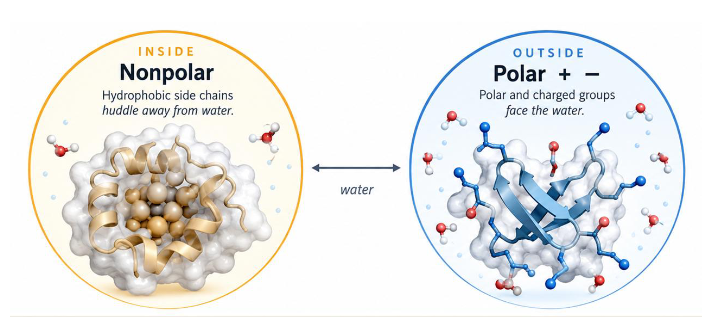
What is the folding rule in water?
What happens to nonpolar, polar, and charged groups?
Nonpolar/hydrophobic groups → inside
Polar/hydrophilic + charged groups → outside
What is the folding rule in lipid membrane?
What happens to nonpolar, polar, and charged groups?
Nonpolar/hydrophilic groups → out
Polar/hydrophilic + charged groups → in
How many amino acid side chains face the water?
Name them according to group + main roles
11 = 6 polar + 3 positive + 2 negative
Polar → -OH, -SH, or amide
Serine, Threonine, Cysteine, Tyrosine, Asparagine, Glutamine
Ser, Thr, Tyr → @ enzyme active sites
-OH → reactive to attack substrate
Positive
Lysine, Arginine, Histidine
TFs, histones
Bind nucleic acids (DNA Backbone = (-) charged)
Negative
Aspartate, Glutamate
Carboxylate groups → hold metal ions in place @ enzyme active sites
What is TRPV5?
What is the polarity of the top, middle, and bottom parts?
TRPV5 = transmembrane protein = ion channel
Top = polar = hydrophilic
Middle = nonpolar = hydrophobic
Bottom = polar = hydrophilic

What is p53?
What is the mutation that causes p53 to be nonfunctional?
How does the difference in properties of amino acids change p53 ability?
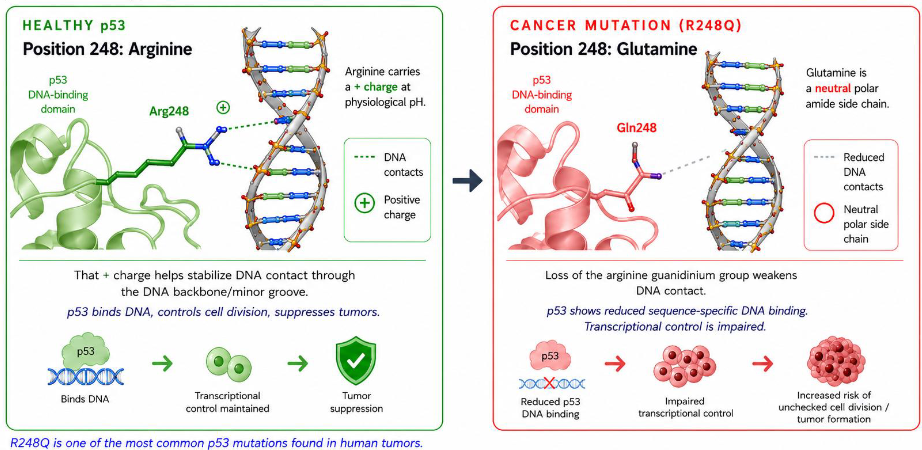
p53 = tumor suppressor protein → binds DNA (Negatively charged) to control cell division
Mutation Arg-248 → Gln-248
Healthy p53: Arginine → (+) charge → able to grip DNA
Cancer mutation p53: Glutamine → polar neutral → unable to grip DNA → unable to suppress tumor → cancer
What types of problems is the Henderson-Hasselbach equation used for?
What are the 3 steps to answer the problem type?
Percentage questions
Ex. What is the percentage of neutral molecules of aspiring in the stomach, pH = 1.5 and pKa = 3.5?
Steps:
Plug in
Solve for ratio
Convert to percentage
Neutral percentage = (Denom)/(Num + Denom)
If aspirin has a pKa of 3.5, stomach has a pH of 1.5, and the small intestine has a pH of 6.5, where is the aspiring expected to be absorbed (according to pKa rule)?
What win, chemistry or anatomy (SA)?
Aspirin = acidic
Stomach → pKa > pH → protonated, neutral → nonpolar, hydrophobic
Easily cross cell membrane → absorbed in stomach
Small intestine → pKa < pH → deprotonated, charged → polar, hydrophilic
Water soluble but blocked from membranes
Anatomy wins → greater surface area
