Balancing Equations
 Call Kai
 Learn
Learn Practice Test
 Spaced Repetition
 Match
Match Flashcards
1/47

There's no tags or description
Looks like no tags are added yet.
Name | Mastery | Learn | Test | Matching | Spaced | Call with Kai | Chat |
|---|

48 Terms
1,1,1
__CaO + __H₂O → __Ca(OH)₂
2, 1, 2
__Na + __F₂ → __NaF
2, 1, 2
__K + __I₂ → __KI
1,1,1
__MgO + __SO₃ → __MgSO₄
1,1,1
__C + __O₂ --> __CO₂
1, 3, 2, 3
__Al₂(SO₄)₃ + __Ca(OH)₂ → __Al(OH)₃ + __CaSO₄
2, 1, 2, 1
__Na + __MgF₂ → __NaF + __Mg
1, 1, 2, 1
__BaCl₂ + __Na₂SO₄ → __NaCl + __BaSO₄
2, 1, 2, 1
__LiCl + __Mg(NO₃)₂ → __LiNO₃ + __MgCl₂
3, 2, 2, 3
__Al + __Cu(NO₃)₂ → __Cu + __Al(NO₃)₃
1,1,1
__Mg + __Cl₂ → __MgCl₂
2, 1, 2
__CO + __O₂ → __CO₂
1, 2, 1, 1
__Cu + __HCl → __CuCl₂ + __H₂
2, 1, 2
__Mg + __O₂ → __MgO
1, 2, 1, 1
__Sn + __HF → __SnF₂ + __H₂
1, 2, 1, 1
__Mg + __HCl → __MgCl₂ + __H₂
1,1,1
__C + __O₂ → __CO₂
4, 3, 2
__Fe +__O₂ → __Fe₂O₃
1, 3, 1, 2
__CS₂ + __O₂ → __CO₂ + __SO₂
2, 3, 2, 2
__MgS + __O₂ → __MgO + __SO₂
2, 1, 1, 1
__NaOH + __CO₂ → __Na₂CO₃ + __H₂O
1, 2, 1, 1
__Mg + __HF → __MgF₂ + __H₂
1, 1, 2
__N₂ + __O₂ → __NO
2, 1, 2
__H₂ + __O₂ →__H₂O
2, 3, 2
__Al + __Cl₂ → __AlCl₃
3, 2, 3, 2
__Mg + __AlCl₃ → __MgCl₂ +__Al
2, 1, 2
__SO₂ + __O₂ → __SO₃
2, 2, 2, 1
__K + __H₂O → __KOH + __H₂
1,1,1
__Cu +__Cl₂ → __CuCl₂
4, 3, 2
__Al + __O₂ → __Al₂O₃
Chemical Formula
a group of chemical symbols and numbers that represent the elements and the number of atoms of each element that make up a compound

Chemical Equation
A representation of a chemical reaction that uses symbols to show the relationship between the reactants and the products

Reactants
Elements or compounds that enter into a chemical reaction.
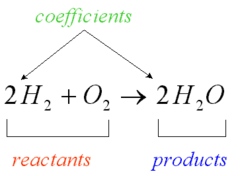
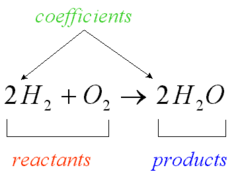
Products
The elements or compounds produced by a chemical reaction.
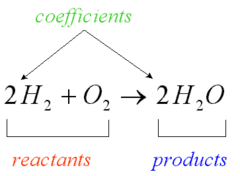
Coefficients
The numbers that appear before the formulas
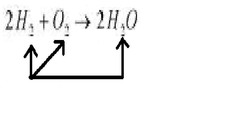
Subscripts
numbers written below the line that tell how many atoms of a given type are in a compound.
Balanced Equation
a chemical equation in which mass is conserved; each side of the equation has the same number of atoms of each element

The Law of Conservation of Mass
The principle that the total amount of matter is constant during any physical or chemical change (matter is neither created nor destroyed during these types of changes).
Decomposition
AB →A + B
decomposition reaction
chemical reaction in which one compound breaks up into 2 or more smaller compounds or elements
synthesis (direct combination) reaction
two or more substances combine to form another substance
synthesis (direct combination) reaction
A + B → AB
combustion reaction
a chemical reaction that occurs when a substance reacts with oxygen, releasing energy in the form of heat and light
(hydrocarbon) combustion reaction
CH(any hydrocarbon) + O₂ → CO₂ + H₂O
double replacement (displacement) reaction
chemical reaction in which atoms or ions from 2 different compounds replace each other
double replacement (displacement) reaction
AB + CD → AD + CB
single replacement (displacement) reaction
a chemical reaction in which one element takes the place of another element in a compound
single replacement (displacement) reaction
AB + C → A + BC or AB + C → AC