1 - Additives & Fillers
 Call Kai
 Learn
Learn Practice Test
 Spaced Repetition
 Match
Match Flashcards
 Knowt Play
1/11

There's no tags or description
Looks like no tags are added yet.
Name | Mastery | Learn | Test | Matching | Spaced | Call with Kai | Chat |
|---|
No analytics yet
Send a link to your students to track their progress
12 Terms
How can we enhance polymers properties or reduce their cost?
By adding additives or fillers
What’s the point of using additives & fillers in polymers?
to enhance properties
To reduce costs
What are additives & fillers?
Substances added to polymers to enhance their properties or reduce the cost
List different additives/fillers and explain shortly their use
plasticisers → make the plastic softer, more flexible, easier to process
Fillers → add bulk (volume), improve mechanical properties, reduce costs)
solvents → help dissolve/disperse other substances during processing
Colours → aesthetic or functional colouring
Antistatic agents → prevent the plastic from having static electricity on its surface
Flame retardants → reduce flammability, slows down combustion
What do plasticisers do when added to a plastic?
make the material softer, more flexible, more elastic
Lower the temperature range of use (at which the material can be processed)
What are the 2 types of plasticisers? What’s the difference between them?
Internal plasticisers
incorporated into the polymer chains (via copolymerisation)
Do not diffuse out over time because monomers are chemically bonded to the polymer chain
external plasticisers
Lie between the polymer chains, not chemically bound to them
Can diffuse out over time, which can affect long-term performance
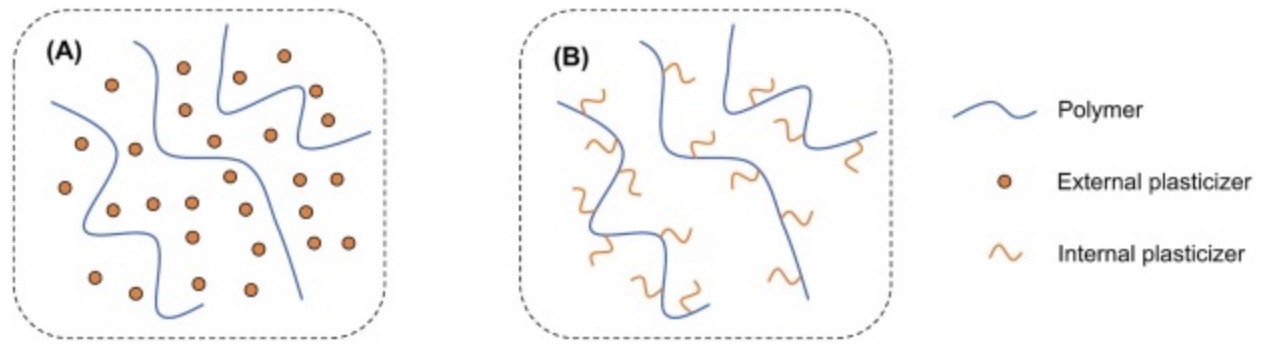
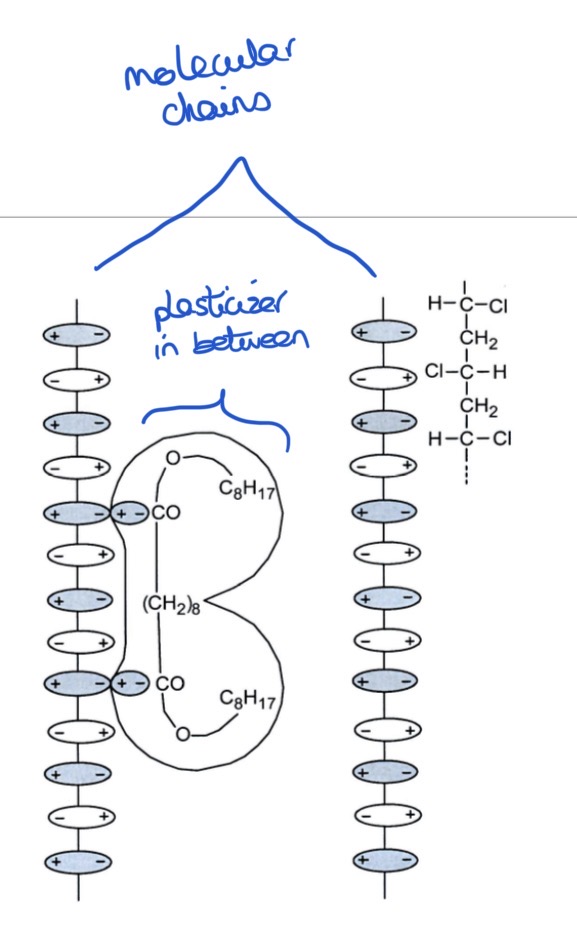
How do plasticisers make the material softer, more flexible and elastic?
They increase the distance between the molecular chains, which reduces the intermolecular forces that hold the chains together
What are the reasons to use fillers? (What do they do?)
improvement of mechanical, electrical & thermal properties
Cost reduction
Density adjustment
List a few examples of fillers
calcium carbonate (chalk = craie)
Natural fibres
Glass fibres
Wood dust (poussière de bois)
Talc
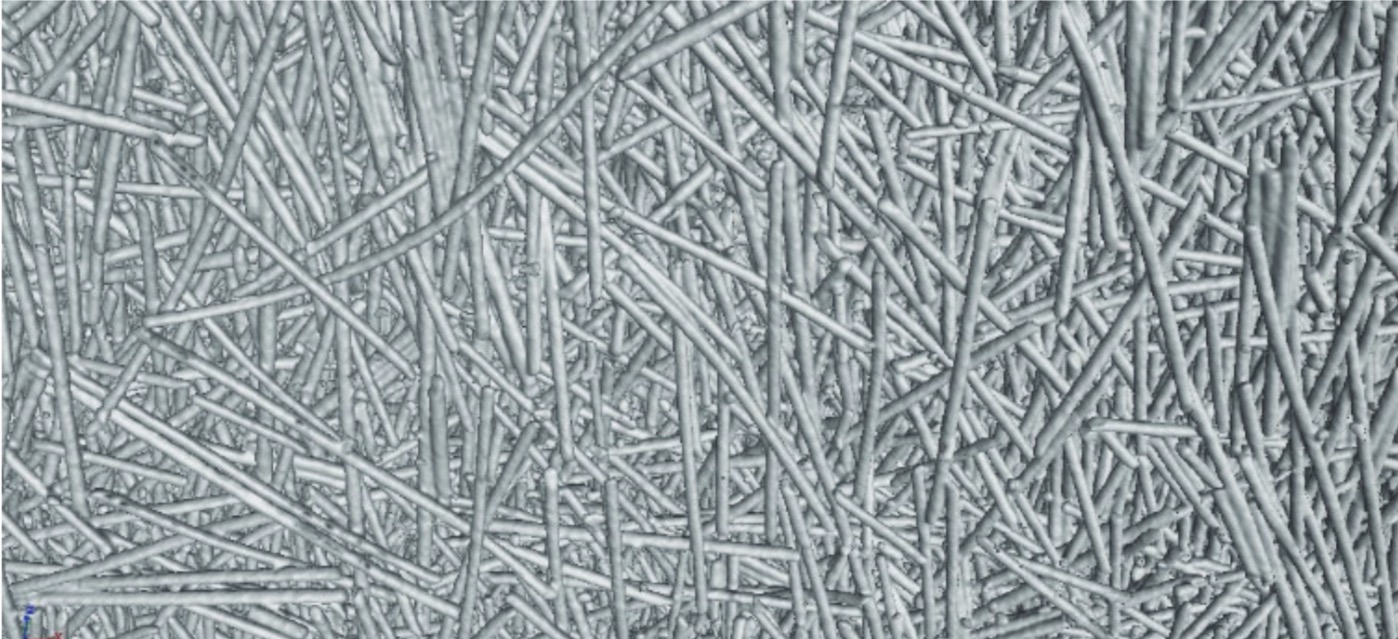
How are the filler’s fibres oriented?
What does it do?
Random orientation → reinforcement in all directions
What happens to the material as the fibre content of the filler increases?
The material becomes more brittle (less ductile) because fibres restrict the movement of polymer chains (stiffer, less able to deform before breaking)
What’s the usual limit of fibre content?
And for glass fibres?
Up to 60%, 40 to 50% for glass fibres