AP Math(Module 1 & 2)
 Studied by 0 people
 Call Kai
 Learn
Learn Practice Test
 Spaced Repetition
 Match
Match Flashcards
 Knowt Play
1/32

There's no tags or description
Looks like no tags are added yet.
Name | Mastery | Learn | Test | Matching | Spaced |
|---|
No study sessions yet.
33 Terms
Define population.
A population consists of all elements whose characteristics are being studied.
Define sample.
A sample is a set of data drawn from a population for examination.
What is analysis using the entire population called.
A census
What is a survey?
A survey is analysis using the sample.
Define Statistics.
Statistics refers to a group of methods used to carry out research in order to find out about the unknown and make decisions.
Why are samples used instead of their entire population?
It is difficult to conduct research on an entire population due to time, money, and accessibility.
What is a parameter?
A parameter is any characteristic of the population.
Statistic?
A statistic is a characteristic of the sample.
What is a variable?
A variable is some characteristic of a population or sample that assumes different values for different elements.
What is qualitative data?
Qualitative data is a categorical measurement expressed not in terms of numbers; descriptive data.
What is quantitative data?
Quantitative data is a numerical measurement.
Which type of quantitative data is countable?
Discrete variable
What is a continuous variable?
A Continuous Variable can assume any value in a given range, and cannot be counted( time, height, weight)
Interval
No true zero, only difference make sense not ratios (temperature, IQ)
Ratio
True zero, differences and ratios make sense. (Time, weight, age)
What is a sampling frame?
The sampling frame is the actual list of individuals that the sample will be drawn from.
Simple Random Sampling
Every member of the population has an equal chance of being selected. You can use random numbers or lottery technique.
Systematic Sampling
Select every k th element; where 𝑘 = 𝑁/𝑛
Stratified Sampling
Group items into strata with a similar characteristic. Choose proportionally from each stratum 𝑥/N × 𝑛
Quota
Form subgroups and choose the sample from within each using convenience/judgement.
What is an advantage and disadvantage of simple random sampling?
-Each individual has an equal chance of selection.
-Can be time-consuming and costly for large populations.
What is an advantage and disadvantage of systematic sampling?
-Simple and quick to carry out.
-Risk of bias if hidden patterns match the interval.
What is an advantage and disadvantage of stratified sampling?
-Ensures representation of all key subgroups.
-Complex and time consuming to organize.
What is an advantage and disadvantage of cluster sampling.
-Convenient for field research.
-Populations may not represented well.
What is an advantage and disadvantage of quota sampling?
-Quick and inexpensive.
-Researcher bias.
Equal Width Histogram
x: class boundaries y: frequencies
Unequal Width Histogram
x: class boundaries y: frequency density
Polygon
x: midpoints y: frequencies (start=midpoint-width, end=midpoint+ width)
Ogive
x: upper class boundaries y: cumulative frequencies
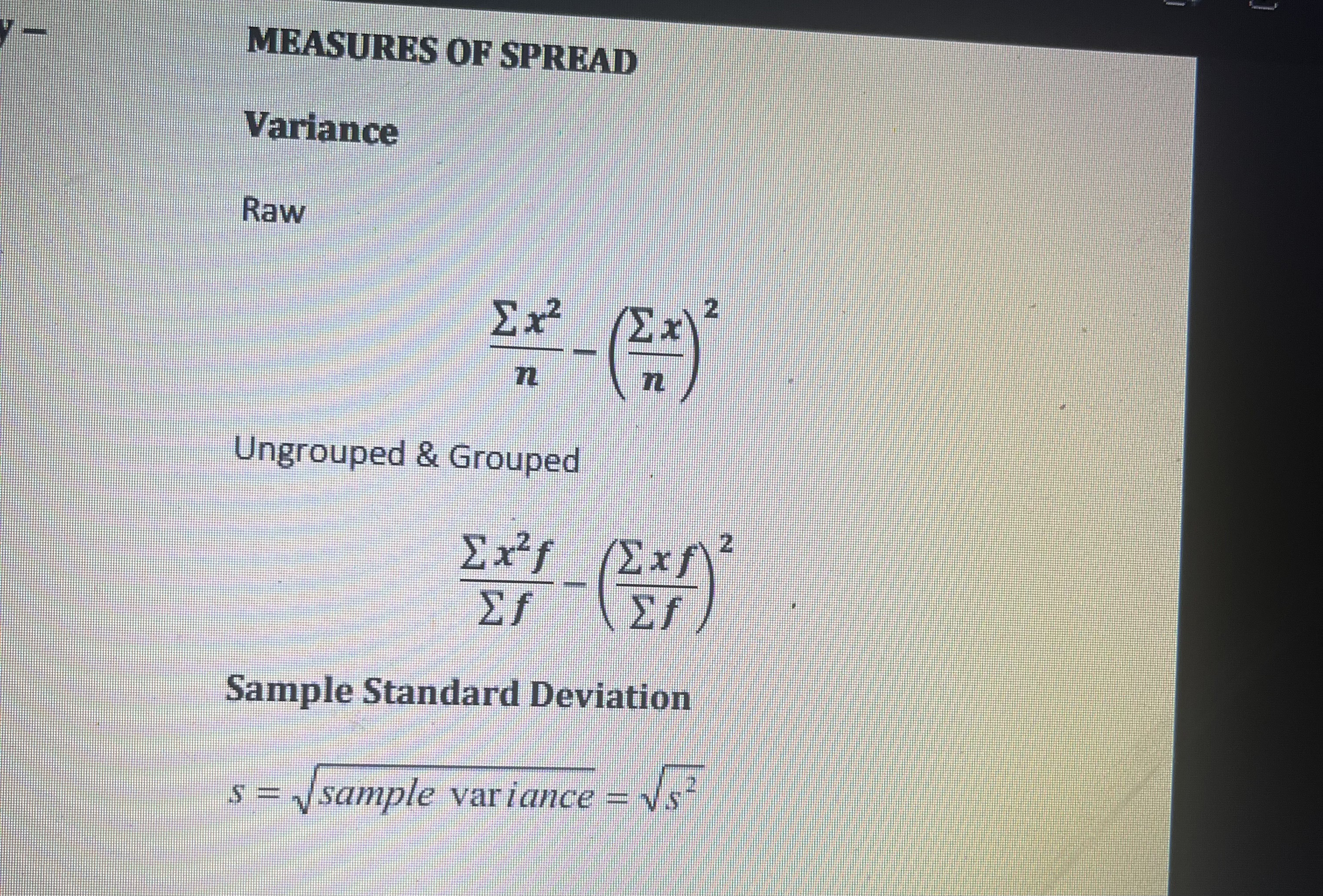
Variance
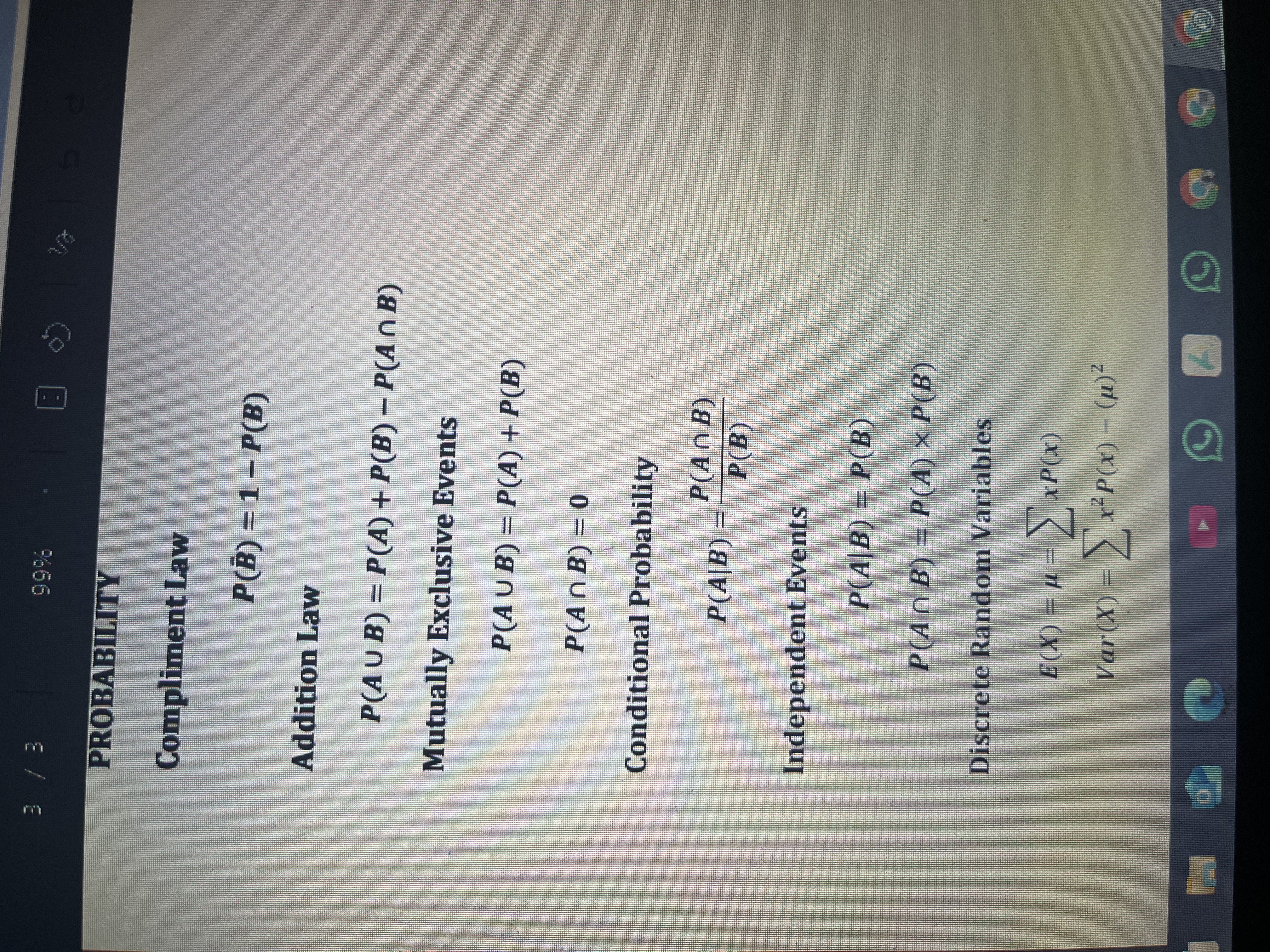
Probability Formulas😜
P(A only) = P(A) - P(A and B)
P(A or B but not both) = P(A) + P(B) - 2P(A and B)
P neither = 1 - P(A U B)
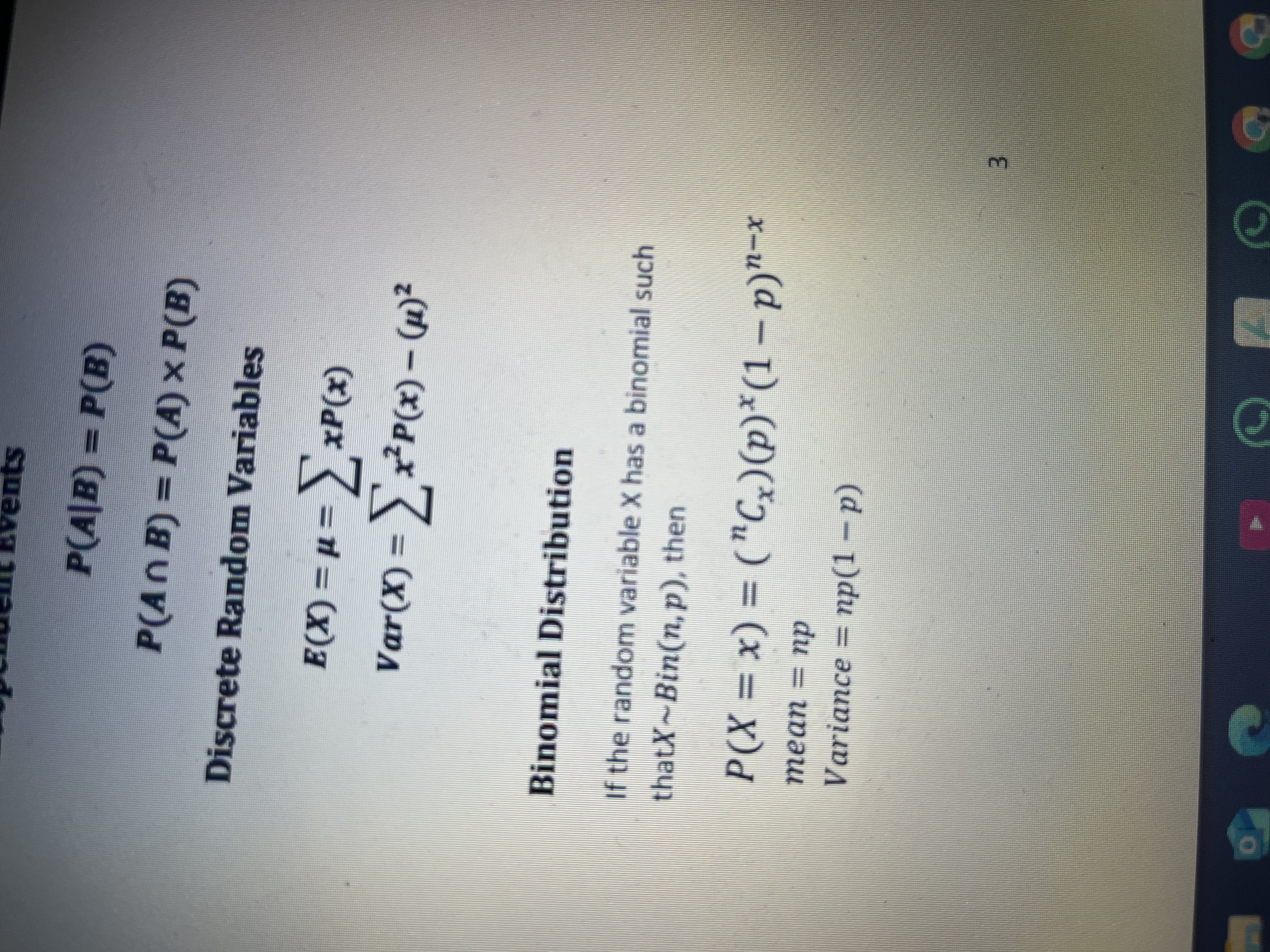
Binomial
Define probability.
Probability is a numerical measure of the likelihood that a specific event will occur.