Smooth Muscle - Exam 1
 Call Kai
 Learn
Learn Practice Test
 Spaced Repetition
 Match
Match Flashcards
 Knowt Play
1/4

There's no tags or description
Looks like no tags are added yet.
Name | Mastery | Learn | Test | Matching | Spaced | Call with Kai | Chat |
|---|
No analytics yet
Send a link to your students to track their progress
5 Terms
smooth muscle monocyte
single nucleus - centrally located, elongated/spindle shaped
each cell surrounded by reticular fibers, tissue rich in BVs and nerves
lack striations (not standard sarcomere)
involuntary
surrounds most hollow organs - uterus, UB, GI
smooth muscle myofilament arrangement
myofilaments - arranged in various orientations
thin filaments - actin, tropomyosin, NO troponin
thick filaments - myosin
dense bodies - anchor actin in association with intermediate filaments

contraction of smooth muscle
dependent upon phosphorylation of myosin
when myosin is phosphorylated it binds to actin and muscle shortens
phosphorylation of myosin caused by and increase in intracellular Ca
Ca binds to calmodulin (activation)
calcium-calmodulin phosphorylates myosin light-chain kinase (MLCK)
MLCK phosphorylates myosin and phosphorylated myosin binds actin
myosin phosphatase reclaims the phosphate to cause relaxation
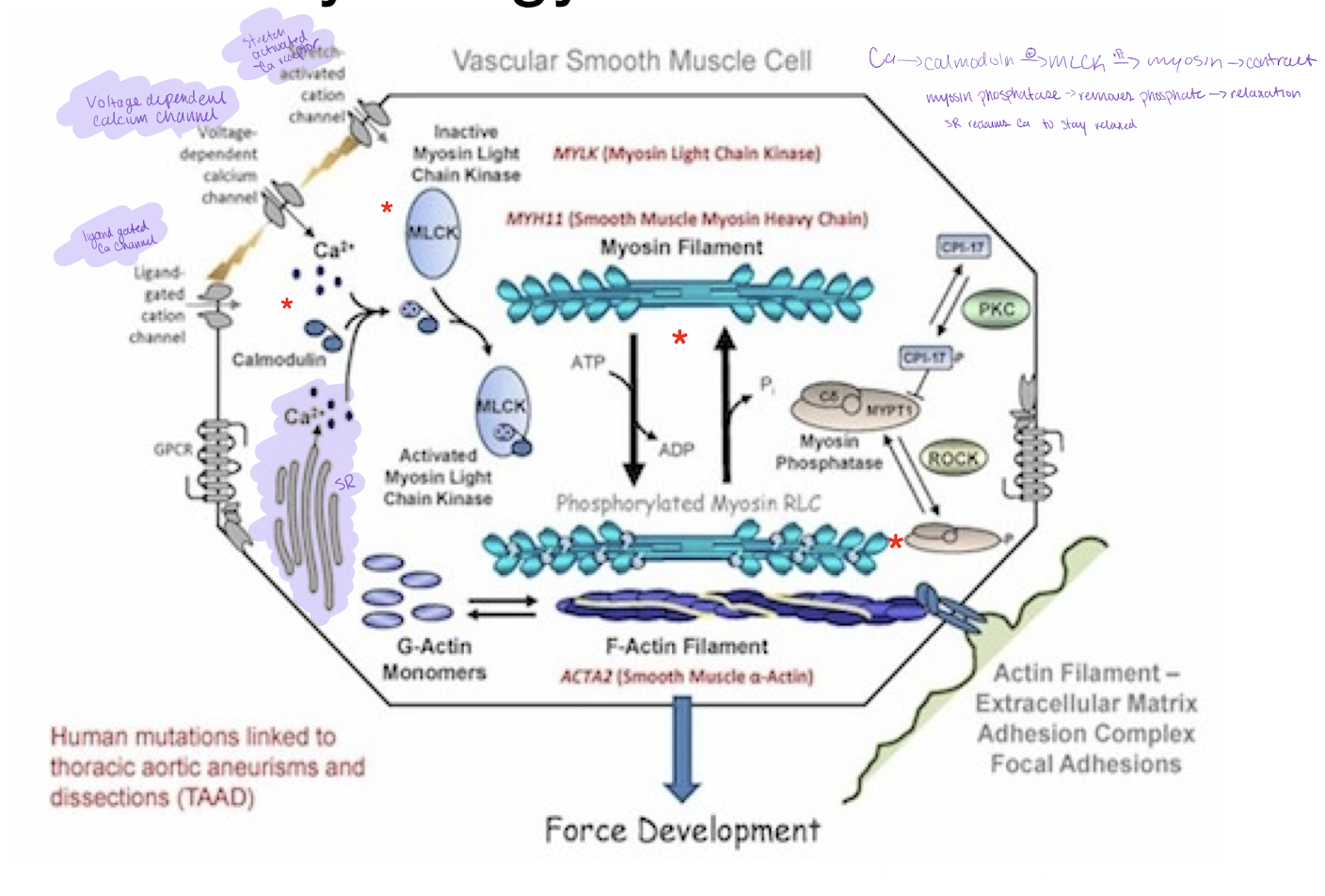
smooth muscle contraction characteristics
cellular events that lead to smooth muscle contraction take longer
contraction is slower and more sustained
many smooth muscle organs maintain constant tone - some level of contraction
smooth muscle innervation
involuntary
under conrol of autonomic nervous system
unitary smooth muscle - signal a few cells and activate whole organ (stomach)
cells linked by gap junctions
all cells in organ act in unit
multi-unit smooth muscle (iris)
no gap junctions between cells
individual cells get their own innervation (fewer muscle cells)
allows for precise contraction