RPD 02 - Interim Partial Denture (Quiz 1)
 Call Kai
 Learn
Learn Practice Test
 Spaced Repetition
 Match
Match Flashcards
 Knowt Play
1/38

There's no tags or description
Looks like no tags are added yet.
Name | Mastery | Learn | Test | Matching | Spaced | Call with Kai | Chat |
|---|
No analytics yet
Send a link to your students to track their progress
39 Terms
Interim Partial Denture
Define the following:
A provisional prosthesis designed to enhance esthetics, stabilization and/or function for a limited period of time, after which it is to be replaced by a definitive prosthesis
interim partial denture
The following are indications for _______:
- Appearance
- Space maintenance
- Re-establishment of occlusal relationship
- When age, health, lack of time precludes more definite tx
- To condition the residual ridge
- Interim restoration during treatment
- Cost
- Relatively easy to fabricate
- Easy to modify
- No mouth preparations necessary
What are the four ADVANTAGES of an interim partial denture?
- Weak
- Non-rigid
- Bulk needed for strength
What are the three DISADVANTAGES of an interim partial denture?
interim partial denture (provisional prosthesis)
Define the following:
Designed to enhance esthetics, stabilization and/or function for a limited period of time, after which it is to be replaced by a definitive prosthesis
transitional partial denture
Define the following:
Interim prosthesis to which artificial teeth will be added as natural teeth are lost and that will be replaced after post-extraction tissue changes have occurred. This may become an interim complete denture when all of the natural teeth have been removed
treatment partial denture
Define the following:
RPD used for the purpose of treating or conditioning the tissues
- Heat curing resin
- Self curing resin
- Light curing resin
What materials are most commonly used to fabricate an interim partial denture?
A. Sprinkling method or flasking method
An interim partial denture can be fabricated using which of the following methods?
A. Sprinkling method or flasking method
B. Lost wax technique only
C. Sintering technique
D. CAD-CAM milling only
B. Extension into interproximal undercuts, with or without wire clasps
Retention for an interim partial denture can be achieved by...
A. Precision attachments only
B. Extension into interproximal undercuts, with or without wire clasps
C. Occlusal rests only
D. Adhesive resin cement
infrabulge
when fabricating an interim RPD, _________ areas should be blocked out to reduce seating problems
above
when fabricating an interim RPD, clasp wires should be placed _________ the height of contour on the proximal surface
Superior
The interim denture border should contact the area _____________ to the height of contour for stability and retention
True
T/F: The occlusion of an RPD should be in harmony to the remaining natural dentition
wrought wire
What is the most common clasp usually?
wrought wire
ID the type of clasp:
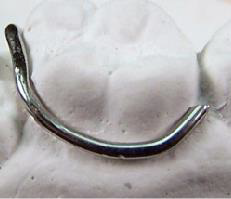
ball clasp (consist of a ball of solder on the end of a piece of a WW)
ID the type of clasp:
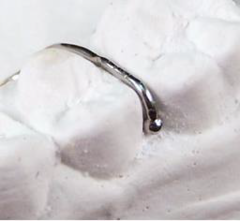
adams clasp
ID the type of clasp:
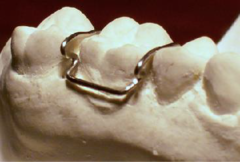
B - should say: extend denture to 1st molar
Which of the following is FALSE regarding denture base?
A) Full palatal coverage increases strength, support, stability
B) Extend denture to 2nd molar
C) Retentive clasps are embedded into denture base
2
How many alginate impressions should you take when fabricating an interim RPD?
At zero tilt
How can you survey a cast to avoid severe undercuts?
Lingual
What surface of the tooth should you block out of the posterior teeth that the resin will contact and proximal surfaces of the teeth adjacent to the edentulous spaces?
1mm
When bending the wrought wire, there should be ______mm of space between the wire and the cast
True
T/F: Place one layer of base plate wax and set artificial denture teeth. There should be inter proximal contacts between the natural teeth and the denture teeth. The denture tooth can be ground for this purpose.
- Interproximal extensions
- Region where clasps exit from resin
- Tissue undercuts
Which areas commonly require adjustments on the RPD when inserting? (3)
pressure indicating paste (PIP)
What can you use to check intimate contact between the denture base and soft tissue?
Anterior
ID the occlusal scheme:
- MIP: No occlusal contacts
- Lateral excursion and protrusion: light contacts
Posterior
ID the occlusal scheme:
- MIP: occlusal contacts
- Lateral excursion: canine guidance or group function
- Protrusion: no occlusal contacts
E) Hard (it is SOFT)
All of the following are characteristics of tissue container except...
A) Non-toxic
B) Non-irritating
C) Elastic
D) Doesn't undergo substantial permanent deformation
E) Hard
viscous
Tissue conditioner feature that allows adaptation to the denture bearing mucosa over several days:
elastic
Tissue conditioner feature that gives cushions for the cyclic forces of mastication and bruxism:
visco-elastic
Tissue conditioner has ability to flow under masticatory force, spreading the load on mucosa evenly, this is known as _______ behavior
powder: metyl/ethyl methacrylate (acrylic polymer)
liquid: ethyl alcohol + aromatic ester 30%
What is the material of the powder and liquid in tissue conditioner?
3-5 days
How often should you replace tissue conditioner?
tissue conditioner
What provides equitable force distribution throughout denture arch + cushioning effect?
TRUE
T/F: The following is the correct order of clinical steps to use tissue conditioner
1. Trim inside and borders of denture (1mm reduction, 1mm shortening)
2. Apply separator on the polished surface
3. Mix and apply on tissue surface
4. Place in mouth with light pressure
5. Border mold it, ask pt to close on posterior teeth
6. Pt holds in occlusion for 4-5 mins
7. Remove denture and trim excess with a sharp blade
8. Any exposed denture surface should be trimmed and new material added
9. Re-seat denture and repeat previous procedures as needed
10. Instructions for home care
False, block out LINGUAL surfaces of posterior teeth
T/F: Block out buccal surface of posterior teeth that the resin will contact and the proximal surfaces of the teeth adjacent to edentulous spaces
survey line/HOC
When scribing the line, where should you draw the line on your abutment teeth and soft tissue?
lingual
You should attach the wrought wire with sticky wax on which side of the cast?