[BABA3/1ST.] ECON501: Human Development Index
 Call Kai
 Learn
Learn Practice Test
 Spaced Repetition
 Match
Match Flashcards
 Knowt Play
1/25

There's no tags or description
Looks like no tags are added yet.
Name | Mastery | Learn | Test | Matching | Spaced | Call with Kai | Chat |
|---|
No analytics yet
Send a link to your students to track their progress
26 Terms
Human Development Index (HDI)
A socio-economic measure built on three pillars of human welfare:
Longevity — Life expectancy
Knowledge — Education and literacy
Living standards — GDP per capita
Human Development Index (HDI)
It is a tool used to measure a country's overall achievement in its social and economic dimensions.
The human development index is a measure of economic development and economic welfare.
Human development
It regards economic growth as essential but emphasizes the need to pay attention to its quality and distribution, analyses at length its link with human lives and questions its long-term sustainability.
Aspects of development
The quality of life people enjoy in a country
The opportunities people have
Freedoms people enjoy
Dr. Mahbub-ul-haq
A Pakistani economist that introduced the concept of human development.
He has described human development as development that enlarges people’s choices and improves their lives.
1990
When was human development devised and launched?
Amartya Sen and Mahbub-ul-haq
They worked upon the capabilities and functioning which provided conceptual framework and was later published by United Nations Development Programme (UNDP).
Equality
Sustainability
Productivity
Empowerment
Four essential pillars of human development
Life expectancy at birth
Expected years of schooling
Average years of schooling
Gross national income (GNI)
Four key metrics of HDI
Life expectancy at birth
To assess a long and healthy life
Expected years of schooling
To assess access to knowledge of the young generation
Average years of schooling
To assess access to knowledge of the older generation
Gross national income (GNI)
To assess the standard of living
Between 0 to 1
HDI is placed between…
HDI of 1
Highest level of economic development
HDI of 0
Lowest level of economic development
HDI is above 0.808
Very high
49 countries
HDI is between 0.700 to 0.807
High
53 countries
HDI is between 0.556 to 0.699
Medium
42 countries
HDI is below 0.555
Low
43 countries
Health
• The indicator chosen to assess health is the life expectancy at birth.
• A higher life expectancy means that people have a greater chance of living longer and healthier lives.
Education
• The adult literacy rate and the gross enrollment ratio represent access to knowledge.
• The number of adults who are able to read and write and the number of children enrolled in schools show how easy or difficult it is to access knowledge in a particular country.
Income or Access to Resources
GDP, GNP and other measures of income per capita and over all output of the economy.
HDI = (LI*EI*II)^1/3
Formula for HDI
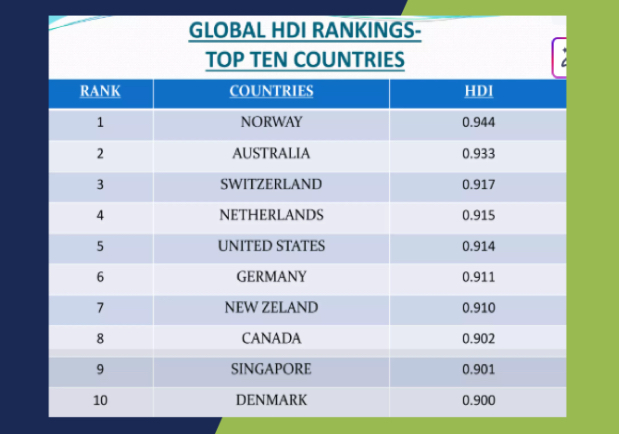
Top 10 countries with the highest HDI
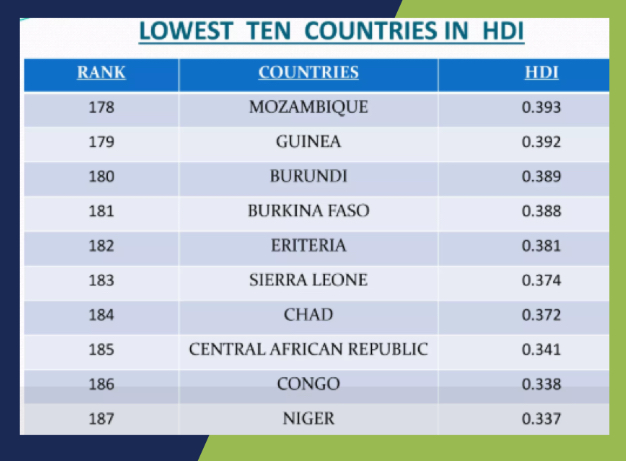
Lowest 10 countries with low HDI