excitatory-inhibitory
 Call Kai
 Learn
Learn Practice Test
 Spaced Repetition
 Match
Match Flashcards
 Knowt Play
1/7

There's no tags or description
Looks like no tags are added yet.
Name | Mastery | Learn | Test | Matching | Spaced | Call with Kai | Chat |
|---|
No analytics yet
Send a link to your students to track their progress
8 Terms
Excitatory synapses
positive signals (via glutamate)
Inhibitory synapse
negative signals (via GABA)
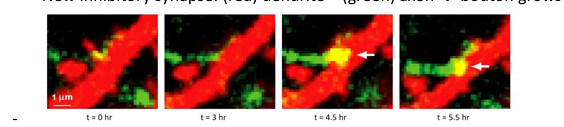
Who/what decides when and where this inhibitory bouton occurs?
hypotheses: if we make the excitatory dendrite (red) too strong, the inhibitory axon (green) will react to that
via glutamate uncaging the excitation was made stronger: activating glutamate with a laser (by breaking the “cage” around the inactive glutamate)
With the 2-photon laser, you can do this very locally right in front of the spina (as if there was a presynaptic terminal releasing glutamate)
This was stimulated several times (an ltp-like stimulus)
The stimulated spine grows/we make them stronger (induce LTP at these spines) → locally more excitation than inhibition - ill the coordination be restored??
A clear bouton was formed; the inhibitory axon responded to the increase in excitation at the dendrites

Formation of a bouton
Een dendritische spine wordt sterk gestimuleerd (door glutamaat).
Hierdoor ontstaat LTP → de spine groeit en wordt sterker.
Door de calciuminstroom via NMDA-receptoren maakt de dendriet de endocannabinoïde 2-AG.
2-AG diffundeert terug naar een nabijgelegen inhibitorisch axon (retrograde signaling).
Op dat axon zitten CB1-receptoren.
Activatie van CB1 zorgt ervoor dat het axon een nieuw inhibitorisch bouton vormt (een nieuwe remmende synaps).

experiment met de CB1-receptorblokkers
De CB1-receptoren op het inhibitorische (groene) axon werden geblokkeerd, waardoor het axon niet langer kon reageren op endocannabinoïden uit de dendriet.
De dendriet werd gestimuleerd → de spine groeide (LTP).
Er werden echter géén nieuwe inhibitorische boutons gevormd.
Conclusie: de vorming van nieuwe inhibitorische synapsen verloopt via de endocannabinoïde (2-AG)-CB1-signaalroute. Zonder CB1-receptoren kan het axon het retrograde signaal van de dendriet niet ontvangen
gating
bepalen welke informatie wel of niet wordt doorgelaten
De extra inhibitie is niet bedoeld om leren tegen te houden, maar om de informatieverwerking selectiever te maken.
-AG zorgt voor de vorming van een lokale inhibitorische synaps naast het actieve cluster.
Die inhibitorische synaps remt alleen dat specifieke cluster en niet de hele neuron.
Hierdoor kunnen neuromodulatoren en interneuronen afhankelijk van de gedragscontext bepaalde clusters aan- of uitzetten.
norepinephrine
NE is released when an animal is aroused or experiences some novelty
NE (probably) enhances the contrast between new (novel) and familiar
NE enhances dendritic excitability in pyramidal neurons (which enhances the plasticity → which is why you remember new experiences much more)
NE triggers small depolarization in interneurons
NE triggers PKA activity in the distal dendrites of interneurons and not so much in the soma → Does NE affect input summation or firing properties in interneurons??
We can also activate PKA activity with norepinephrine or with dopamine: do they also trigger bouton formation?
Yes, if we activate the dopamine D1 receptor, we can trigger new inhibitory bouton formation
5 min of norepinephrine results in only a small PKA activity, with no significant bouton formation
prolonged norepinephrine results in long and strong PKA activity and significant bouton formation ➢ so whether you’re happy (more dopamine) or stressed (more norepinephrine) modulates the plasticity of your inhibitory synapses