Patterns of Life Review
 Call Kai
 Learn
Learn Practice Test
 Spaced Repetition
 Match
Match Flashcards
 Knowt Play
1/67

Earn XP
Description and Tags
Test on Monday September 28th 2026.
Name | Mastery | Learn | Test | Matching | Spaced | Call with Kai | Chat |
|---|
No analytics yet
Send a link to your students to track their progress
68 Terms
Define the term taxonomy
The term taxonomy describes the science of classification of all living and extinct organisms.
What is classification
a method to organize or group things based on a specific criteria. In biology classification it's called a catalogue of life.
Clearly distinguish between Aristotle's mode of classification and St. Augustine's mode of classification.
Aristotle mode of classification(the first system) was classifying animals by their habitat, creatures of land (land dwellers), creatures of the sea (water dwellers) and creatures of the sky (air dwellers). While St. Augustine classified organisms as useful to humans, harmful to humans to superfluous to humans.
The Herbalists
During the Middle Ages (approximately between 476 CE and the 14th century) classified plants according to what they produced
Fruit
Vegetables
Wood
Describes the contributions of Carl Linnaeus to modern day taxonomy.
Carl Linnaeus is the father of modern taxonomy; he grouped species according to their physical similarities (morphology). Each species was identified by a unique name based on the organism’s genus and species (binomial nomenclature). Ex. Homo sapiens. (CAPITAL LETTER GENUS, LOWERCASE SPECIES) It is a system of identification of organisms, both living and extinct, by assigning specific scientific names.
With the use of a upside down triangle explain the levels of traditional taxonomy.
Did King Phillip call out for good soup. (Eukarya, Animalia, Chordata, Mammalia, Carnivora, Canidae, Vulpes, and Vulpes Vulpes)

Explain how the shared number of taxons between different species can be used to determine relatedness.
The shared number of taxons between different species can be used because the higher the number the greater the relatedness between organisms.
Species information.
Is a group of organisms similar in structure and shape, that have the ability to reproduce with each other
The resulting offspring also have the possibility to reproduce
Share the most common characteristics
Define the term dichotomous key
A dichotomous(means 2) key is a tool that is used to classify unknown organisms into specific groups or categories based on specific characteristics. Also used to classify unknown organisms by answering of a series of questions based on specific features that have 2 possible outcomes, which lead to another question or identification.
State three different advantages pertaining to the use of a dichtomous key
easy to use
cost effective
can precisely identify the unknown organism
easily translated into other languages
organisms do not need to be physically present
State three different disadvantages pertaining to the use of a dichtomous key
one error you must rebegin task
colour blindness
distinguishing similar features
confusing
images may be blurry
bias of interpretation
assumes for knowledge
Clearly distinguish between a prokaryotic cell and eukaryotic cell.
Prokaryotic cells
small in size
DNA nt bounded by membrane
genome is composed of a single chroomosome
mitosis and meisois does not occur
mode of reporduction; asexual
most are single cellular
organisms are not present except for ribosomes
most do not require oxygen therefore anaerobic
Eukaroytic cells
large in size compared to prokaryotes
DNA bounded by membrane
genome is composed of many chromosemes
mitosis and meisois occurs
mode of reproduction ; sexual
organelles are not present
most require oxygen therefore aerobic
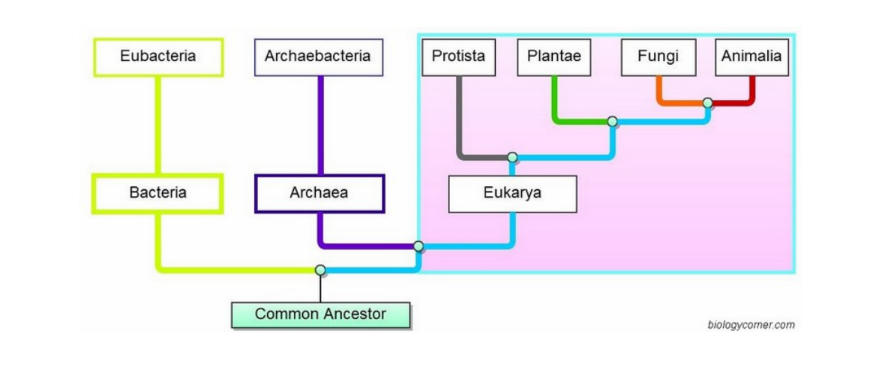
Study the diagram found below and then describe the relationship between domains and kingdoms.
3 known domains are Archaea
oldest domain
believed to have given rise to the Bacteria domain
Archaebacteria is the only kingdom.
Consists of prokaryotic cells
Bacteria
consists of prokaryotic cells
Bacteria is the only kingdom
Eukarya
Consists of eukaryotic cells
Includes the kingdoms Plantae, Animalia, Protista, Fungi
What is an Archeae cell type
Archeae’s cell type is Prokaryotes
What is an Archeae body type
Archeae’s body type is Unicellular
What is an Archeae mode of obtaining nutrients
Archeae mode of obtaining nutrients is autrophic and heterotrophic
What is an Archeae mode of reporduction
Archeae mode of reporduction is sexually and asexually
What is an Archeae habitat
Live in extreme environments
Methanogens live in the digestive tract of animals
Halophiles live in concentrated salt water environments
Thermoacidophiles live in hot acid waters
Archeae examples
Halobacterium salinarum
Sulfolobus acidocaldarius
Archaea random facts
Are the oldest known living prokaryotes on the planet
What is an Eubacteria cell type
Eubacteria cell type is Prokaryotic
What is an Eubacteria body type
Eubacteria body type is unicellular
What is an Eubacteria mode of obtaining nutrients
Eubacteria mode of obtaining nutrients is autrophic and heterotrophic
What is an Eubacteria habitat
Eubacteria can be found everywhere on earth
What is an Eubacteria examples
E.coli, Lactobacillus
Eubacteria random facts
some are pathogenic
most are helpful
E coli is an example that is found in the human digestive tract
What is Protista cell type
Protista cell type is Eukaryotic
What is Protista body type
Protista body type are mostly unicellular
What is Protista mode of obtaining nutrients
Protista mode of obtatining nutrients are autrophic and heterotrophic
What is Protista mode of reproduction
Protista mode of reproduction is both sexually and asexually
What is Protista habitat
Protista is foundin moist and watery environments
What is Protista examples
Protista examples are Amoeba and Kelp
Protista random facts
Most diverse of the kingdoms
Believed to have given rise to the plant, animal and fungi kingdoms
Can be both beneficial as well as harmful to humans
What is fungi’s cell type
fungi’s cell type is eukaryotic
What is fungi’s body type
fungi’s body type is unicellular
What is fungi’s mode of obtaining nutrients
fungi’s mode of obtaining nutrients is heterotrophic
What is fungi’s mode of reproduction
fungi’s mode of reproduction is both sexual and asexual
What is fungi’s habitat
fungi can be found on land with a few in watery environments
What is fungi’s examples
fungi’s examples are mushroom and penicillium
Fungi’s facts
Absorb nutrients
Are decomposers
Can be both beneficial as well as harmful to humans
What is Animalia cell type
Animalia cell type is eukaryotes
What is Animalia body type
Animalia body type is multicellular
What is Animalia mode of obtaining nutrients
Animalia mode of obtaining nutrients is heterotrophic
What is Animalia mode of reproduction
Animalia mode of reproduction is mostly sexual
What is Animalia habitat
Animalia habitat is on land and in water
What is Animalia examples
Animalia examples are any animals like lions, dolphin, earthworm etc.
Animalia facts
Largest of the kingdoms
Cells lack a cell wall
What is Plantae cell type
Plantae cell type is eukaryotes
What is Plantae body type
Plantae body type is multicellular
What is Plantae mode of obtaining nutrients
Plantae mode of obtaining nutrients is autrotrophic
What is Plantae mode of reproduction
Plantae mode of reproduction is both sexual and asexual
What is Plantae habitat
Plantae habitat is both on land and in water
What are Plantae examples
Algae, Bryophytes
Plantae facts
Cells possess a cell wall composed of cellulose
Undergo the process of photosynthesis, therefore are autotrophs
Producers in every food chain
Source of oxygen
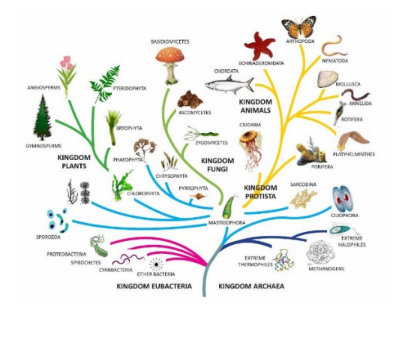
Identify the diagrams illustrated below and describe how it describes the kingdoms of life.
The tree of life.
illustrates a few examples of organism in each kingdom
illustrate the relationship between kingdom by branches
suggests that all life began with Archea

Identify the diagrams illustrated below and describe how it describes the kingdoms of life.
Fan Diagram
time line that suggest life began in the Precambrian era
suggest that all life began with Archea
area is related to size of kingdom
organism found near outer rim are modern day species
Why is it believed that the kingdom Protista gave rise to the kingdoms animalia, plantae and fungi?
It is believed that the kingdom Protista gave rise to the kingdoms Animalia, Plantae, and Fungi because…. there are plant like protists
there are animlas like protists
there are fungi like protists
Explain why there was a need to move away from the two kingdom mode of classification.
It mixed prokaryotes and eukaryotes. Bacteria (simple cells with no nucleus) were wrongly placed in the plant kingdom alongside complex multicellular plants.
It grouped single-celled and multi-celled organisms together: Microscopic organisms like amoebas and single-celled algae were grouped with complex animals and trees.
Fungi were misclassified as plants: Mushrooms were placed in the plant kingdom even though they cannot make their own food through photosynthesis (they absorb nutrients) and their cell walls are made of chitin, not cellulose.
Some organisms fit both categories: Organisms like Euglena behave like plants in sunlight (photosynthesis) and like animals in the dark (feeding on other organisms), making them impossible to classify into just two kingdoms.
Hypothesis as to why the organism in the kingdom fungi were once placed in the kingdom plantae.
Fungi were originally placed in Kingdom Plantae because early taxonomists relied on basic observable physical traits. Specifically, fungi are non-motile, like plants, remaining rooted in one spot rather than moving around like animals. They also possess a rigid cell wall surrounding their cells, which is a structural feature found in plant cells but completely absent in animal cells. Additionally, their morphology resembles plants, as they produce fruiting bodies like mushroom stalks that grow directly out of the ground or soil.
Define the term phylogenic tree.
Phylogenic tree is a tool used to predict the relationship between organisms.

Explain how the phylogenic tree below represent the relationship between different species.
Illustrates the relationship between species
Hypothesis of the evolutionary relationships
Nodes represent a common ancestor
The tips of the branches represent a specific species
What is binomial nomenclature
Biomial nomenclature is a naming systemthat gives each organism a two-word name
The full classification of humans
Domain: Eukaryota
Kingdom: Animalia
Phylum: Chordata
Class: Mammalia
Order: Primates
Family: Hominidae
Genus: Homo
Species: Homo sapiens
What is genus
Genus consists of a group of similar species
What is the scientific name of modern humans
Homo sapiens
Whar is the language of scientific names
Latin
Are dinosaurs related more to amphibians than reptiles
No, dinosaurs are more related to birds.
Do taxonomists try to identify the evolutionary relationships among organisms?
True