Psych of Personality Exam 1
 Call Kai
 Learn
Learn Practice Test
 Spaced Repetition
 Match
Match Flashcards
 Knowt Play
1/126

There's no tags or description
Looks like no tags are added yet.
Name | Mastery | Learn | Test | Matching | Spaced | Call with Kai | Chat |
|---|
No analytics yet
Send a link to your students to track their progress
127 Terms
Personality
An individual’s characteristic patterns of thought, emotion, and behavior, together with the psychological mechanisms behind those patterns.
Characteristic patterns
Individual differences that are relatively stable across situations and over time
Thinking “Thought”
→ What you think
→ How you think
Feeling (“Emotion”)
→ Mood
→ Motivation
Behaving “Behavior”
→ What you do
→ How you do it
Psychological Triad
Thinking, Feeling, Behaving
What Personality is NOT
physical characteristics → Height, weight
abilities, skills → singing ability, basketball skills
social/demographic attributes → s3x, race, religion
states → hungry, tired
psychological mechanisms
the biological, social, cognitive, motivational, and emotional processes that explain these patterns
Personality psychology
the scientific study of personality
→ gaining knowledge through systemic observation
personality data as clues
→ cannot directly observe personality characteristics and processes. MUST be inferred
types of personality data
S-Data, I-Data, B-Data, L-Data
S Data
Self Judgements
I Data
Informant Judgements
B Data
Behavioral Observations
L Data
Life Outcomes
What is S Data
→ asks person about themselves
→ subjective measurement
→ gathered through: interviews and questionnaires
What is I Data
→ ask knowledgeable informant(s) about target like roommate, friends, family
→ subjective measurement
→ gathered through: interviews and questionnaires
S-data vs I-data
→ Who do we think is the best judge of our behavior?
→ Who really is the best judge?
→ Do peers know something about our behavior that we don’t know?
Lay Perceptions of Accuracy (I vs S)
→ compared accuracy of predictions made by self vs. others
Electronically-Activated Recorder (EAR)
Digital audio recorder with that records ambient sounds of people’s daily lives
Study w/ EAR
→ Wore for 4 days (Fri-Tue); recorded 30s every 12.5 min
→ Participants could not tell when the recorder was on or off
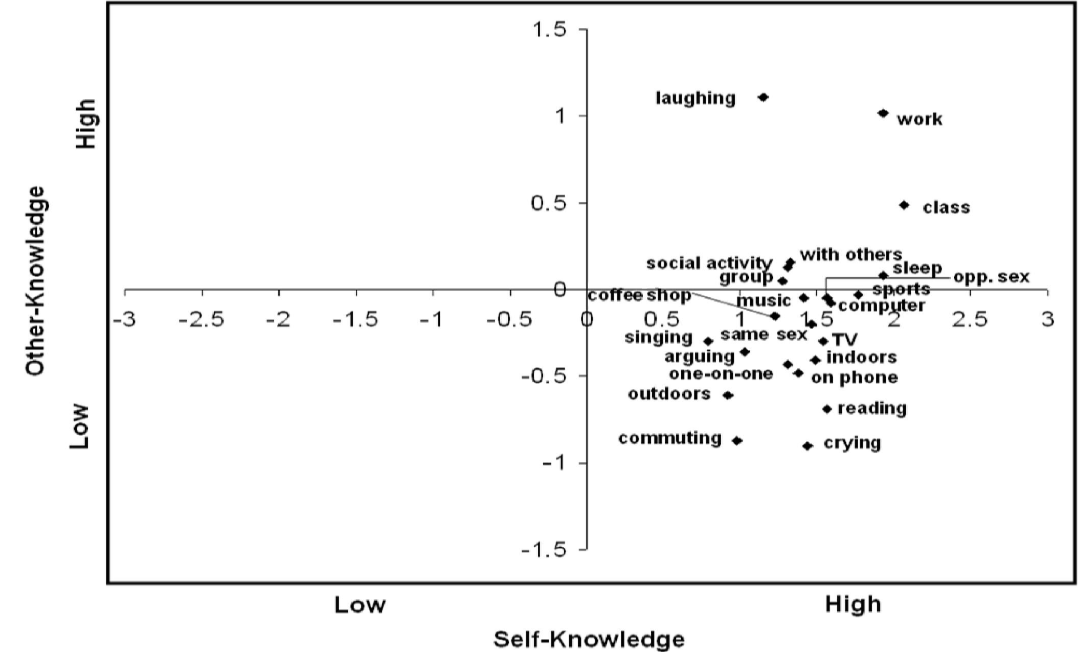
Results of EAR Study

SOKA Model
→ Self-Other Knowledge Asymmetry
What SOKA Model ask
→ When is self-knowledge better?
→ When is other-knowledge better?
→ Some informants better than others
Advantages of S-Data
→ Based on lots of information
→ Filtered through common sense
→ Access to internal states
→ Easy to obtain
Disadvantages of S-Data
→ Can be mistaken, biased, or deceptive
→ Aren’t always aware of own behavior
Advantages of I-Data
→ Based on lots of information (potentially)
→ Filtered through common sense
→ External perspective
Disadvantages of I-Data
→ Can be mistaken, biased, or deceptive
→ Can’t always access internal states
→ More difficult to obtain
What is B-Data?
→ Observe what the person does; how they react
→ Objective measurement of behavior
→ Record behaviors in: Naturalistic settings & Laboratory settings
Naturalistic B-Data
→ Behaviors in everyday life
→ Examples: Daily diary of specific behaviors , EAR , Online environment (e.g., Instagram)
Lab B-Data
→ Behaviors in the ____ : Contrived or more natural
→ Examples: Delay of gratification paradigm , Emotional expressions , Physiological data , Certain personality tests (e.g., TAT, Rorschach)
Is B-Data really objective?
→ Intuitively, it seems to be
→ However, involves many subjective decisions
→ Observers often don’t agree
When is B-data the MOST useful?
→ When participants can’t or won’t tell you
→ When comparing different groups and you are worried about response styles
→ For convergent validity
What is L-Data
Verifiable, concrete, real-life outcomes
→ Reflects past behaviors
Can be obtained from archival records
→ e.g., arrests, GPA, marriage, Facebook friends
Easier to ask the person instead?
→ not necessarily, may be more likely to lie about an arrest record
Behavioral Residue
Physical Space
Advantages of B-Data
→ Are objective
→ Intrinsically important
→ Can create particular situations in the lab
Disadvantages of B-Data
→ Can be difficult to interpret
→ Difficult to obtain
Advantages of L-Data
→ Are objective
→ Intrinsically important
Disadvantages of L-Data
→ Can be difficult to interpret
Mixed Data
→ Not all data fit neatly into one category
→ Many examples of hybrid data
Roommate’s report of how often you make your bed: L-Data & B-Data
Funder’s 2nd Law
no perfect indicators of personality; only clues
Funder’s 3rd Law
something beats nothing, 2 times out of 3
Henry Murrary
founder of personality psych, commented that in order to understand personality, first have to look at personality
self-verification
people trying to bring others to see them as they see themselves
expectancy effect
others expect you to be sociable, intelligent, aloof, etc, you may become those things
expectancy effect also known as
behavioral confirmation
Duck Test
best to draw on multiple sources
→ Triangulation
personality test
Any standardized procedure for assessing one or more personality characteristics.
→ Same instructions, items, and scoring procedure
what are personality tests good for
→ Psychological research
→ Clinical screening and diagnosis
→ Organizational uses
two types of personality tests
Objective & Projective
objective tests
present items that people respond to using a fixed set of options.
→ Examples: Rating scales, true-false
Adjective Checklist (ACL)
checklist of adjectives, can be used to measure personality
specific example of objective test
the ACL
projective tests
present ambiguous stimuli that people respond to
→ Open-ended responses
→ Responses should reflect their own personalities
→ Responses interpreted by a trained scorer
specific example of projective tests
thematic apperception test (TAT)
what is TAT
Responses scored for motives
TAT Scoring
Identify and count prevalence of narrative themes
→ Need for Affiliation – positive feelings towards others (establish/maintain/restore relationship); negative feelings about separation/disruption of relationship
→ Need for Power – strong actions with inherent impact on others or society at large (influence, persuade, concern for prestige)
→ Need for Achievement – reference to standard of excellence (good/better/best); negative reactions to failure; winning competition/succeeding
Need for Affiliation
positive feelings towards others (establish/maintain/restore relationship); negative feelings about separation/disruption of relationship
Need for Power
strong actions with inherent impact on others or society at large (influence, persuade, concern for prestige)
Need for Achievement
reference to standard of excellence (good/better/best); negative reactions to failure; winning competition/succeeding
stimuli for objective tests
Relatively clear (e.g., adjectives, sentences)
stimuli for projective tests
Ambiguous (e.g., Inkblots, pictures)
response format of objective tests
Fixed (e.g., check boxes, rating scales)
response format of projective tests
Free response (open-ended)
response interpretation of objective tests
Straightforward; not necessarily obvious
response interpretation of projective tests
Complex, uncertain; hidden aspects
why use projective tests
→ Projective tests have generally not been shown to be reliable or valid diagnostic tools
→ Clinicians still find them useful as a springboard to open up conversation with clients
→ Some validity?
May assess the readiness and frequency with which certain thoughts come to mind (chronic accessibility
three common ways of test construction
→ rational method
→ factor analytic method
→ empirical method
rational method
→ Create items based on theory or definition of a construct
→ Relies on subjective judgments of test writer
e.g., what would a shy person say?
factor analytic method
→ Identify groups of items that “hang together”
→ Humans interpret factors
Label in a meaningful way
→ “Garbage in, garbage out”
Ideally use a large set of representative items
factors
Identify groups of items that “hang together”
empirical method
→ Create scales based on how pre-existing, well- understood groups differ
e.g., diagnosed depressed vs. not depressed
→ Content of items often ignored
e.g., “I like hopscotch”
constructing a good personality test
→ combine diff approaches
1. Write a bunch of items that you think should measure the personality characteristic of interest (Rational)
2. Run a factor analysis to see whether the items correlate with each other and form different subscales (Factor analytic)
3. Check whether responses to these items predict relevant behaviors and outcomes (Empirical)
Cross-validate
data can vary in quality which leads to us _________
needing to be able to tell good from bad
reliability
stability or repeatability
generalizability
applies more broadly
validity
measures what you’re trying to measure
The Reproducibility Project
→ Large scale effort to test whether findings replicate
→ Other labs tried to reproduce studies published in psychology journals
Open Science Movement
→ Increase disclosure in methods, results, and hypothesis presentation
→ Pre-register hypotheses and studies
→ Share data
→ Be a responsible scientist regardless of outcome
what is reliability
→ The extent to which measurements are stable, dependable, and can be replicated
Assuming your target is stable (trait vs. state)
→ All measurements are somewhat imperfect
Observed score = “true” score + error
Sources of Error
→ State of the participant
→ Characteristics of the experimenter
→ Experimental environment
→ Low precision
ways to boost reliability
→ Careful control of the setting/experiment
→ Aggregation
Average across multiple items/observations
Random influences cancel out
types of reliability
a. test-restest (stability)
b. internal consistency
c. interjudge agreement
test-restest stability
assesses the stability of a measurement
→ Should get a similar result every time
internal consistency
Correlating every item on a scale with each other
alpha (α) reliability
→ Items on a personality test should “hang together” to measure the construct of interest
inter-judge reliability
agreement or consensus among observers
what is validity
Extent to which a measure captures what it should
evidence of validity
Scores predict expected behaviors or life outcomes
reliability vs validity
→ can be reliable without being valid
→ if something is valid it is reliability
face validity
Does the item/question look valid?
face validity example
“I know that I’m good because everyone keeps telling me so”
content validity
Does the assessment adequately sample the construct you hope to measure?
high content validity = good coverage
predictive validity
Does the assessment predict appropriate outcomes?
generalizability
To what extent to results apply more broadly
→ Other people
→ Other places
→ Other times
steps to research process
formulate hypothesis
design study
collect data
analyze data
interpret results
research design
A plan for making systematic observations, in order to answer one or more key questions
types of research design common in personality
Case study, Correlational study, Experiment
case study
→ In-depth examination of a particular person or event
→ Usually someone/something interesting or unusual
→ Standard approach for some
Freud
McAdams
correlational study
→ Examines the associations between two or more variables, using a sample of participants
→ Variables are measured but not manipulated
→ Variables often referred to as predictors and outcomes
experiment
→ A researcher manipulates one or more independent variables (IV), then observes the effects on one or more dependent variables (DV).
→ Each participant is randomly assigned to a level of the independent variable (i.e., study condition)
→ Compare experimental condition(s) to control condition