Coastal Landforms.
 Call Kai
 Learn
Learn Practice Test
 Spaced Repetition
 Match
Match Flashcards
 Knowt Play
1/43

There's no tags or description
Looks like no tags are added yet.
Name | Mastery | Learn | Test | Matching | Spaced | Call with Kai | Chat |
|---|
No analytics yet
Send a link to your students to track their progress
44 Terms
Are headlands and bays formed by erosion or deposition?
Erosion
Are cliffs and wave-cut platforms formed by erosion or deposition?
Erosion.
Are Caves, arches, stacks and stumps formed by erosion or deposition?
Erosion.
Are beaches formed by erosion or deposition?
Deposition.
Are Sund Dunes formed by erosion or deposition?
Deposition.
Are spits formed by erosion or deposition?
Deposition.
Are spits formed by erosion or deposition?
Deposition.
What are headlands and bays?
A headland is a cliff that ‘juts out’ into the sea and is surrounded by water on 3 sides.
A bay is a crescent-shaped indent in the coastline found between 2 headlands.
Describe an example of a headland and bay.
They are formed on discordant coastlines.
Such as swanage bay, which lies between the foreland and Peveril Point (headlands) on the Dorset Coast.
What are characteristics of headlands?
Composed of hard rock such as granite, chalk or limestone, that are difficult to erode.
Near vertical cliff face jutting out to sea.
High energy area with destructive waves.
Caves, arches, stacks and stumps usually form here.
What are characteristics of bays?
Softer rock such as sand and clay.
Forms a crescent-shaped beach.
Low energy area with constructive waves.
2 headlands mark the edge of the bay.

Describe how headlands and bays are formed.
Geology is a discordant coastline with alternating bands of hard and soft rock at right angles to the coast.
Over time the soft rock gets eroded faster than hard rock, creating bays.
The hard rock remains ‘jutted out’ to form headlands as they are eroded slower
The bays become sheltered by the headland with less energy, more constructive waves, building up the beach.
The headland is left more vulnerable to erosion due to wave refraction and destructive waves eroding it faster.
What are cliffs and wave-cut platforms?
Cliffs are usually vertical with deposits at the base.
Wave-cut platforms are an area of bedrock visible at the base of cliffs which slopes gently to the sea and is usually only visible at low tide.
Describe an example of a cliff and wave-cut platform.
Chalk and limestone cliffs at the Isle of purpeck, Dorset.
Crumbling shale cliffs and ‘washing ledge’ wave cut platform at kimmeredge, Dorset.
What are characteristics of cliffs?
Soft rocks produce slumping cliffs whereas hard rocks produce high cliffs and wave cut platforms.
Hard rock cliffs will have layers of rock jutting out horizontal bedding planes.
Near vertical, bare rock.
Wave-cut notch at base.
Fallen rocks at base.
What are characteristics of wave-cut platforms?
Slopes gently down to sea at angle of 3-4 degrees.
Has a ‘pitted’ appearance of bare rock and smoothed by attriion and rock pools.
Deep cracks in places.
Barnacles clinging to rocks with seaweed.
Covered at high tide and exposed at low tide.
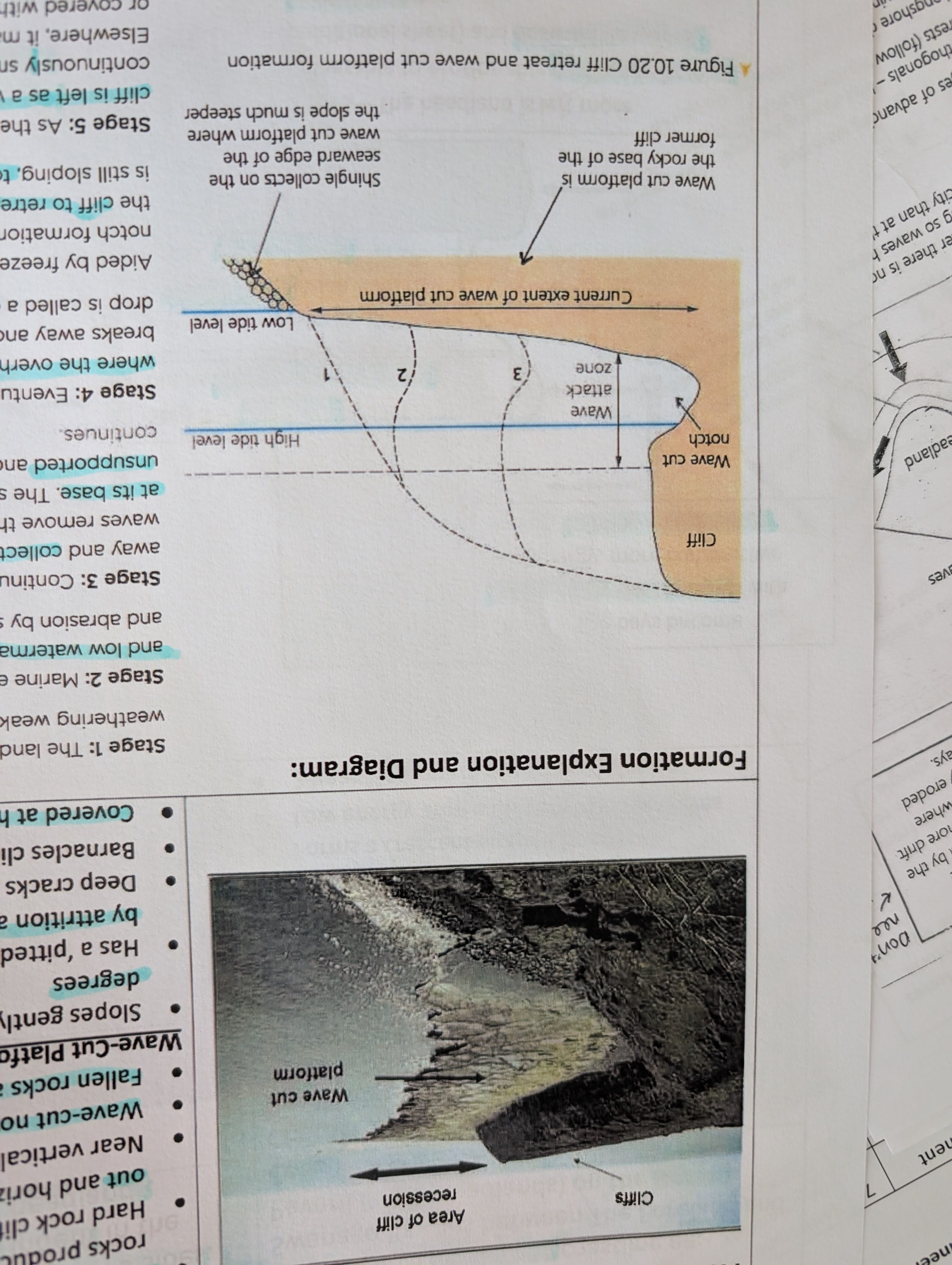
Describe the formation of cliffs and wave-cut platforms.
The land slopes down to the sea. Freese-thaw weathering weakens the rock.
Marine erosion is concentrated between the high and low watermark. Wave pounding by hydraulic action and abrasion by shingle hurled at the land erodes the base.
Continued erosion causes rock to break away and collect at the base of the cliff. Destructive waves remove this material. The cliff now has a notch at its base. The section of the cliff above the notch is unsupported and becomes more precarious as erosion continues.
Eventually the notch can no longer support itself and breaks away and falls onto the beach. The resulting steep drop is called a cliff.
Aided by freeze-thaw weathering, this process of erosion, notch formation and cliff collapse continues. This causes the cliff to retreat towards the land.
As the cliff retreats, the former base of the cliff is left as a wave cut platform.
What are caves, arches, stacks and stumps?
Features created through the erosion of a headland.
Describe an example of where caves, arches, stacks and stumps are found.
Old Harry Rocks (the stacks) at The Foreland and Arch ar Durdle Door, Dorset.
What are characteristics of caves?
Wide entrance becoming smaller further back.
What are characteristics of arches?
Unsupported top of the arch
Wide base with wave cut notches
Water goes all the way through.
Arch is part of the headland.
What are characteristics of stacks?
Detached pillars/ blocks off a headland.
Several metres high.
Wave-cut notches at base.
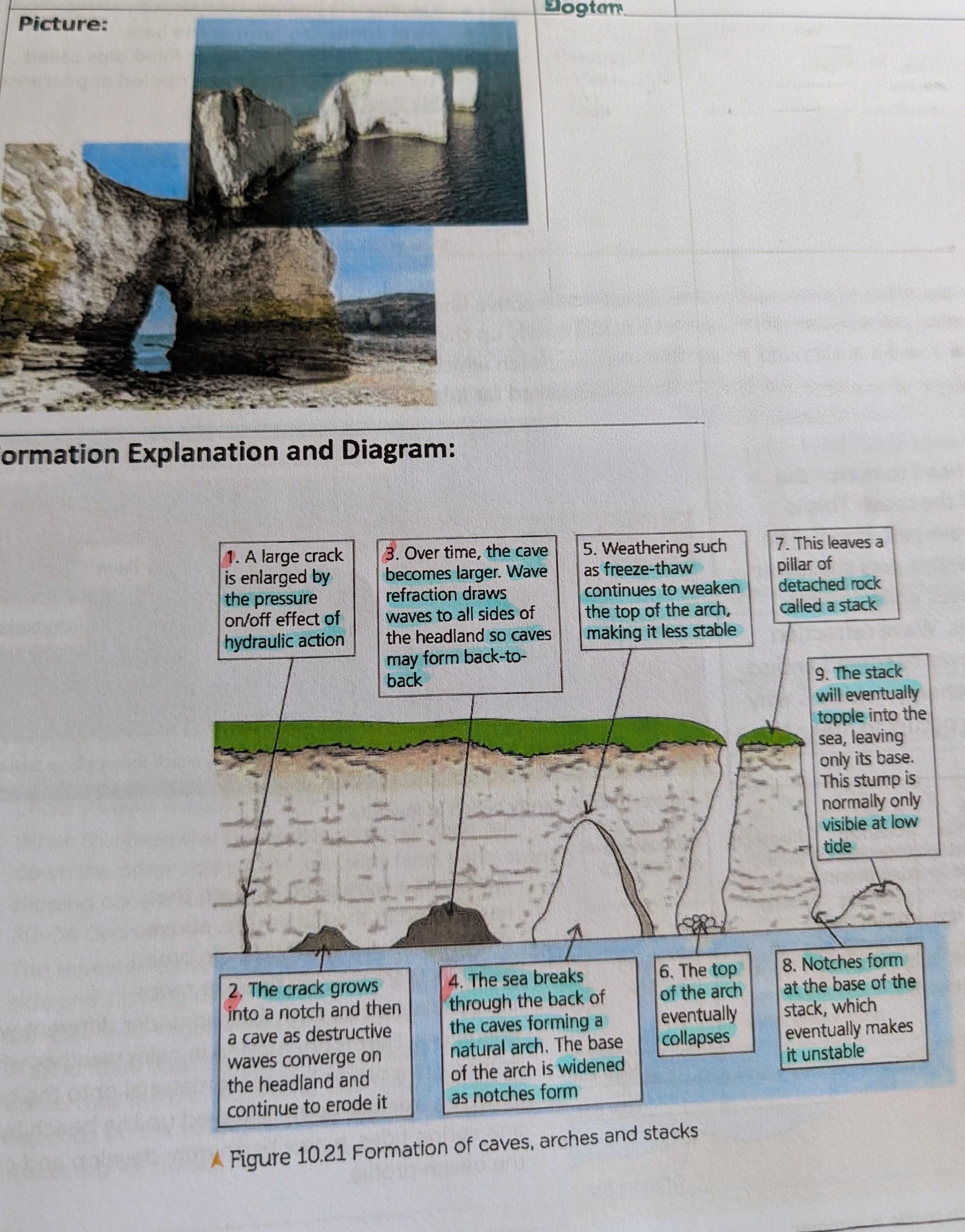
Describe how caves, arches, stacks and stumps are formed.
A large crack is enlarged by the pressure on/off effect of hydraulic action.
The crack grows into a notch and then a cave as destructive waves converge on the headlend and continue to erode it.
Over time, the cave become larger. Wave refraction draws waves to all sides of the headland so caves may form back-to-back.
The sea breaks through the back of the caves forming a natural arch. The base of the arch is widened and notches form.
Weathering such as freeze-thaw continues to weaken the top of the arch, making it less stable.
The top of the arch eventually collapses.
This leaves a pillar of detached rock called a stack.
Notches form at the base of the stack, which eventually makes it unstable.
The stack will eventually topple into the sea, leaving only its base. The stump is normally only visible at low tide.
What is a beach?
Something formed of sand, shingle or pebbles through deposition of sediment between high and low tide.
Give an example of where a sandy and pebbly beach is found.
Sandy - sandbanks, poole, Dorset
Pebbly beach - chesil beach, Dorset
What are characteristics of sandy beaches?
Shallow, almost flat gradient.
Formed by constructive waves.
Usually wide beach.
Sand dunes can form at the back.
At low tide xposes water filled dips called ‘runnels.’ wet sand has rippled appearance.
What are characteristics of pebbly beaches?
Steep gradient
Formed by destructive waves
Usually narrower beach
Back of beach has large pebbles (increases in size with distance from sea).

Describe the formation of a sandy beach.
In sheltered bays, low energy constructive waves transport material onto shore.
Swash is stronger than backwash so sediment is moved slowly up the beach.

What are characteristics of pebbly beaches?
Exposed beaches can have a large fetch which creates destructive waves.
These have a stronger backwash than swash so pebbles not moved far inland creating a steep beach.
What is wave refraction?
When waves enter bays and tend to bend to mirror the shape of the coast.
The way the water gets shallower as the waves enter the bay causes this.
Wave refraction causes waves to spread and so lose their energy, which is why deposition occurs to make the beach.

What are berms?
A terrace on a beach that has formed in the back shore above the water level at high tide.
They are formed in calm weather and constructive waves transport material onto the beach.
What are sand dunes?
Large heaps of sand formed on the back shore of
Describe an example of sand dunes.
Studland bay, dorset
Describe the characteristics of sand dunes.
Unstable
Steep slope (30-34 degrees) on the sheltered leeward side (away from sea)
Crests (up to 15m)
Gentle slope on windward side (facing the sea)

Describe the formation of sand dunes.
When there are obstacles, like driftwood, the heaviest grains of sand will settle against the obstacle to form a small ridge. lighter grains may be transported and settle on the other side of the obstacle.
Eventually, the area facing the wind begins to reach a crest. Ths is because the pile of sand becomes unstable and begins to collapse under its own weight.
When this happens, lighter grains of sand fall down the other side on the lee (slip) face. Sand stops slipping once a stable angle has been reached at 30-34 degrees.
The repeated cycle of wind blowing up the windward side and slipping down the leeward side causes a sand dunes to migrate inland over time.
A sand dunes itself becomes an obstacle, so more dunes form in front of it. The height of the dune depends on the strength of the wind. Stronger winds create higher dunes.
Describe what is needed for sand dunes to form.
A large flat beach
A large supply of sand
A large tidal range so there's time for the sand to dry
An onshore wind to move sand to the back of the beach
An obstacle such as drift wood for the dune to form against.
What is a spit?
A sand or shingle beach that is joined to the land but extends into the sea.
Forms where the coast suddenly changes direction/shape or at the mouth of an estuary.
Give an example of a spit.
Sandbanks spit in Dorset.
What are characteristics of spits?
Narrow beach extending out from the end of mainland
A ‘hook’ at the end that may me ‘recurved’ several times.
Mudflates and saltmarshes behind the spit.
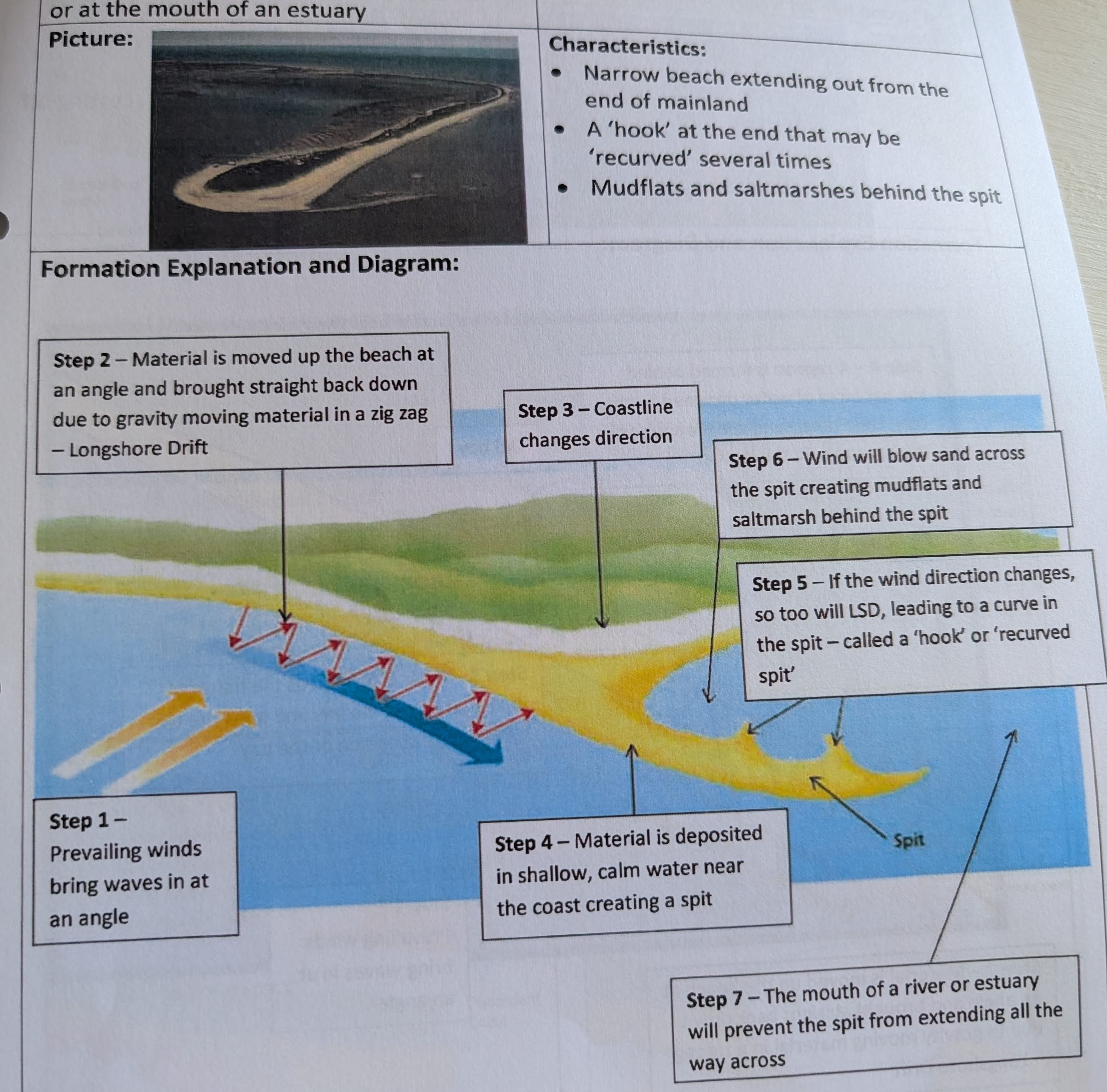
Describe how a spit is formed.
Prevailing winds bring waves in at an angle.
Material is moved up the beach at an angle and brought straight back down due to gravity in zig zag - longshore Drift.
Coastline changes direction.
Material is deposited in shallow, calm water near the coast creating a spit.
If the wind direction changes, so too will LSD, leading to a curve in the spit - called a ‘hook’ or ‘recurved spit’
Wind will blow sand across the spit creating mudflats and saltmarsh behind the spit.
The mouth of a river or estuary will prevent the spit from extending all the way across.
What is a bar?
A ridge of sand or shingle tht stretches from one side of a bay to the other, forming a lagoon behind it (bay bar).
Give an example of where a bar is found.
Slapton Ley, Devon.
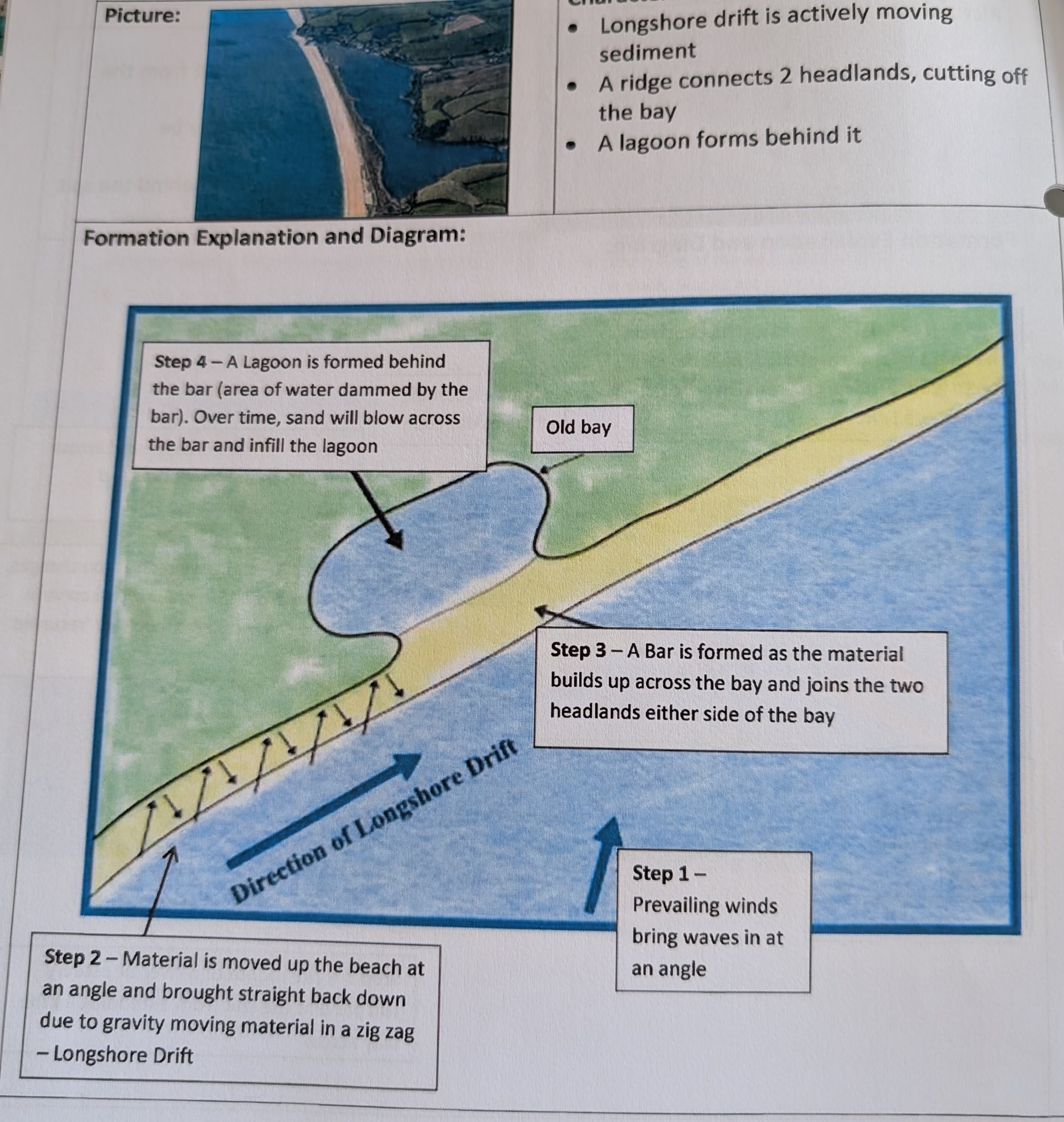
Describe how a bar is formed.
Prevailing winds bring waves in at an angle.
Material is moved up the beach at an angle and brought straight back down due to gravity moving material in a zig zag - LSD
A bar is formed as the material builds across the bay and joins the two headlands either side of the bay
A lagoon is formed behind the bar (area of water dammed by the bar). Over time, sand will blow across the bar and infill the lagoon.
Example of coastline in the UK: describe the Dorset Coast landforms.
An arch in Durdle door
Wave cut platform in kimmeredge
Cliffs in secombe
Headland and cliff in durlston head
Beay and beach in swanage
Stacks as Old Harry
Bay and sand dunes at studland.
Beach, spit and offshore bars at sandbanks
Spit at hurst castle.