MAE 213 Final Exam
 Call Kai
 Learn
Learn Practice Test
 Spaced Repetition
 Match
Match Flashcards
 Knowt Play
1/41

There's no tags or description
Looks like no tags are added yet.
Name | Mastery | Learn | Test | Matching | Spaced | Call with Kai | Chat |
|---|
No analytics yet
Send a link to your students to track their progress
42 Terms
internal shear sign convention?
Positive creates rotation clockwise, down on a left face and up on a right face
internal bending moment sign convention?
Positive bending moment ‘holds water’
What is the principle of the method of sections?
A body in equilibrium cannot, itself, be in equilibrium if cut in half, so there must be internal forces to balance it
Point load effects on V(x) and M(x)?
Constant shear and Linear bending moment
Uniform Distributed load effect on V(x) and M(x)?
Linear V(x) and Quadratic Bending moment contribution
Linear distributed load effect on V(x) and M(x)
Quadratic V(x) contribution and cubic bending moment M(x) contribution
Uniaxial Stress Principle
The normal stress on the bottom and top of a differential element must be equal in magnitude but opposite in sign
Normal Stress equation
N/A
Shear Stress Equation
V/A = Tao
Double Shear Equation
V/2A, common for bolts or pins
Factor of Safety
F fail/ F allow= F.S.
Average Normal Strain equation
dL/ L, or L-L’ /L
Engineering Shear strain
pi/2 - theta, where theta is the degree of the angle, and its measured from 90
Small angle approximation
where dY= radius* radians
(radians= degrees* pi/180)
sin alpha= h/L
or
cos alpha= b/L
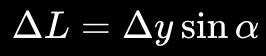
If using the small angle approximation for a wire ALONG the vertical axis
dY = dL, the vertical displacement is equal to the displacement in the wire
Positive for engineering shear strain?
Less than 90 degrees (pi/2) , if it is above the strain is negative
Law of Cos
a²= b² + c² - 2bc*cos(alpha)
Law of Sines
c/ sin (gamma) = b/ sin (beta) = a / sin (alpha)
Conventional Stress-Strain Diagram
Stress is along the vertical axis (y), and Strain is along the horizontal axis (x)
Elastic region
Exists as a straight line following hooke’s law until the yield strength
Hooke’s Law
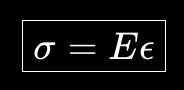
Proportional Limit, Elastic Limit, and Yield strength can be?
All treated as roughly the same place on the stress-strain diagram, they all mark the end or near end of the elastic region
Regions of Stress-Strain Diagram in order
Elastic, Yielding, Strain Hardening, and Necking
In the yielding region, deformation is?
Plastic, cannot return to it’s original shape after
E is?
The modulus of elasticity, the slope of the line in the elastic region
Peak of the stress-strain graph and end of the ____ region?
Ultimate Stress, strain hardening
Ultimate stress to _____ is the ______ region
Fracture stress, necking
Ductile materials?
Those that demonstrate the behaviors as outlined by the stress strain diagram (steel)
Brittle Material
Those that demonstrate little to NO yielding in tension before failure, but they are often strong in compression (concrete)
Modulus of elasticity indicates what property?
Stiffness
Total strain equation
Total strain= Elastic strain + Plastic Strain
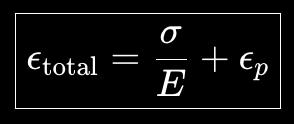
The ‘permanent set’ in deformation?
the total strain- the elastic strain= permanent set
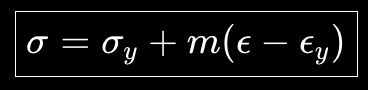
Equation for Stress in the plastic region
where m = max stress- yield stress/ max strain- yeild strain
Displacement’s in Axially Loaded members?
F*L/ A*E
The ONLY WAY to solve for statically indeterminate structures is?
To remove the redundant supports, solve for the displacement, and then recalculate the redundant force with what you know from compatibility conditions and displacement. This is the same for axially loaded and beam structures
Thermail displacement
alpha* dT* L
Scenario in which something isn’t moving, bridge, statically ind, etc, with a thermal ‘displacement’
0= (alpha* dT* L) - (FL/AE)
Stress sign convention?
Compression is negative and tension is positive
When solving axially loads… what is true for the sign convention?
Start on the unbounded side, but while you’re solving, the sign of the arrow is arbitrary. After its solved, decide, are those arrows in compression or tension with the elements of the bar? Tension= Positive force and compression = negative.
Why does the sign of internal force matter for axially loaded systems when calculating displacement?
If a element is compressed, it is moving left, if it is in tension, it moves right, and the total displacement is the sum of these movements.
FL/AE assumes what?
Elastic behavior, if you are dealing with stress/strain in the yielding region, you MUST use strain equations to find elongation, not this
Equation to project displacement down a beam?
Displacement @ known point + r(theta)
where theta is the angle of displacement at that point and r is the distance down the beam your projection,
like the small angle approximation