chemistry in science
 Call Kai
 Learn
Learn Practice Test
 Spaced Repetition
 Match
Match Flashcards
 Knowt Play
1/42

Earn XP
Description and Tags
Name | Mastery | Learn | Test | Matching | Spaced | Call with Kai | Chat |
|---|
No analytics yet
Send a link to your students to track their progress
43 Terms
Atom
The basic building block of all matter
Element
A pure substance made up of only one type of atom
Compound
A substance, made up of two or more different elements (atoms) bonded together in a fixed ratio
Elements in the same period have the same
number of electron shells
Elements in the same group have the same
Number of valence electrons
What is the mass number of an element
The total number of protons and neutrons an atom has
What is the atomic number of an element
The number of protons an atom has.
What is the Bohr model of the atom
Describes electrons as being physical particles, moving on one path in one direction
What is unique about elements in Group 18
All have full valence shells
List 3 properties of Alkali metals
reactive, soft, low melting + boiling points
List 3 properties of Halogens
reactive, toxic, brittle when solid
Properties of metals
malleable, shiny (lustrous), high melting and boiling point, good conducters of electricity and heat, solids, ductile.
Properties of non-metals
dull, low melting and boiling point, bad conductors of electricity and heat, brittle
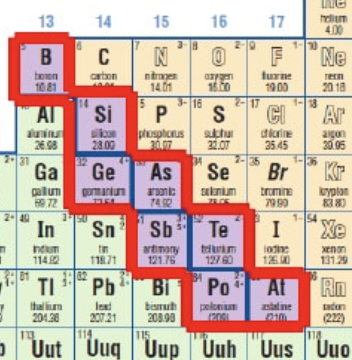
examples of metalloids
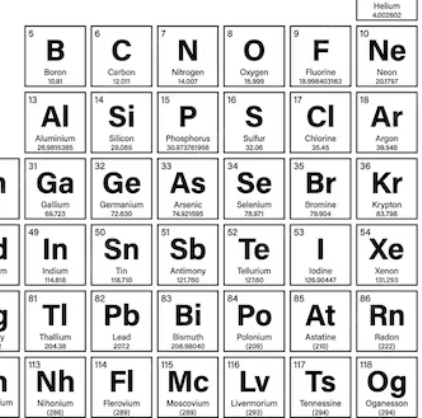
boron, silicon, germanium.
What is the mass of an electron
1/1837
group 1 (not hydrogen)
alkali metals
group 2
alkaline earth metals
group 3-12
transition metals
group 17
halogens
group 18
noble gases

What is the first row called
Lanthanides
What is the second row called
Actinides
properties of noble gases
non-flammable, full valence shell, unreactive, colourless, tasteless
neutrons charge, symbol and location in atom
0, N, nucleus
protons charge, symbol and location in atom
+1, P, nucleus
electrons charge, symbol, and location in atom
-1, e, outside the nucleus
When are protons and electrons not equal
When an atom is not neutral (ions)
The periodic table is arranged in order of
increasing atomic number
columns of periodic table
groups
rows of periodic table
periods
Isotopes
atoms of the same element with different mass number
What are the 2 types of ions? Describe each.
Ions are formed by the gain /loss of electrons
Cations is formed by the loss of electrons. Metals form cations
Anion is formed by the gain of electrons. No metals form anions
How is an ionic bond formed?
Ionic bond is formed by the transfer of electrons between a metal and non metal. Metals lose electrons to form cations, non metals gain electrons to form anions. Due to strong electrostatic force of attraction between the ions, ionic bond is formed.
Isomer
Isomer is a compound that has the same molecular formula but different structural formulas
Metallic bond
Metallic bond is formed due to strong electrostatic force of attraction between positive metal ions and delocalised electrons
Covalent Bond:
Covalent bond is formed due to sharing of valence shell electrons between non -metals.
What is rate of a reaction?
The rate of a reaction is how quickly reactants are converted into products.
Factors that affect rate of a reaction
1.Concentration
2. Temperature
3. Pressure
4. Surface area
5. Catalysts/enzymes
6. Agitation (stirring)
Explain why the rate of reaction increases with the increase in surface area ?
Rate of reaction increases with the increase in surface area because increasing the surface area causes the frequency of successful collisions to increase. Higher the surface area higher the rate of a reaction.
Explain why the rate of reaction increases with the increase in temperature?
With the increase in temperature, rate of a reaction increases due to :
• the particles have more (Kinetic energy) energy and will collide with greater force
• the frequency of collisions will increase, increasing the rate of a reaction
Explain what a catalyst is and give an example of a catalyst.
A catalyst is a substance that increases the rate of a chemical reaction without being used up.
Catalysts enables/helps the reaction to occur at a lower temperature.
Example: Catalytic convertors(containing Platinum) in the car converts toxic carbon monoxide into carbon dioxide
Explain how enzymes are a type of a catalyst .
Enzymes are biological catalysts. They are proteins that help speed up chemical reactions in the body e.g. digestive enzymes
What is activation energy ?
Activation energy is the energy required to start a reaction.