Unit 2 - Erosion and Deposition
 Call Kai
 Learn
Learn Practice Test
 Spaced Repetition
 Match
Match Flashcards
 Knowt Play
1/13

There's no tags or description
Looks like no tags are added yet.
Name | Mastery | Learn | Test | Matching | Spaced | Call with Kai | Chat |
|---|
No analytics yet
Send a link to your students to track their progress
14 Terms
Erosion and Deposition
Erosion and Deposition help to form many of the features we see in the world
Eg:
Features along rivers such as bank erosion (the weathering away of a stream or river)
This is because of the way in which the agents of erosion and deposition act on the natural world
The five agents of erosion and deposition are:
Gravity
The force that pulls things down
The underlying agent for all four other agents
Cause erosion by mass-wasting, which is the down slope movement of rock and sediments where transporting agents like streams and glaciers cand then pick up the material and move it to even lover elevations
Water (Rivers)
Glaciers (Moving Ice)
Sea waves
Wind
Erosion
The process by which soil and rock that has been broken down by weathering is moved from one area of the earth’s surface by natural processes, like wind or waterflow, and then deposited in another location
Transportation
Deposition
Occurs when eroded material is deposited in a new location
The end of the process that started with weathering
Depositing (Placing in the final location)
Rivers
From the river source (where the river starts flowing) to the ocean passes through 3 stages:
Youth stage
Mature stage
Old age stage
Each is characterised by features of erosion and deposition
Youth Stage of Rivers
The beginning of a river
This river flows quickly and with a lot of energy
Smaller and has waterfalls (Steep slopes)
It cuts a narrow channel through mountains
The youth stage is characterised by:
Rapid vertical erosion (Downward erosion that deepens a river channel in the ground)
Mountains
Steep slopes
V-Shaped Valleys
Waterfalls
Rapids (Fast moving parts of a river caused by a steep descent in the riverbed)
Mature Stage of Rivers
A wide valley with a wide floor
More lateral (side) erosion resulting in a U-Shaped valley
Gentle slopes
A narrow flood plain (Level land along the banks of a stream)
Meanders (Bends in a river)
Old Age Stage of Rivers
The relief around the river becomes very flat
River flow is very slow
Meandering (Bends in a river) courses are dominant
Deposition is dominant because the flow is slow and more meandering often causing an oxbow lake (U-Shaped Lake that is formed on a river plain when a river channel is cut off from a main stream) to develop
The sea (Erosion, Deposition and Wave Action)
Wave action has an enormous amount of power that causes erosion and deposition
Deposition associated with wave action often cause spits and barrier islands.
Spits - When waves break along the shore and form sand bars that extend away from the shore
Barrier Islands - Form when the land along the shore is flat or slopes gently. Act as the first layer of defence against storms
Forms beaches
Happens when rivers carry sand, soil and rocks that comes from erosion of mountains and land areas of the continents to the shore
As a result, there are many features associated with wave action
Erosion by wave action is primarily caused by:
Hydraulic action
The force of the water on the cliffs or coastal rocks. The force of water has the power to break the rocks apart
Corrasion (Or abrasion)
When rocks and pebbles are flung by waves wear the coastal rocks away
Attrition
When eroded rock particles are worn down, becoming small and rounded
Corrosion (erosion by chemical action)
When certain rocks and minerals such as chalk and lime are dissolved in water
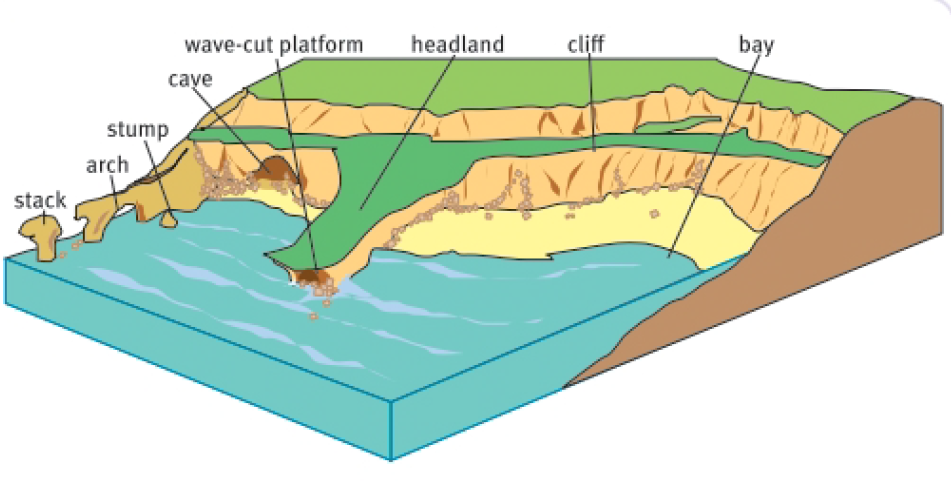
Features asosiated with wave action
A Stack
An isolated pillar of rock that has been separated from a headland by coastal erosion
It is formed by the collapse of an arch
An Arch
A natural bridge formed where a cliff is subjected to erosion by the sea
A stump
A low out crop of rock formed by the erosion of a coastal stack
A Sea Cave
A hollow opening in the base of the sea cliff formed by waves acting on weak parts of the rock
A Wave Cut Platform
A flat surface at the base of a sea cliff formed by wave erosion
A Headland
A narrow piece of land that projects from a coastline into the sea
A Cliff
A steep rock formed by wave erosion along costal landforms
Cliffs are formed by processes the start with the erosion of rock at the foot of the slope when it is acted on by powerful waves
This is called abrasion (The scraping or wearing away of rock by small stones when they rub against the rock)
A Bay
An area of the ocean, sea or lake enclosed by land but with a wide mouth that allows access to the sea
Moving Ice
Moving ice is called a glacier
Moving ice causes erosion by abrasion and plucking
Abrasion is the scraping process caused by the impact of rocks caried in ice upon the bedrock
Plucking is the process by which blocks or pieces of bedrock under the glacier are pulled from the surface as the glacier moves
Features of glacier erosion includes:
Horns
Pyramidal peaks formed when cirques erode a mountain from 3 or more sides
Aretes
Narrow saw-like ridges found in glaciated areas
Cirques
Bowl-shapped depressions found at the head of a glacial valley
Glacial Deposition
Called till or moraine
Till is boulder clay or other sediments deposited by a glacier
Moraine is the till deposited along the edges of a glacier
Terminal (End) Morine is deposited at the furthest advance of a glacier
Recessional (Retreats) moraine is deposited when a glacier retreats
Lateral (Side) moraine is a narrow belt of debris deposits along the side of the glacier
When 2 glaciers move at the same time their lateral moraines can merge to form a medial moraine
Wind erosion
Wind has the ability to erode, transport and deposit material
It is not a very effective method of erosion on its own, but when wind picks up sand particles its power to erode becomes effective
Two important processes in wind erosion are abrasion and deflation
Abrasion is when sand particles carried by the wind wear down on rocks
Deflation is when wind removes loose sand particles from the ground to produce a lowered surface level
Wind erosion Features
Mushroom logs (or pedestals)
When the upper parts of the rocks are less eroded than the bottom leaving a mushroom shape
Hammadas (Bare bedrock areas exposed by wind erosion)
Deep groves
Depressions
Tapered hills
Yardangs (Landforms about 10m high and 100m long aligned to the prevailing wind, steep slopes facing the wind direction)
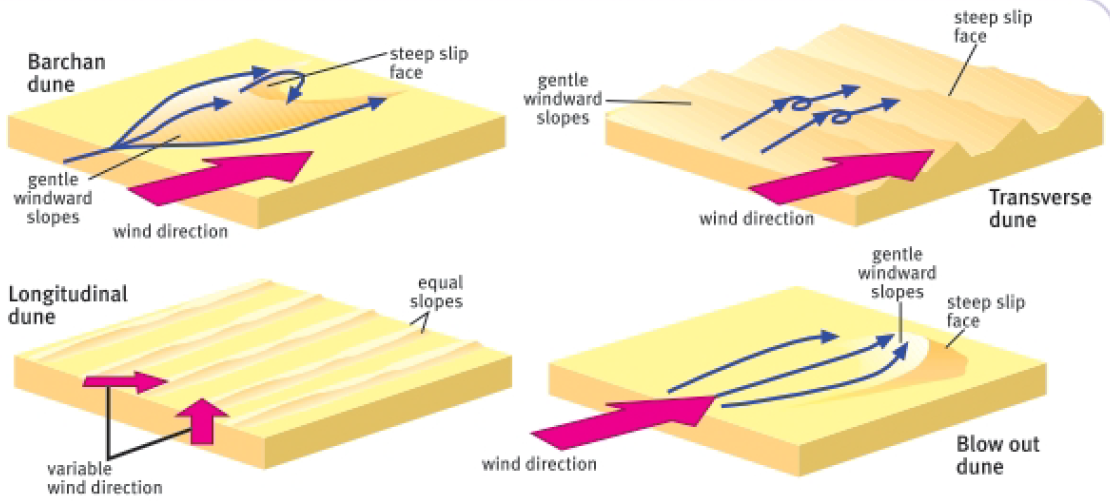
Sand Dunes (4 types)
Wind depositions mainly results in the formation of sand dunes
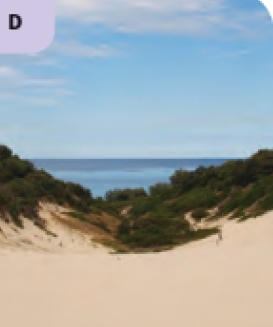
A sand dune is a ridge of windblown sand
Four common dune forms:
Barchans
Occurs when there is a limited
supply of sand and constant wave direction
Gentle windward slopes
Steep slip face
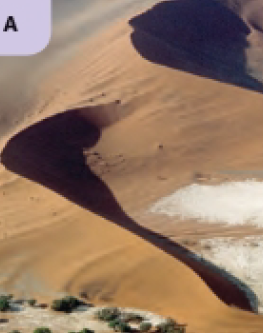
Winding traverse
Form in areas where there is plentiful supply of sand
Gentle windward slopes
Steep slip face
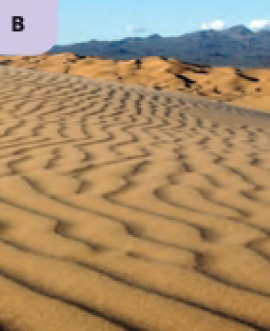
Longitudinal (or liner)
Run parallel to the wind directions
Variable wind direction
Equal slopes
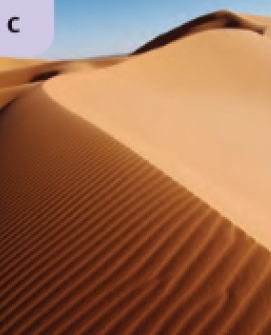
Blowout (or parabolic)
Occurs where vegetation anchors
Gentle windward slopes
Steep slip face