Lecture 14: Pleistocene Extinctions
 Call Kai
 Learn
Learn Practice Test
 Spaced Repetition
 Match
Match Flashcards
 Knowt Play
1/48

There's no tags or description
Looks like no tags are added yet.
Name | Mastery | Learn | Test | Matching | Spaced | Call with Kai | Chat |
|---|
No analytics yet
Send a link to your students to track their progress
49 Terms
When did the extinction of large animals occur in the Americas?
during the late Pleistocene-Early Holocene
What did Comte Buffon criticize the New World fauna as?
“diminutive” and “degenerated” (1766)
What would fossil evidence lead A.R. Wallace (1876) to state?
“We live in a zoologically impoverished world, from which all the hugest, and fiercest, and strangest forms have recently disappeared”
Why did Thomas Jefferson, then president, initiate the Lewis and Clark expedition to cross North America overland in 1804?
in part to search for megafauna to prove Comte Buffon wrong
What did late Pleistocene conditions in Las Vegas Valley during the LGM show evidence of?
no evidence of humans in the valley
Tule Springs Fossil Beds National Monument
held lots of fossils, which were evidence of Megafauna
What were some Late Pleistocene large mammals found in southern Nevada?
Columbian Mammoths (~14.6kya)
Two species of Bison
Three species of Horses:
Yesterday’s Camel
Two species of Ground sloths:
American Lion (Panthera atrox)
Dire Wolf (Canis dirus)
Saber-tooth cat (Smilodon fatalis)
What were the two species of Bison found in Southern Nevada?
Bison latifrans
Bison antiquus
What were the three species of Horses found in Southern Nevada?
Large stout-legged horse (Equus scotti)
Small stout-legged horse (Equus sp.)
Small stilt-legged horse (Haringtonhippus)
What was Yesterday’s Camel?
Western Camel (Camelops westernus)
What were the two species of Ground sloths found in Southern Nevada?
Jefferson’s (Megalonyx jeffersoni)
Shasta (Nothrotheriops shastensis)
What were three of the general theories to the extinction of Megafauna?
As classically interpreted, the ‘arrival’ of Clovis people in North America from Asia
Erratic swing in climate towards the end
Combination of the two
What did erratic swings in climate towards the end mean?
animals simply couldn’t deal with the abrupt change in climate that was too fast for them to adapt to
What was the arrival of Clovis people in North America marked by?
abundant sites across the Americas
When does the arrival of Clovis people in North America date to?
13,400 years ago
Were there any close sites in Siberia?
No
What does genetic data suggest about Clovis people?
only one single colonization event occurred
What was the Clovis First Hypothesis?
the classical interpretation where Clovis people, or “big game hunters”, followed herds through Beringia and then south through an ice-free corridor sometime between ~13,000 years ago
When did evidence of Clovis tools in N.A. date back to?
13,400 years ago
What was the Overkill Model of Megafauna extinction?
Modern Homo sapiens were novel predators that overkilled animals
How were modern Homo sapiens thought to be novel predators?
by being ecosystem engineers: through fires and built traps
Who developed the Overkill Model of Megafauna extinction?
Paul Martin in 1973
Why were extinctions not limited to N.A.?
not temporally linked to specific climatic periods across continents (extinction occurred from 50-10ka across continents)
not observed during previous glacial-interglacial transitions
strong correlation with the arrival of novel predator species, modern Homo sapiens
Why did size matter in terms of extinction?
the bigger the species was, the more likely they were to go extinct
the smaller the species was, the less likely they were to go extinct
Why did size not impact Africa Megafauna similarly?
they coevolved with humans as they figured out how to deal with humans to avoid being hunted
Spatial-temporal correlation
percent of Megafauna extinction
distributions of Homo sapiens
change in temp
there is some correlation
What were some Pleistocene hunting technology?
atlatl
clovis point
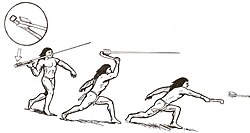
What is an atlatl?
a spear-thrower (tool) used to provide leverage for greater velocity and distance
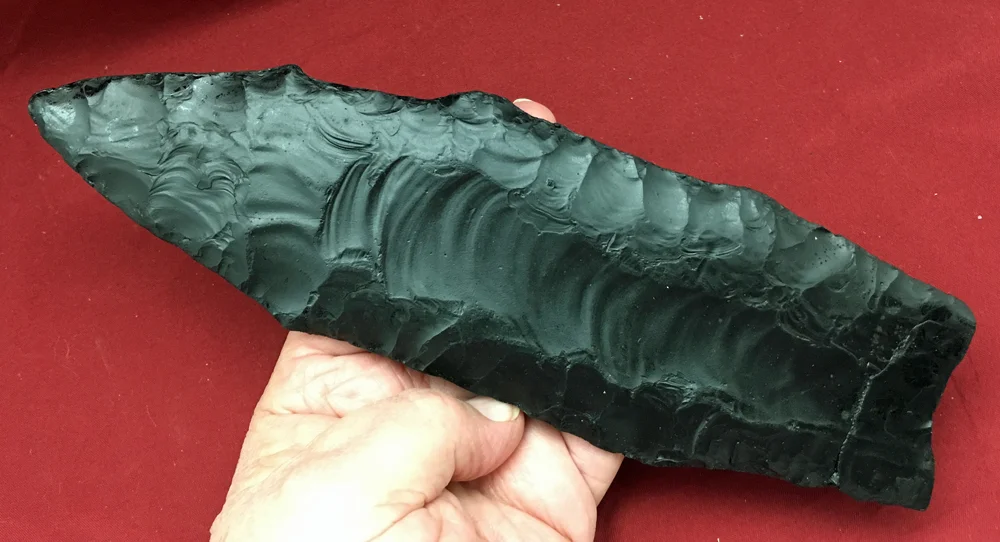
What is a Clovis point?
fluted stone projectile points; ~14Kya
What did technology evolve for?
hunting and big game
What were some support for human impacts in the Americas?
Indisputable hunting of some extinct species
Clustering of extinctions around first contact with Clovis people
Widespread distribution of Clovis people
Support from simulations of hunting impact
Extinctions during the latest glacial-interglacial transition were more pronounced than during any of the earlier climate changes throughout the Pleistocene
At the end of the last glaciation, the Northern Hemisphere plunged back into and then out of glacial conditions for decades
What were some problems with the Overkill hypothesis?
Evidence of humans as the primary driver is predominantly correlative
Argument uses "untested" assertions about human-environment interactions: can't test interactions with extinct organisms
Direct evidence of megafauna hunting by Pleistocene humans is rare despite a rich fossil record: lots of evidence that humans hunted
The argument has a political connotation that supports common environmentalist perspectives of humans as a wholly destructive species
Data accumulating that humans may have arrived earlier in the Americas (south of Alaska)
Evidence of humans as the primary driver is predominantly?
correlative
Argument uses "untested" assertions about human-environment interactions:
can't test interactions with extinct organisms
Direct evidence of megafauna hunting by Pleistocene humans is rare despite a rich fossil record:
lots of evidence that humans hunted
The argument has a political connotation that supports common environmentalist perspectives of humans as?
a wholly destructive species
Data accumulating that humans may have?
arrived earlier in the Americas (south of Alaska)
What was the Coastal Migration Hypothesis?
Modern humans arrived much earlier in the Americas, following a coastal route by boat to jump from one ice-free patch in another until arriving south of the glaciers
Why was there no evidence for Coastal Migration Hypothesis?
evidence was washed away by coastlines/oceans
What does the Coastal Migration Hypothesis assume?
that Pre-Clovis people had their own technology and a more coastal lifestyle
There was not a lot of evidence of humans in the Americas before Clovis people, but:
Non-Clovis style spear points and tools dating to 14 - 16 Ka
In Paisley Cave, Oregon, human mtDNA extracted from coprolites dating to 14,300 years ago matched with common haplotypes found in modern Native Americans
In White Sands, New Mexico, ancient fossilized footprints were found, 21,000 - 23,000 years old (children's and teenagers’ footprints)
Several other sites with non-Clovis lithic artifacts beneath Clovis artifacts
When did Non-Clovis style spear points and tools date back to?
14 - 16 Ka
In Paisley Cave, Oregon, human mtDNA extracted from coprolites dating to 14,300 years ago:
matched with common haplotypes found in modern Native Americans
In White Sands, New Mexico, ancient fossilized footprints were found:
21,000 - 23,000 years old (children's and teenagers’ footprints)
What is the genetic data and other observations beginning to support?
the perspective that Clovis people did not migrate south from Beringia, instead their culture may have evolved in the Americas from people already here
Novel technology and culture:
allowed Clovis people to hunt Megafauna, gaining access resources not generally pre-Clovis people
Clovis populations spread
Where does this leave us?
Evidence now seems to dispute the traditional Clovis First Hypothesis
However, it is fairly clear that the Clovis People played a role in hunting, changing fire regimes
How does speculation remain regarding climate change?
the erratic swings in temperature would have been difficult to tolerate
Lots of evidence that both humans and climate were?
synergistic