Unit 3: section 9 - Glycolysis, Citric Acid Cycle and Oxidative Phosphorylation, and Fermentation
 Call Kai
 Learn
Learn Practice Test
 Spaced Repetition
 Match
Match Flashcards
 Knowt Play
1/25

Earn XP
Description and Tags
the process of Cellular Respiration, which uses sugars to make ATP. The process has many different steps: glycolysis, the citric acid cycle, and oxidative phosphorylation. When oxygen is not available, cells will go through a process called Fermentation.
Name | Mastery | Learn | Test | Matching | Spaced | Call with Kai | Chat |
|---|
No analytics yet
Send a link to your students to track their progress
26 Terms
what is ATP?
is a small, relatively simple molecule, but within its bonds contains the potential for a quick burst of energy that can be harnessed to perform cellular work. is used to power the majority of energy-requiring cellular reactions.
why cant a cell store signifigant amounts of free energy?
Excess free energy would result in an increase of heat in the cell, which would denature enzymes and other proteins, and thus destroy the cell.
how do cells accomplish safe energy storage and relesse it only when needed?
using ATP. It functions as a rechargeable battery.
What is the heart of the ATP molecule?
adenosine monophosphate (AMP),
what is adenosine monophosphate (AMP) composed of?
adenine molecule bonded to both a ribose molecule and a single phosphate group
what is Glycolysis?
is the first step in the breakdown of glucose to extract energy for cell metabolism. Many living organisms carry out glycolysis as part of their metabolism.
where does Glycolysis take place?
in the cytoplasm of most prokaryotic and all eukaryotic cells.
what are the two distinct phases of Glycolysis?
In the first part of the glycolysis pathway, energy is used to make adjustments so that the six-carbon sugar molecule can be split evenly into two three-carbon pyruvate molecules. In the second part of glycolysis, ATP and nicotinamide-adenine dinucleotide (NADH) are produced
If the cell cannot catabolize the pyruvate molecules further… what will happen?
it will harvest only two ATP molecules from one molecule of glucose. For example, mature mammalian red blood cells are only capable of glycolysis, which is their sole source of ATP. If glycolysis is interrupted, these cells would eventually die.
Where in a eukaryotic cell do the citric acid cycle and oxidative phosphorylation take place?
Inside the mitochondria
What happens to pyruvate before it can enter the citric acid cycle?
Pyruvate is transported into the mitochondria and transformed into a two-carbon acetyl group (releasing $CO_2$). It is picked up by coenzyme A (CoA) to form acetyl CoA, which delivers the acetyl group to the citric acid cycle
What are the key products/outputs produced per turn of the citric acid cycle?
CO_2 (released as waste)
ATP (or GTP, depending on cell type)
NADH
FADH_2
What is the primary job of NADH and FADH_2 produced during glycolysis and the citric acid cycle?
They act as electron carriers that deliver high-energy electrons to the electron transport chain during oxidative phosphorylation
Overall, what percentage of the energy contained in glucose is extracted by the pathways of glucose catabolism in living systems?
About 34 percent. (The rest is lost as heat).
Are all intermediate molecules in glycolysis and the citric acid cycle used solely to produce energy?
No. Intermediate molecules can be removed from these pathways to synthesize other essential biological molecules, such as nucleic acids, amino acids, and lipids.
What causes mitochondrial diseases, and what is the primary cellular consequence?
They are genetic disorders caused by mutations in nuclear or mitochondrial DNA. The primary consequence is that body cells produce less energy (ATP) than normal.
What is acetyl CoA?
its major function is to deliver the acetyl group derived from pyruvate to the next pathway in glucose catabolism.
what is oxidative phosphorylation?
the final stage of cellular respiration where cells generate ATP.
what is a electron transport chain?
a series of protein complexes and molecules in the inner mitochondrial membrane. It transfers electrons from donors (NADH and FADH₂) to oxygen. This energy pumps protons (H⁺) across the membrane, creating a gradient that drives ATP synthase to produce ATP.
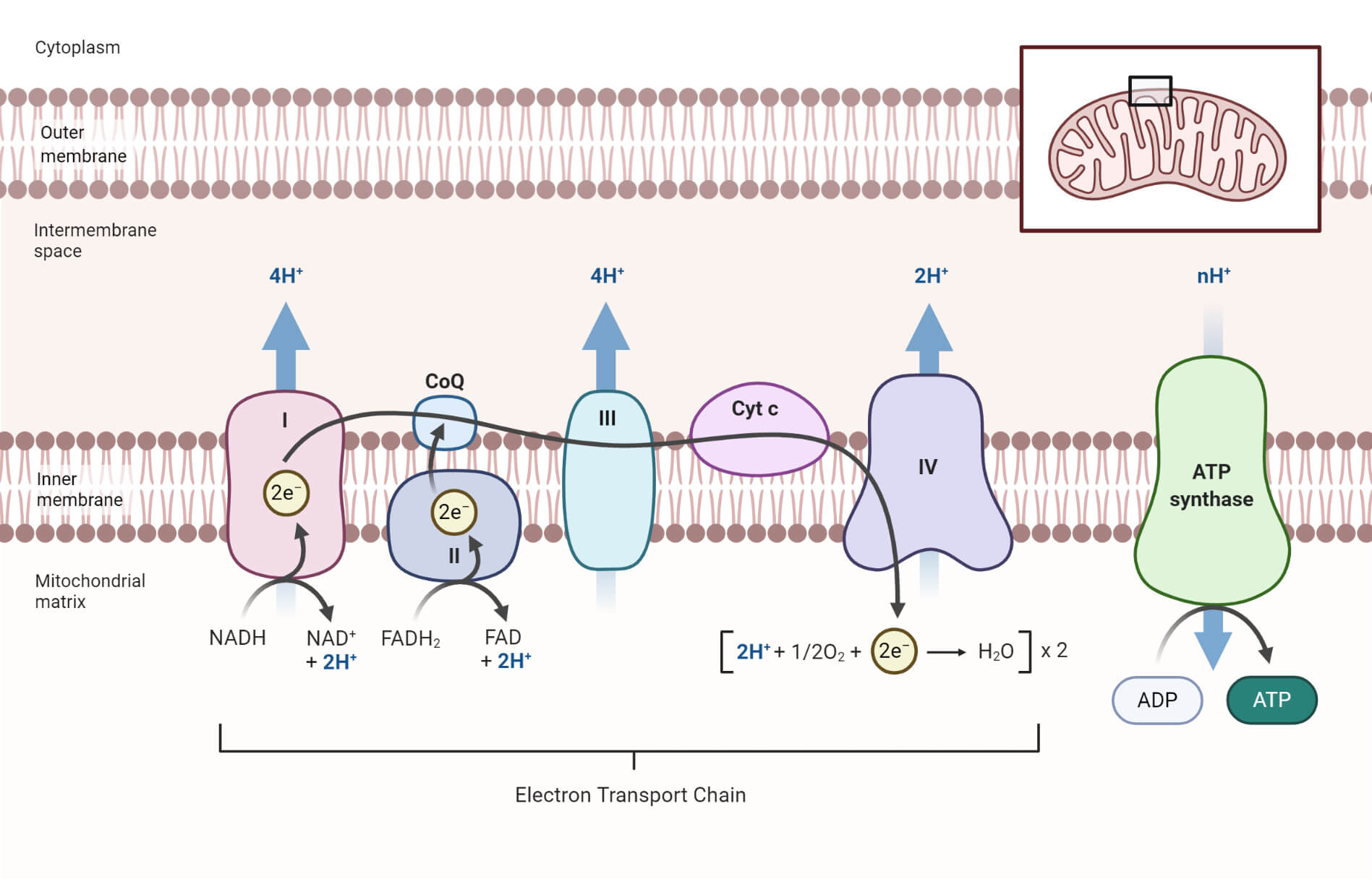
what is a ATP synthase?
a specialized enzyme that creates adenosine triphosphate (ATP), the primary energy currency of the cell. Found in mitochondria, chloroplasts, and bacteria, it functions like a molecular rotary motor. It captures energy from a flowing stream of protons to stitch a phosphate group onto ADP.
what is chemiosmosis?
the process by which ions move across a selectively permeable membrane down their electrochemical gradient.
What is the primary purpose of fermentation pathways when oxygen is absent?
To regenerate NAD+ from NADH so that glycolysis can continue to harvest ATP.
What is the key difference between fermentation and anaerobic cellular respiration?
Fermentation uses an organic molecule to regenerate NAD+ from NADH. and Anaerobic cellular respiration uses an inorganic molecule (other than oxygen) as the final electron acceptor in an electron transport chain.
What are the two end products formed during alcohol fermentation (such as in yeast)?
Ethanol (alcohol) and CO_2 (carbon dioxide gas).
What is the difference between a facultative anaerobe and an obligate anaerobe?
Facultative anaerobes can switch between aerobic respiration and fermentation depending on whether oxygen is present. Obligate anaerobes live only in the absence of oxygen; oxygen is poisonous to them and kills them upon exposure
Which major fermentation pathway generally does not produce gas?
Lactic acid fermentation generally does not result in gas production.