UWCSEA - IB Biology 2023 - D2.1 - Cell and nuclear division
 Call Kai
 Learn
Learn Practice Test
 Spaced Repetition
 Match
Match Flashcards
 Knowt Play
1/21

There's no tags or description
Looks like no tags are added yet.
Name | Mastery | Learn | Test | Matching | Spaced | Call with Kai | Chat |
|---|
No analytics yet
Send a link to your students to track their progress
22 Terms
D2.1.1—How are new cell generated in living organisms?
In all living organisms, a parent cell;
often referred to as a mother cell;
divides to produce two daughter cells;
via cell division
through mitosis; and cytokinesis;
D2.1.2—How do the new cells split the cytoplasm between them?
in animal cells a ring of contractile actin and myosin proteins; pinches a cell membrane together to split the cytoplasm;
in plant cells;
vesicles assemble sections of membrane;
and cell wall to achieve splitting;
D2.1.3—When is division of cytoplasm even? When is it uneven? What happens with mitochondria for the new cells?
the division of cytoplasm is usually even;
and that both daughter cells must receive at least one mitochondrion and any other organelle that can only be made by dividing a pre-existing structure;
however in egg formation in humans (and other animals);
called oogenesis;
it is uneven, with one cell getting almost all the cytoplasm;
and budding in yeast is also uneven;
D2.1.4—What is the a brief role of mitosis and meiosis in eukaryotes?
Nuclear division is needed before cell division to avoid production of anucleate cells;
cells without a nucleus;
Mitosis maintains the chromosome number and genome of cells;
whereas meiosis halves the chromosome number and generates genetic diversity;
D2.1.5—What is required before both mitosis and meiosis (in terms of genetic information)? What is the form of the genetic information at the start of these processes?
DNA replication comes first;
after replication, each chromosome consists of two elongated DNA molecules;
called chromatids;
held together until anaphase;
D2.1.6— What are shared features between meiosis and mitosis in terms of movement and packaging of DNA?
Both include supercoiling of DNA;
using histones proteins;
in the condensation of DNA by supercoiling;
and the use of microtubules and
microtubule motors;
to move chromosomes;
D2.1.7—What are the phases of mitosis in order? What is ultimately produced by mitosis?
Prophase:
Supercoiling (condensation) of chromosomes;
breakup of nuclear membrane;
growth of microtubules;
attachment of microtubules to chromosomes;
Metaphase - Chromosomes line up at the equator
Anaphase - division of centromeres;
sister chromatids move to opposite poles;
Telophase - reformation of nuclear membranes around chromosomes at each pole;
D2.1.8—What does prophase look like?
Supercoiling (condensation) of chromosomes;
breakup of nuclear membrane;
growth of microtubules;
attachment of microtubules to chromosomes;
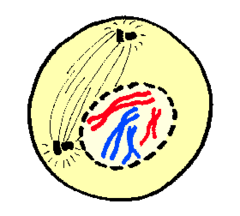
D2.1.8—What does metaphase look like?
Chromosomes line up at the equator

D2.1.8—What does anaphase look like?
division of centromeres;
sister chromatids move to opposite poles;

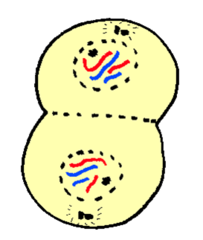
D2.1.8—What does telophase look like?
reformation of nuclear membranes;
around chromosomes at each pole;
D2.1.9— Why is meiosis necessary in sexually reproducing organisms? What does diploid mean? Haploid?
Diploid means two sets of each chromosome; 2n;
they are in pairs;
haploid means one set of chromosomes;
meiosis involves two divisions of a diploid cell;
to produce four haploid nuclei;
in meiosis chromosome pairs (a pair of the same chromosomes) separate in the first division and sister chromatids are pulled apart in the second;
Stages of meiosis essay from IB
prophase I;
chromosomes condense during
(homologous) chromosomes pair up
crossing over happens as chiasmata form
metaphase I;
movement of pairs of chromosomes known as bivalents to the equator in
random assortment of chromosomes along equator;
anaphase I;
movement of half of the chromosomes to each pole
telophase I,
chromosomes uncoil;
reduction of chromosome number to haploid;
metaphase II
(double-stranded) chromosomes line up on the equator and are attached to both poles at the centromere;
anaphase II;
sister chromatids move to opposite poles in
telophase II;
decondensation and uncoiling in reformation of nuclear membranes;
cytokinesis then occurs;
tetrad of haploid daughter cells formed.
D2.1.10—What is disjunction? How does Down syndrome result from it?
non-disjunction is when chromosomes and or chromatids do not separate correctly;
and therefore go to the same pole;
non-separation of (homologous) double-stranded chromosomes during anaphase I;
also known as bivalents;
due to incorrect spindle attachment;
ALSO due to non-separation of chromatids during anaphase II;
due to centromeres not dividing;
occurs during gamete formation;
less common in sperm than egg formation;
Down syndrome due to extra chromosome 21;
called trisomy 21;
sperm or egg receives two chromosomes of same type; offspring has three chromosomes of same type;
D2.1.11—Why is meiosis a source of genetic diversity? When do the events responsible happen?
due to crossing over;
during prophase I;
leading to new combinations of alleles/genes on chromosomes;
random orientation of chromosomes during metaphase I;
leading to different chromosomes (maternal or paternal) being selected for each gamete;
almost infinite variety created;
HL ONLY - D2.1.12—What is cell proliferation? How is it used for growth, cell replacement and tissue repair?
proliferation (making more cells) is used for growth within plant meristems; the regions of growth at the end of shoot tips and root tips;
and early-stage animal embryos;
in skin, cell proliferation is used during routine cell replacement;
and during wound healing;
HL ONLY - D2.1.13—What is the cell cycle? What are the phases?
Cell cycle is the period between one cell division and the next;
Interphase is what happens between mitosis;
Composed of G1, G2 and S;
G1: the cell grows; duplicates organelles e.g. mitochondria and extra cytoplasm including enzymes;
synthesises proteins;
S: The stage during which DNA is replicated
G2: more growth
HL ONLY - D2.1.14— How does the cell grow during interphase?
interphase is a metabolically active period;
there is biosynthesis of cell components including proteins and DNA;
Numbers of mitochondria and chloroplasts increase;
through growth and division of these organelles;
HL ONLY - D2.1.15—How is the cell cycle controlled?
Cyclins are proteins that control the movement through different phases of the cell cycle;
e.g. from G1 to S;
the concentration of different cyclins increases and decreases during the cell cycle;
and a threshold level of a specific cyclin is required to pass each checkpoint in the cycle.;
if this doesn't happen, the division will stop;
HL ONLY - D2.1.16—How can mutations in genes that control the cell cycle caused cancer?
mutations in proto-oncogenes;
convert them to oncogenes;
which lead to tumour formation;
and mutations in tumour suppressor genes;
which normally stop tumour formation;
result in uncontrolled cell division;
known as cancer;
HL ONLY - D2.1.17 — How are tumour cells different than normal ones? How do they spread? Which tumours are not usually harmful? Which are?
benign tumours are not normally harmful as they do not spread, invading other tissues;
malignant tumours however can spread and invade other tissues;
a primary tumour is the site of the first cancer;
a secondary tumour is one that has moved to a different site;
HL ONLY - D2.1.17 — What is a mitotic index?
the mitotic index is the number of cells in mitosis (prophase, metaphase, anaphase, telophase and cytokinesis);
divided by the total number of cells;
gives an indication of how many cells out of the total are in a state of cell division;
high mitotic index in root tips;
and other regions of cell division;
or tumours;