Cervical Unit- Background and condition specific information
 Call Kai
 Learn
Learn Practice Test
 Spaced Repetition
 Match
Match Flashcards
 Knowt Play
1/33

There's no tags or description
Looks like no tags are added yet.
Name | Mastery | Learn | Test | Matching | Spaced | Call with Kai | Chat |
|---|
No analytics yet
Send a link to your students to track their progress
34 Terms
what are the different kinds of cervical spine pathologies?
can be myogenic, mechanical, anatomical, neurogenic, psychosomatic (and acute, chronic, acute on chronic)
what are the preferred/biased movements in the cervical spine based on the anatomy of the cervical vertebrae?
flexion/extension, lateral flexion, and rotation
which artery is susceptible to damage or stretching/compressio9n due to osteophyte formation and sclerotic build up in the cervical region?
the vertebral artery (since runs through the transverse foramen
describe the 5 Ds and 3Ns that occur with vertebral artery damage
dysarthria
dysphagia
diplopia
dizziness
drop attacks
nystagmus
numbness around the nose and mouth
nausea
how can you tell if there is internal carotid damage and not vertebral artery damage?
internal carotid dysfunction typically occurs in younger patients, and see presentation of horners syndrome (miosis, anhidrosis, ptosis)
what is unique about the ligamentum flavum?
has a high concentration of elastin, is yellowish but is especially susceptible to age related changes (decreased water content, leads to reduced elasticity)
about how much motions is available at the AO joint?
5 degrees of flexion, 10 degrees of extension, negligible rotation, and 5 degrees of lateral flexion
about how much motion is available at the AA joint complex?
5 degrees of flexion, 10 degrees of extension, 35-40 degrees of rotation, and negligible lateral flexion
how much motion is available at the intracervical region?
35-40 degrees of flexion, 55-60 degrees of extension, 30-35 of both lateral flexion and rotation
how do the zygopophyseal joints move during rotation?
to the ipsilateral side (to the side of rotation) the joints approximate and gap on the opposite side
what is the prevalence of neck pain in PT practice?
2nd most common body region treated (after LBP) and is also second to LBP in annual worker’s compensation costs
what are the risk factors for acquiring neck pain?
age (40 years or older)
co-existing LBP
cycling
loss of hand strength
worrisome attitude
poor QOL
less vitality
what are items that may determine poor prognosis for neck pain?
6 or greater on NPRS
high self reported disability
high pain catastrophizing
high acute post-traumatic stress symptoms
cold hyperalgesia
what are the 4 classifications for neck pain?
neck pain with mobility deficits
neck pain with radiating pain
neck pain with movement coordination deficits
neck pain with headaches
which disorders fall under neck pain with mobility deficits?
degenerative joint disease, degenerative disc disease, fracture, facet dysfunction, spondylosis/OA, stenosis
describe the typical characteristics of neck pain with mobility deficits
pain is gen localized to the neck, prox humerus, or scapular region
limited ROM
usually no associated radicular symptoms (except in stenosis)
pain is reproduced with segmental motion or ROM assessment
may be associated weakness of neck musc or periscapular musc
onset is gradual
stiffness with sustained positions and better with motion
what is spondylosis/cervical OA?
spondylosis is a loss of disc height and changes to the vertebral body, OA is a loss of space in the zygopophyseal joint (both may be evident on imaging but asymptomatic) and either can lead to spondylolithesis (usually anterior slippage of 1 vertebrae to another)
what is spondylolisthesis?
a condition where one vertebra slips forward over the one below it, often due to degeneration of the intervertebral disc or a defect in the pars interarticularis. This displacement can cause nerve compression and result in pain or other neurological symptoms.
what are the physical examination findings of spondylosis?
reduced motion, capsular pattern, possible “giving way” or catch in movement
describe facet joint dysfunction/zygopophyseal joint syndrome
generally acute onset
usually in younger pop
“neck stiffness/slept wrong”
usually directionally specific with closing pattern (when turn left it hurts on the left)
localized muscle guarding
imaging tends to be unremarkable
describe the referral patterns of facet/zygopophyseal joint dysfunction/syndrome
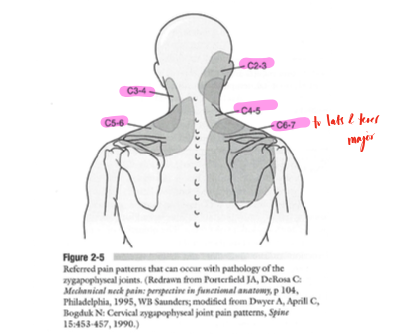
C2-C3 refer pain to the back of the lead and laterally, C3-C4 to the lateral neck, C4-C5 into the lateral neck and part of the upper trapezius, C5-C6 into the UT, and C6-C7 into the scapular region (see image)
what is stenosis?
narrowing of the spinal canal or foramen that can lead to compression of neural structures and resultant symptoms.
what are the symptoms of central stenosis (which occurs more often in middle age and older pops)?
hypperreflexia below the level of the injury, + UMN reflexes, possible muscle atrophy, LE weakness, wide based gait, altered/poor balance, UE and LE parasthesia
what are the symptoms of foraminal stenosis?
unilateral (more common) or bilateral symptoms, hyporeflexia, dermatomal sensory changes, myotomal strength deficits, hand weakness (think similar to herniated disc which usually affects 1 segment)
what is the cervical myelopathy cluster?
gait deviation
+ hoffmans test
inverted supinator sign
babinski
age over 45
post test prob 94% when 3/5 of above are present
what things may cause stenosis?
anything encroaching on the central canal or nerve root (bone spurring/arthritis, retrolisthesis, ligamentum flavum hypertrophy, large disc herniations, tumors)
how does foraminal stenosis typically present?
present similar to discogenic problem (herniation) but is due to arthritis of the neck (think aged population), radiating symptoms may be intermittent and be position dependent, myotomal weakness may be present, hyporeflexia, no UMN signs, parasthesias
what are some reasons for neck pain wirth movement coordination deficits?
often thought of as whiplash (acute)
can also be caused by
hypermobility/laxity
poor posture/motor control
poor muscular endurance (scapular and cervical musculature)
can be related to concussion and other trauma
describe the staging of movement coordination deficits
acute is often very guarded
traction often painful AND compression
increased muscle tone
multiple structures irritated
may present with concussion symptoms
what are risk factors for delayed recovery for whiplash associated disorders?
decrease in spine mob immediately after acciden t
pre-existing neck trauma
older
female
psychological factors
pending litigation
describe neck pain with headaches
aka “cervicogenic headaches”
usually unilateral “ram’s horn presentation”
provocated by sustained neck positions
sensitive to external pressure or manual palpation over th eupper cervical C0-C2 region
symptoms usually starts in neck/base of head (subocciptal) and progress superiorly/anteriorly
what “unusual symptoms” might present with cervicogenic headaches?
can have unusual symptoms- photophobia, phonophobia, nausea, autonomic signs and symptoms, and dizziness