Complete Denture (Midterm Exam): Week 1
 Call Kai
 Learn
Learn Practice Test
 Spaced Repetition
 Match
Match Flashcards
 Knowt Play
1/211

There's no tags or description
Looks like no tags are added yet.
Name | Mastery | Learn | Test | Matching | Spaced | Call with Kai | Chat |
|---|
No analytics yet
Send a link to your students to track their progress
212 Terms
Complete denture prosthodontics
Define the following:
The replacement of all of the natural teeth in an arch and their associated parts by artificial substitutes. They are supported by the edentulous ridges and the mucosa
- Number of adults needing complete denture is increasing
- Learn about occlusion
- Learn about tooth anatomy, tooth position, and esthetic
Why do we learn about complete denture?
Entire peripheral roll
Custom trays edges are reduced so they are a couple millimeters short of the ________
Border molding
________ is performed to develop correct width and height of the extensions of the tray
Camper's plane (ala-tragus)
What plane do you adjust the occlusal rim according to?
First clinical visit
What clinical visit number includes the following:
- Completion of the electronic records
- Complete the patient's interviews and health history on AxiUm
- Determine the diagnosis and the treatment plan
- Complete the Denture Interview and Evaluation Form
- Have your P.C. approve all of the above
- Obtain a prosthodontic consultation
Philosophical
What house classification is the following:
One who willingly accepts the dentists judgement
Exacting
What house classification is the following:
One who is demanding, involved and has many questions
Indifferent
What house classification is the following:
One who has low motivation, appreciation, and will easily give up
Hysterical
What house classification is the following:
Unstable and never satisfied
C. Indifferent
According to the House Classification, what kind of patient has the worst prognosis?
A. Philosophical
B. Exacting
C. Indifferent
D. Hysterical
True
T/F: Trays are made with stock tray, which can be constructed either in metal or plastic and may be perforated or unperforated
5mm
When taking the preliminary impression, the height and width of the residual ridges should be observed to select the proper tray. An edentulous stock tray that is approximately ____mm larger than the outside surface of the residual ridge is selected.
Mylohyoid ridge
It is particularly important for preliminary mandibular impression in the area of the lingual flange. If the tray is not extended beyond the ___________, the lateral border of the tongue will wash off all the alginate and the impression obtained will not capture the lingual area. As a result, the custom will be under extended and a large amount of compound for border molding will need to be added to compensate for this deficiency. However, compound material is brittle and extending the custom tray with compound over 2 mm with is very challenging.
Alginate
Even a correctly selected stock tray will not fit the denture bearing area perfectly. Therefore when the impression is made, the objective is to obtain a preliminary impression that is slightly overextended around the borders.
It is advisable to select an impression material that has a relatively high viscosity (mucocompressive), thereby allowing the material to compensate more easily for the deficiency of the tray. The most suitable material is ____________
Because the triad used to make custom trays shrinks and if the undercuts are not blocked out, the custom trays would be locked/stuck after curing
Why do you need to block out any undercuts when making the custom trays?
Upright
How should you seat the patient when taking a maxillary impression?
45 degrees back
How should you seat the patient when taking a mandibular impression?
Border molding
Define the following:
The shaping of the border areas of an impression tray by functionally or manually manipulating the tissue adjacent to the tray borders in order to duplicate the contour and size of the peripheral roll areas
If you do not have the entire left and right hamular notches included on the impression!!
When would you absolutely have to retake maxillary impressions?
If you do not have the entire retromolar pads and retromylohyoid areas on the impression!!
When would you absolutely have to retake mandibular preliminary impressions?
True
T/F: All impressions MUST be disinfected before leaving the dental operatory
1 µm / min
What is the deformation rate of alginate?
False - rinse the impression and shake off excess before saturating with lodophor disinfectant (wrap in a wet towel until pouring cast --> poor ASAP)
T/F: You should not rinse the preliminary impression under cool running tap water
Place alginate with your finger into the palatal vault, peripheral walls (maxilla) and vestibular folds (mandible) - Be sure there are no voids under the alginate material
This allows you to capture all of the necessary anatomy
When taking an alginate impression of the edentulous patient, it is important to use a finger and place alginate where? Why?
mean foundation plane of the maxillary cast
Define the following:
_______ is from the midline crest of the residual ridge, anteriorly, to the crests of the left and right tuberosities, posteriorly.

mean foundation plane (MFP) for the mandible cast
Define the following:
________ is from the crest of the residual ridge in the anterior region to the area where the ascending rami begin in the posterior region.
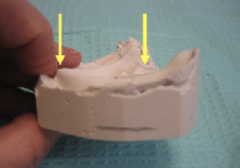
FALSE - they are NOT (it is the crest of the residual ridge in the anterior region to the area where the ascending rami begin in the posterior region)
T/F: The posterior points of references for the mean foundation plane (MFP) for the mandible cast are the left and right retromolar pads.
45 degrees
What is the degree of bevel needed around the entire cast prior to making the custom trays?
10mm
On the model trimmer, remove all of the excess plaster from the sides of the base portion of the maxillary and mandibular cast. Trim these areas up to a surface which is about _____mm lateral to the depth line of the facial peripheral roll line.
15mm
When you adjust the thickness of the base for a preliminary cast, the palatal vault is the thinnest area and should be about ____ mm thick
5-6
About how many clinical visits does it take to complete a set of complete dentures?
Labial vestibule
ID the area in green:

Buccal vestibule
ID the area in blue:
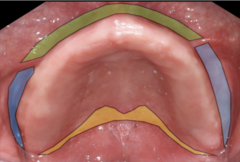
Posterior palatal seal
ID the area in yellow:
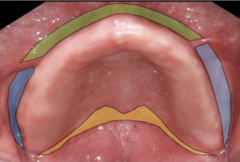
Labial vestibule
What has the following characteristics:
- Limiting structures: from buccal frenum to buccal frenum on the labial side of the maxillary ridge.
- Includes: Labial frenum, orbicularis oris.
Labial Frenum
What has the following characteristics:
Fold of mucous membrane at the median line. It contains no muscle and has no action of its own. The labial notch of the denture should be just wide enough and just deep enough to allow the frenum to pass through it without manipulation of the lip.
Orbicularis oris
What has the following characteristics:
- Main muscle of the lips. It lies and rests upon the labial flange and teeth of a denture.
- Its tone depends on the support it receives from the thickness of the labial flange and the position of the teeth on the arch.
orbicularis oris
the labial vestibule comprises what muscle?
labial flange and cervical 3rd of teeth
the lips are normally supported by what structures?
none
the labial frenum provides attachment/support for what muscle?
Maxillary buccal vestibule
What has the following characteristics:
Limiting structures: from the buccal frenum to the hamular notch (synonym: pterygo-maxillary notch)
Buccal
The _________ frenum is sometimes single, sometimes double, and sometimes broad and fan-shaped
Buccal
What requires more clearance: the buccal or lingual frenum?
buccinator m.
the buccal frenum provides attachment/support for what muscle?
Buccal frenum, pterygo-mandibular raphe
The buccinator muscle in the cheek extends from the _________ (anteriorly) to the ____________ (posteriorly)
Pterygomaxillary notch or Hamular notch
Define the following:
Fissure situated between the tuberosity of the maxilla and the hamulus of the pterygoid plate
- Hamulus
- Maxillary tuberosity
What two structures form the hamular notch?
posterior palatal seal area
What is the most distal extension of the maxillary denture?
posterior palatal seal area
What is the line between mobile and non-mobile soft palate?
Posterior palatal seal area
What has the following characteristics:
- Location of anterior outline of ____________; a ball-ended burnisher use to press gently against the hard palate and gradually worked backward until displaceable tissue could be located.
- Establishing depth; by pressing a ball-ended burnisher against soft tissue of ____________ to approximate the amount of displacement.
Fovae palatinae
What has the following characteristics:
- Indentations near the midline of the palate that are formed by a coalescence of several mucous gland ducts.
- Landmark as the vibrating line is often anterior to the __________
"Ah"
To identify the vibrating line, what should the patient say?
Incisive papilla
What has the following characteristics:
- Located in the palate on the median line and comes nearer to the crest of the ridge as resorption progresses.
- Should be relieved routinely to prevent impingement on the nasopalatine nerves and blood vessels as they pass through the nasopalatine foramen
- Pressure in this area is interpreted by the patient typically as a "burning sensation"
incisive papilla
The _______ is a thickness of tissue over the nasopalatine nerve and serves to help protect the neurovascular vessels
- Important anatomical landmark for fabricating wax rims and setting teeth as its position does not change much after teeth are extracted
Palatal rugae
Define the following:
In the area of the rugae, the palate is set at an angle to the residual ridge and is rather thinly covered by soft tissue.
Residual ridge
Define the following:
As it resorbs and may have some nutrient canal and sharp spicules of bone or when the crest of the ridge is knife-edge shaped
maxillary tuberosity
What has the following characteristics:
- The most distal portion of the maxillary alveolar ridge.
- Needs to be assessed prior to starting treatment as it often extrudes leading to a lack of prosthetic space
- It has tendency of enlargement
Maxillary tuberosity
ID the structure:

Palatal suture
What has the following characteristics:
In the region of the medial ___________, the submucosa is extremely thin, with the result that the submucosa is practically in contact with the bone. For this reason, the soft tissue covering the ___________ is non-resilient and may need to be relieved to avoid trauma from the denture base.
Mentalis
The mandibular labial vestibule is limited inferiorly by the _________ muscle
Mandibular buccal vestibule
What has the following characteristics:
- Limiting structures: from the buccal frenum to the lateral aspect of the retromolar pad.
- Includes: buccal frenum, buccinator, masseter.
Buccinator
What muscle keeps food in but the cheek and air out?
Masseter
What muscle is for powerful jaw closure and protrusion?
Labial vestibule
ID the region in green:
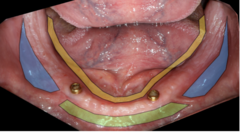
Buccal vestibule
ID the region in blue:
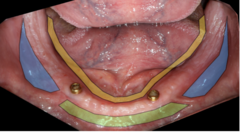
Alveololingual sulcus
ID the region in yellow:
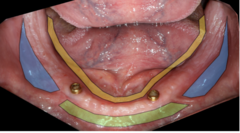
labial frenum
ID #1:

labial vestibule
ID #2:

buccal frenum
ID #3:
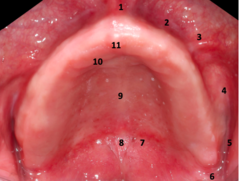
buccal vestibule
ID #4:
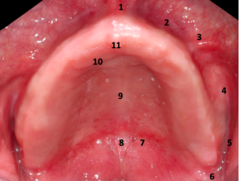
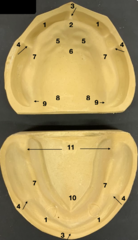
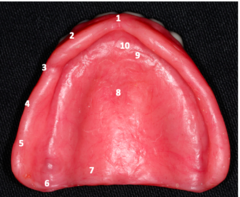
corono-maxillary space/Retro-zygomatic area
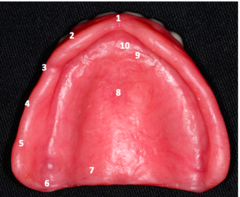
ID #5:
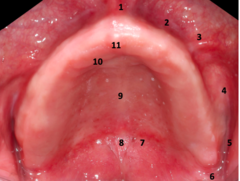
hamular notch (pterygomandibular notch)
ID #6:
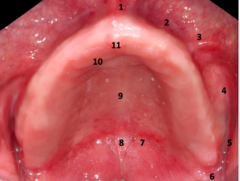
posterior palatal seal area
ID #7:
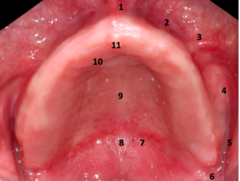
fovea palatine
ID #8:
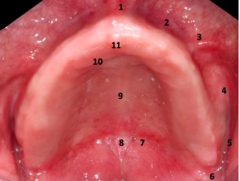
mid-palatal suture
ID #9:
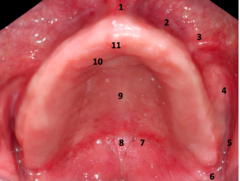
maxillary rugae
ID #10:
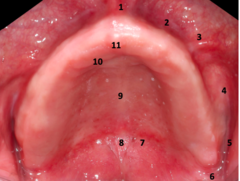
incisive papilla
ID #11:

labial notch
ID #1:
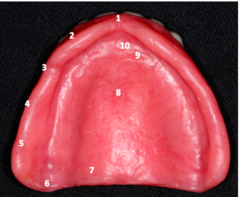
labial flange
ID #2:
buccal notch
ID #3:

buccal flange
ID #4:
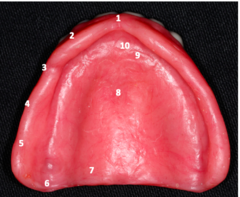
retro-zygomatic flange
ID #5:
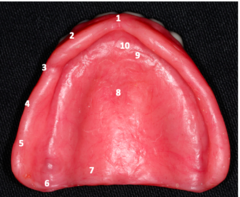
hamular notch/pterygomandibular notch
ID #6:
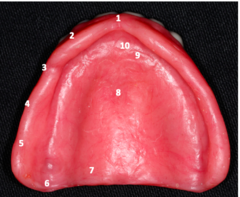
posterior palatal seal area
ID #7:
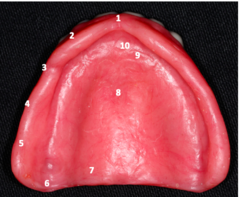
mid-palatal suture relief
ID #8:

maxillary rugae
ID #9:

incisive papilla relief
ID #10:
Midpalatine raphae
ID #6
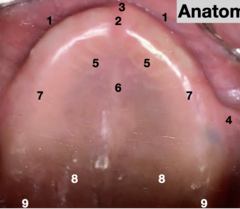
Residual ridge
ID #7
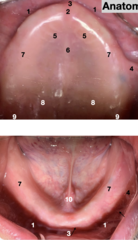
Lingual vestibule
ID #12

Mylohyoid area
ID #13
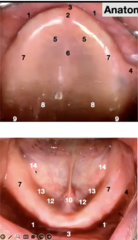
Retromylohyoid area
ID #14
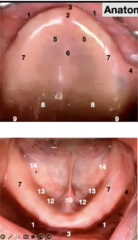
Labial vestibule
ID #1

Incisive papilla
ID #2
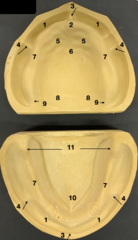
Labial frenum
ID #3
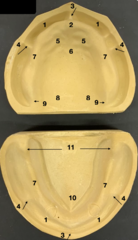
Buccal frenum
ID #4
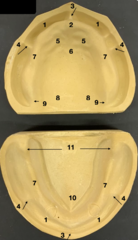
Rugae
ID #5
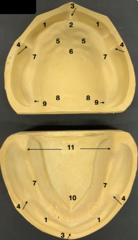
Midpalatine raphae
ID #6
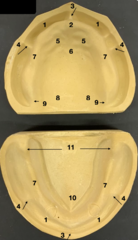
Residual ridge
ID #7