Lecture 1.5: Techniques for Studying Proteins
 Call Kai
 Learn
Learn Practice Test
 Spaced Repetition
 Match
Match Flashcards
 Knowt Play
1/33

There's no tags or description
Looks like no tags are added yet.
Name | Mastery | Learn | Test | Matching | Spaced | Call with Kai | Chat |
|---|
No analytics yet
Send a link to your students to track their progress
34 Terms
What is the first step of protein purification
To prepare the cell extract
What are the 3 types of preparing a ell extract
1) Sonication
2) Shearing
3) Mild Detergents
Why does getting the extract of the cell help with protein purification
The cell membrane acts as a barrier by keeping the proteins in the cell. Creating an extract, allowed for easier access to the proteins
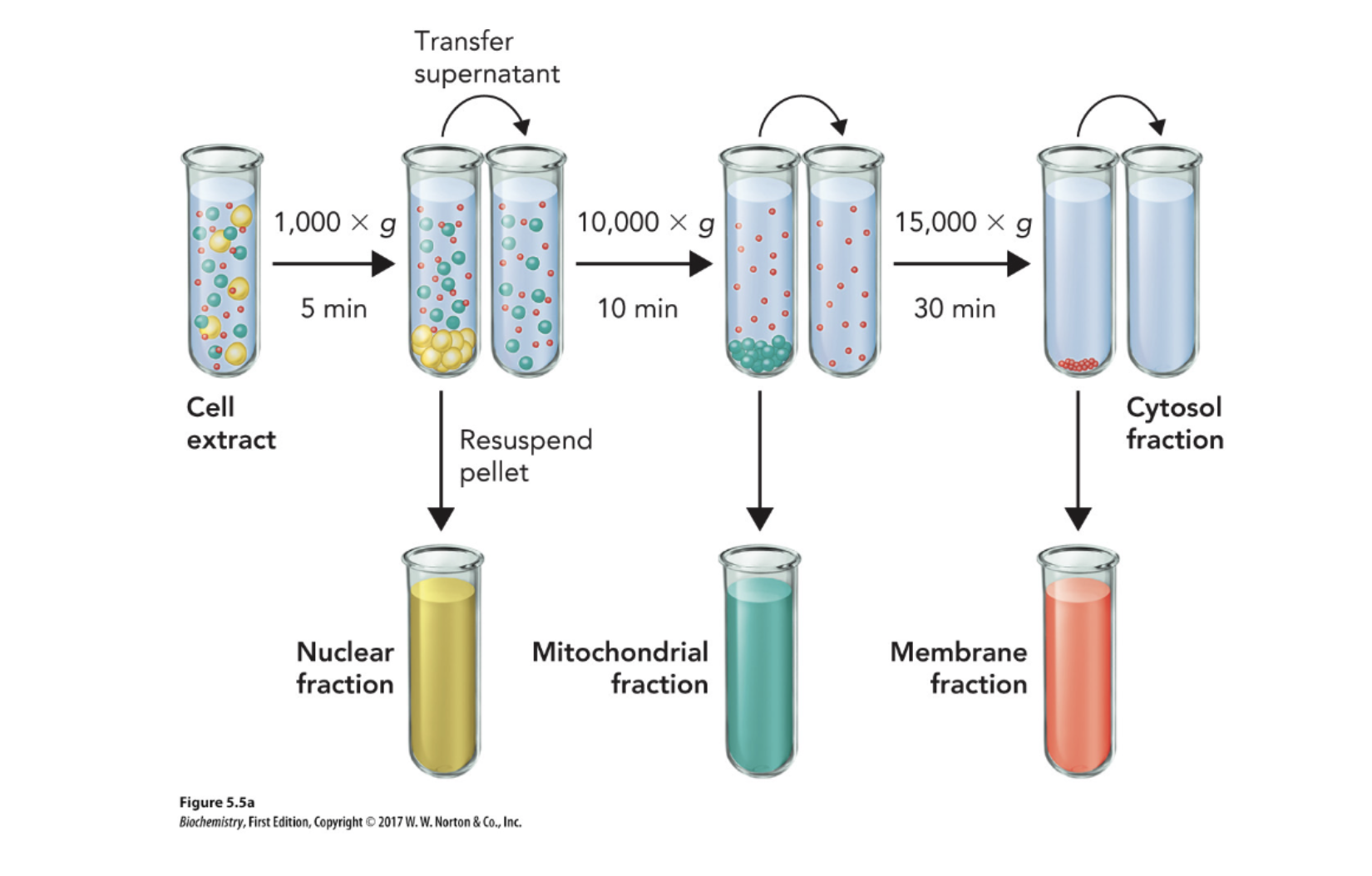
What mechanism does differential centrifugation use to separate organelles
Differences in sedimentation rate
How does mass effect the speed of centrifugation
The greater the mass the lower the speed it can be separated at
What is the specific activity equation
Specific activity (units/mg) = total activity (units) / total protein (mg)
Explain the concept behind “salting out” the target protein
By using salt you’re create a hypertonic environment, this forces protein to interact with each other rather than stay dissolved in solution. In other words, the salts “steals” the water that the protein needs to stay dissolved
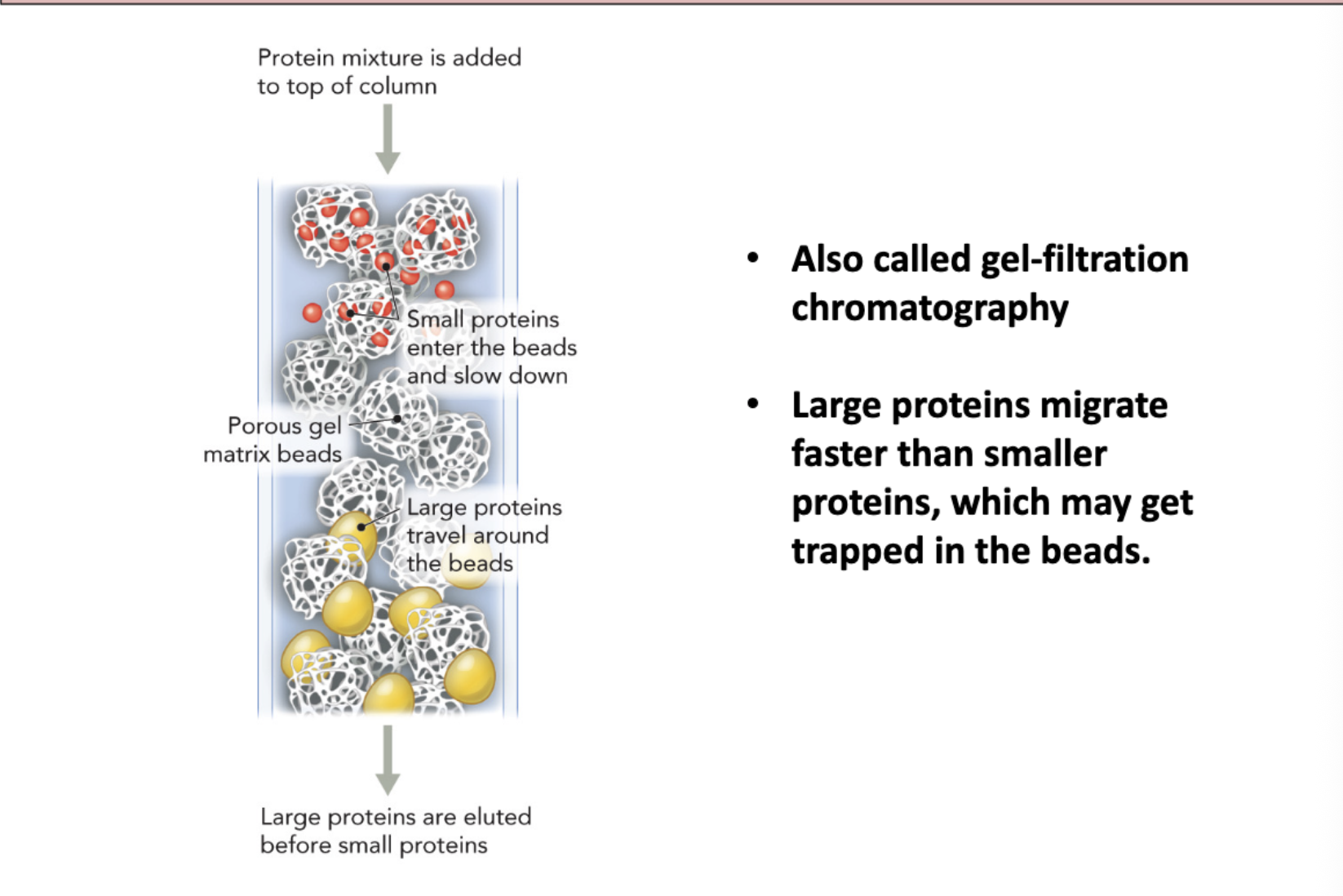
How does size-exclusion column chromatography separate proteins
Column chromatography used porous beads to filter through differed sized proteins. The smaller the protein the more it will get stuck in the beads. Larger proteins fall down the column faster.
What is elution?
The process of extracting one material from another by washing it with a solvent
What is an ion-exchange column and how does it work?
An ion-exchange column used charged beads to bind to proteins of the opposite charge.
If an ion-exchange column contain negatively charged at with a buffer at a pH of 6 beads which AA would fall the quickest?
Aspartate (Asp)
Glycine (Gly)
Lysine (Lys)
Histidine (His)
Aspartate (Asp) — Aspartate has a pI of 2.8. Since the buffer pH (6.0) is well above its pI, Asp will be deprotonated at its side chain meaning it will be negative and unreactive with the matrix
Why must an elute (NaCl) be used after the ion-exchange?
To wash out the bound proteins and take their place attached to the beads
What is the isoeletric point (pI)
The point at which the overall charge of a protein is 0
In what order would the following proteins elute from a cation exchange column running with buffer at pH 8.0?
protein A pI = 8.4
protein B pI = 7.5
protein C pI = 6.4
protein D pI = 10.0
C,B,A,D
What is charge cation exchange?
Negative beads
What is charge anion exchange?
Positive beads
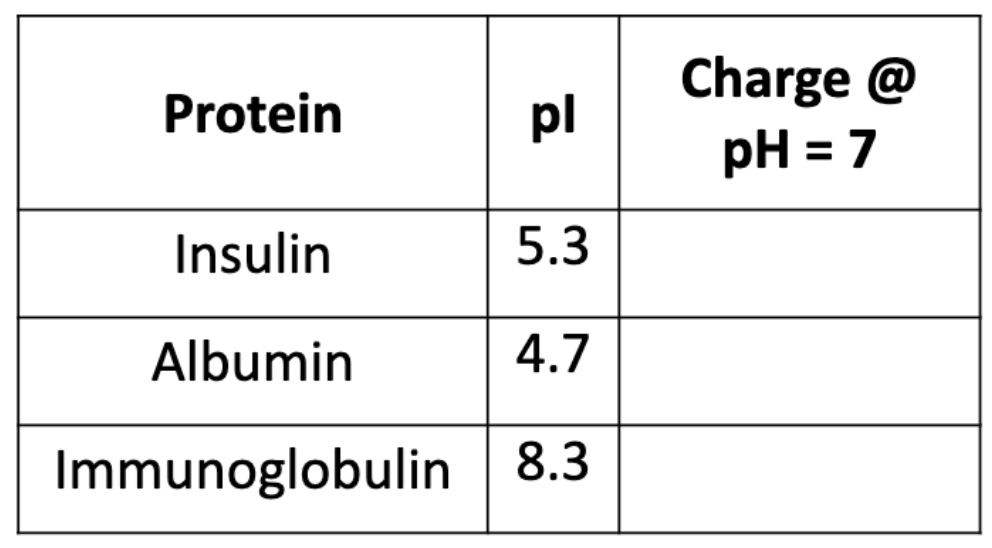
What is the net charge (positive or negative) for each of the following proteins in a buffer at pH=7?
Insulin = negative
Albumin = negative
Immunoglobulin = postive
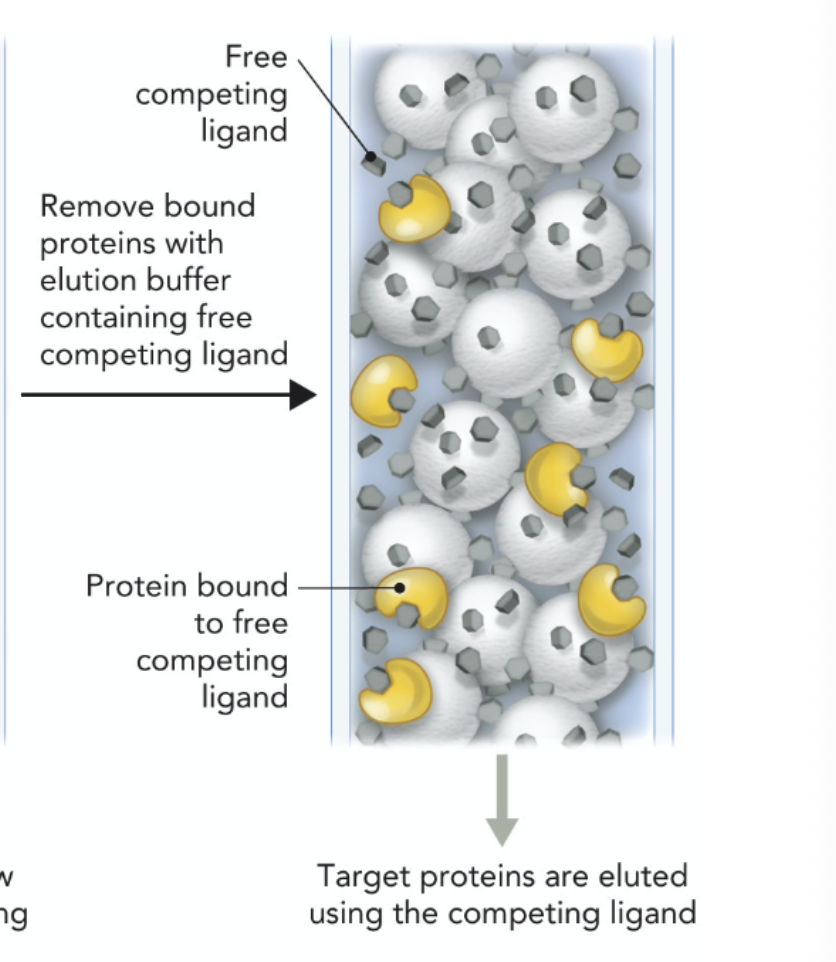
What is affinity chromatography and how does it work?
Affinity chromatography used specific ligands to bond to the target protein. Therefore, nonspecific proteins flow through without interacting with the ligands
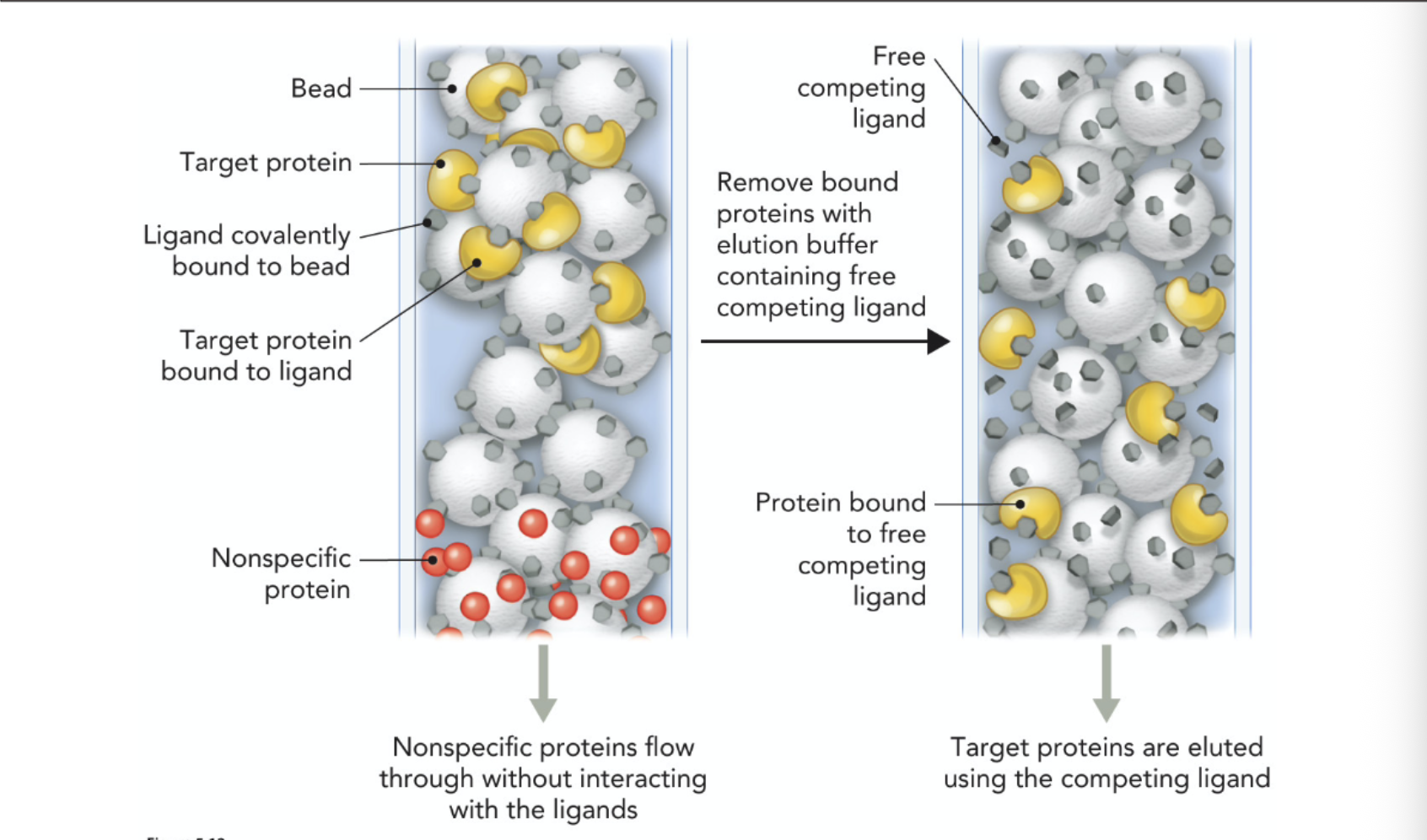
How are the ligand bound proteins removed form ligand after inital run?
A elution buffer containing free competing ligand is used to take the protein off of the matrix elute the protein out of the column
What is polyacrylamide Gel Electrophoresis (PAGE) and how does it work?
PAGE is used to determine the successfulness of the protein purification. Uses heat to denature the protein into its linear chain. Then the proteins are coated with sodium dodecyl sulfate (SDS), this gives them all a negative charge that is relative to their size. Proteins are then ran through gel electrophoresis — proteins migrate from the negative electrode (top) toward the positive electrode (bottom).
Smaller proteins = more easily and migrate faster/farther
Larger proteins = slower/less far
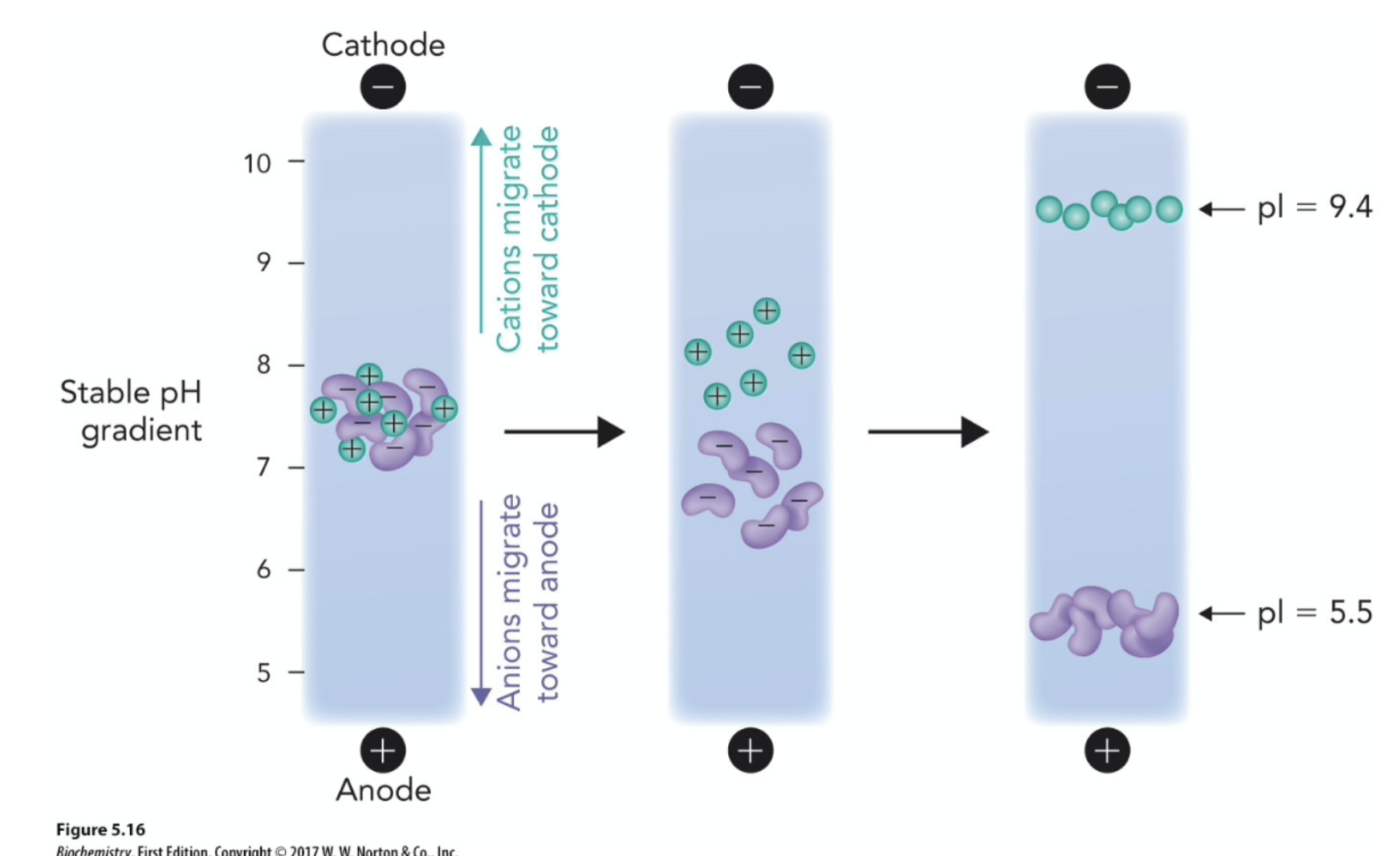
What is IEF and how does it work?
Isoeletric focusing (IEF) is used to determine pI of a protein or separate proteins based on pI. Cations are attracted to the cathode and anions are attracted to the anode.
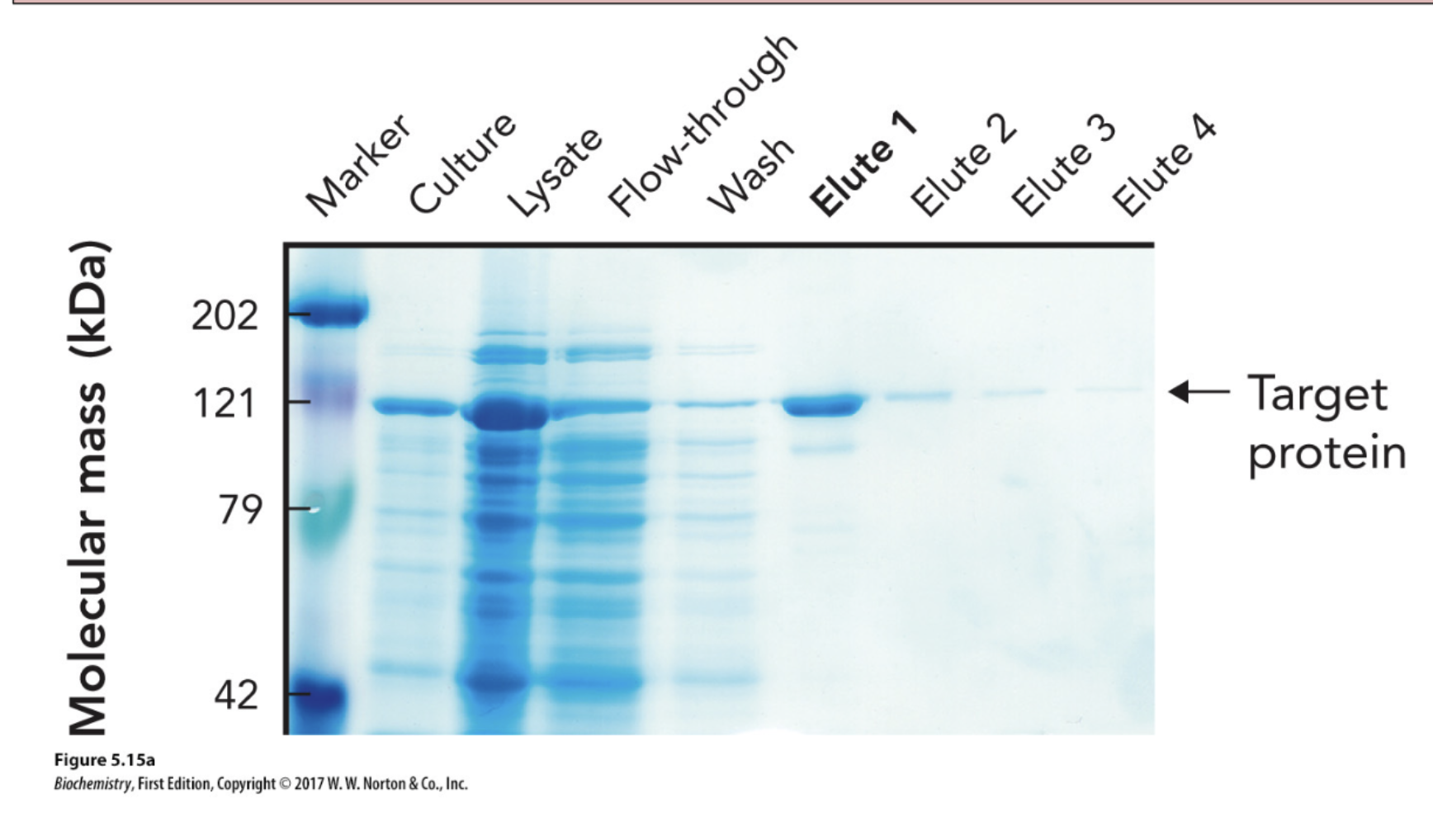
Explain how to read this chart
When reading a gel, the different samples (marker lysate, flow-through, wash) serve as a reference point to determine the molecular mass of where your target protein is located on the gel. In the diagram, 121 kDa is where the target protein is, specifically from elute 1. In Elute 1, the majority of the protein was purified which is being shown as a prominent clear band at 121 kDa. In elute 2,3, and 4, the target protein is less visible progressively because it was already mostly purified by Elute 1.
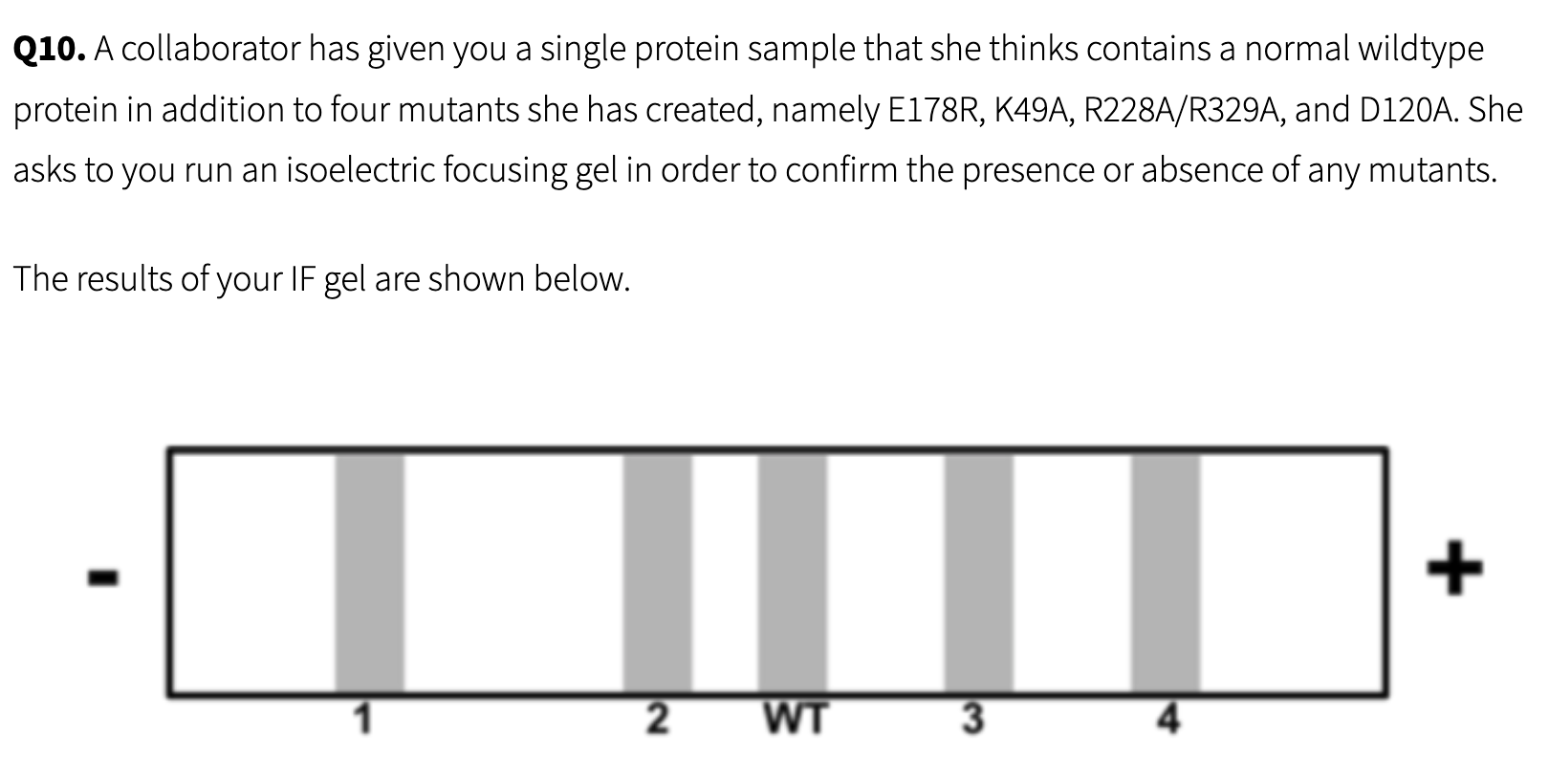
Match the mutations with the corresponding number on the IF gel
1) E178R
2) D120A
3) K49A
4) R228A/R229A
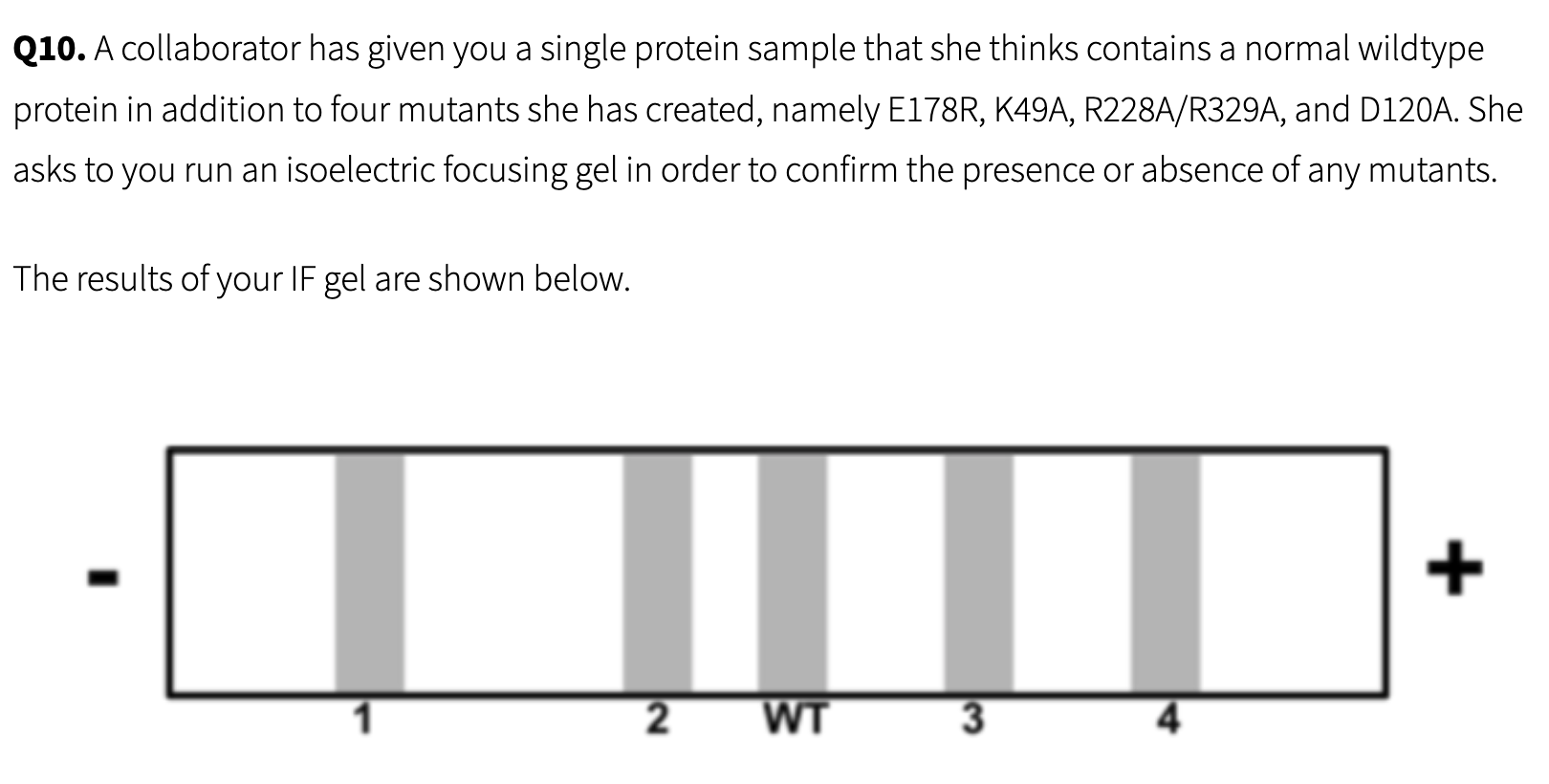
What is 1 and explain your reasoning
1) E178R — going from glutamate to arginine results in a negative to positive charge. This is the largest charge change out of the 4 options meaning it will be the furthest from the WT in the negative direction
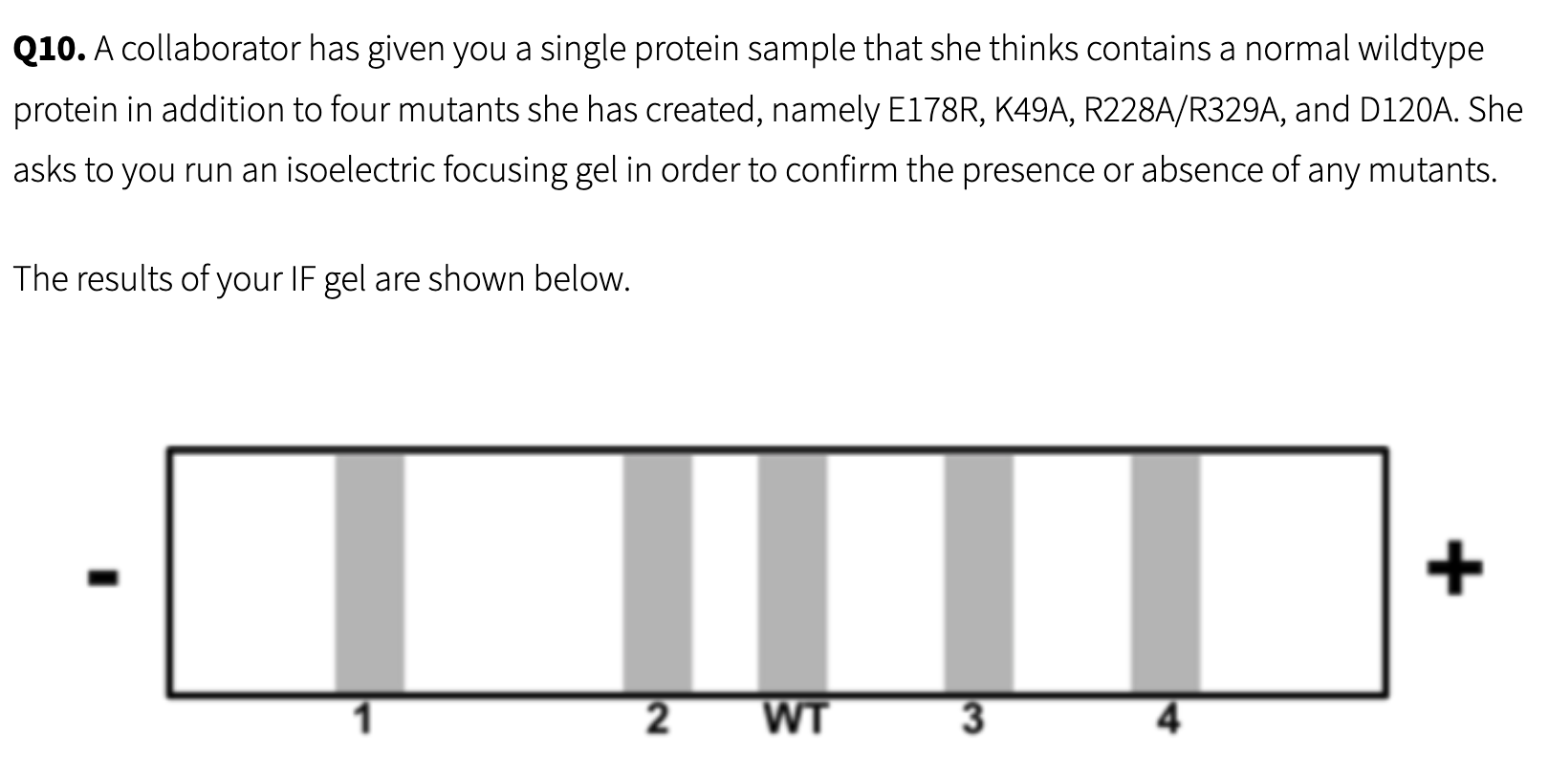
What is 2 and explain your reasoning
2) D120A — going from aspartate to alanine results in a negative to neutral charge change. This pulls it in the negative direction but not as extreme as mutation 1
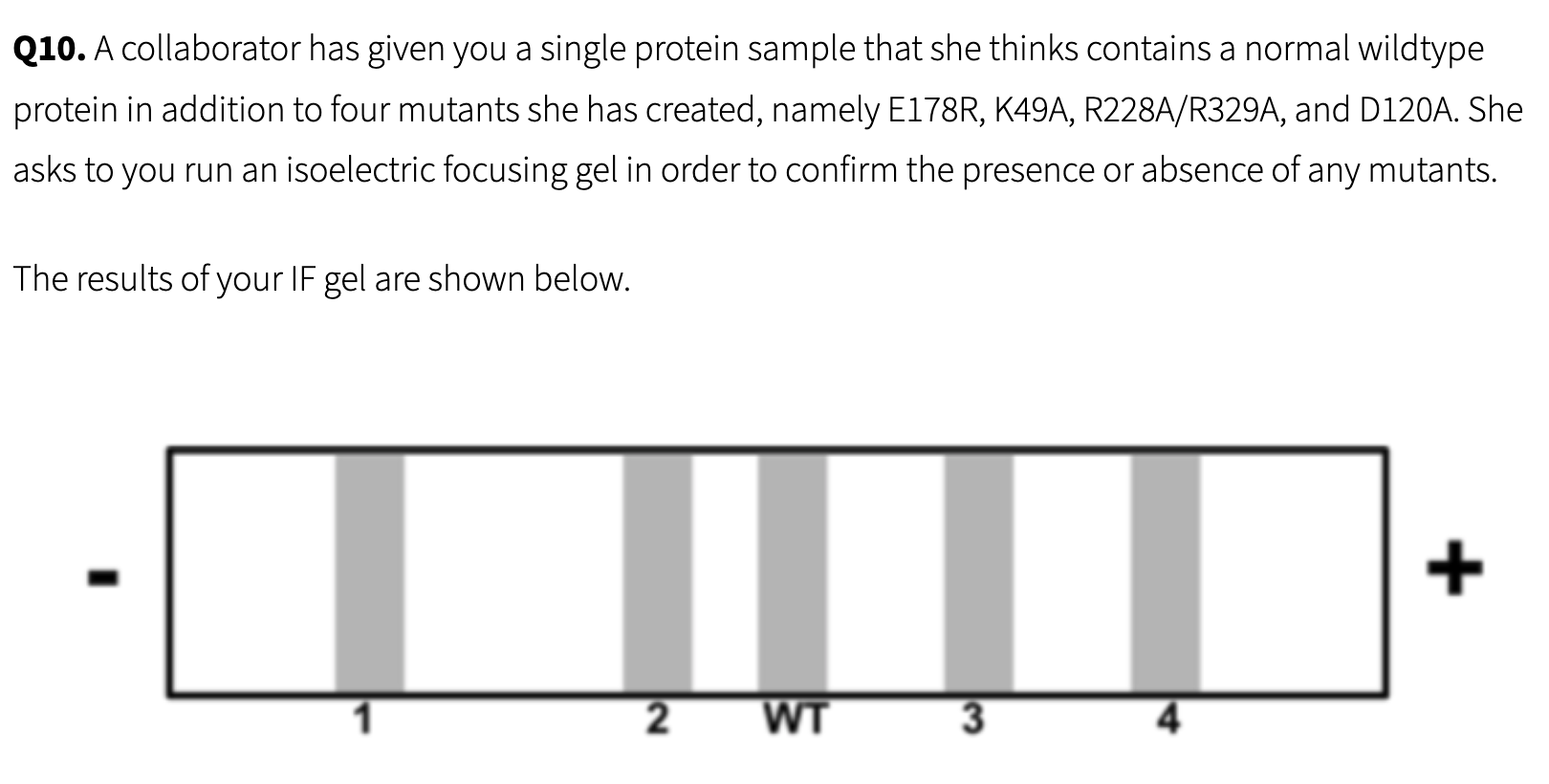
What is 3 and explain your reasoning
3) K49A — going from lysine to alanine results in a charge change from positive to neutral. This make the mutant be pulled to the positive side (became more negative + —→ neutral)
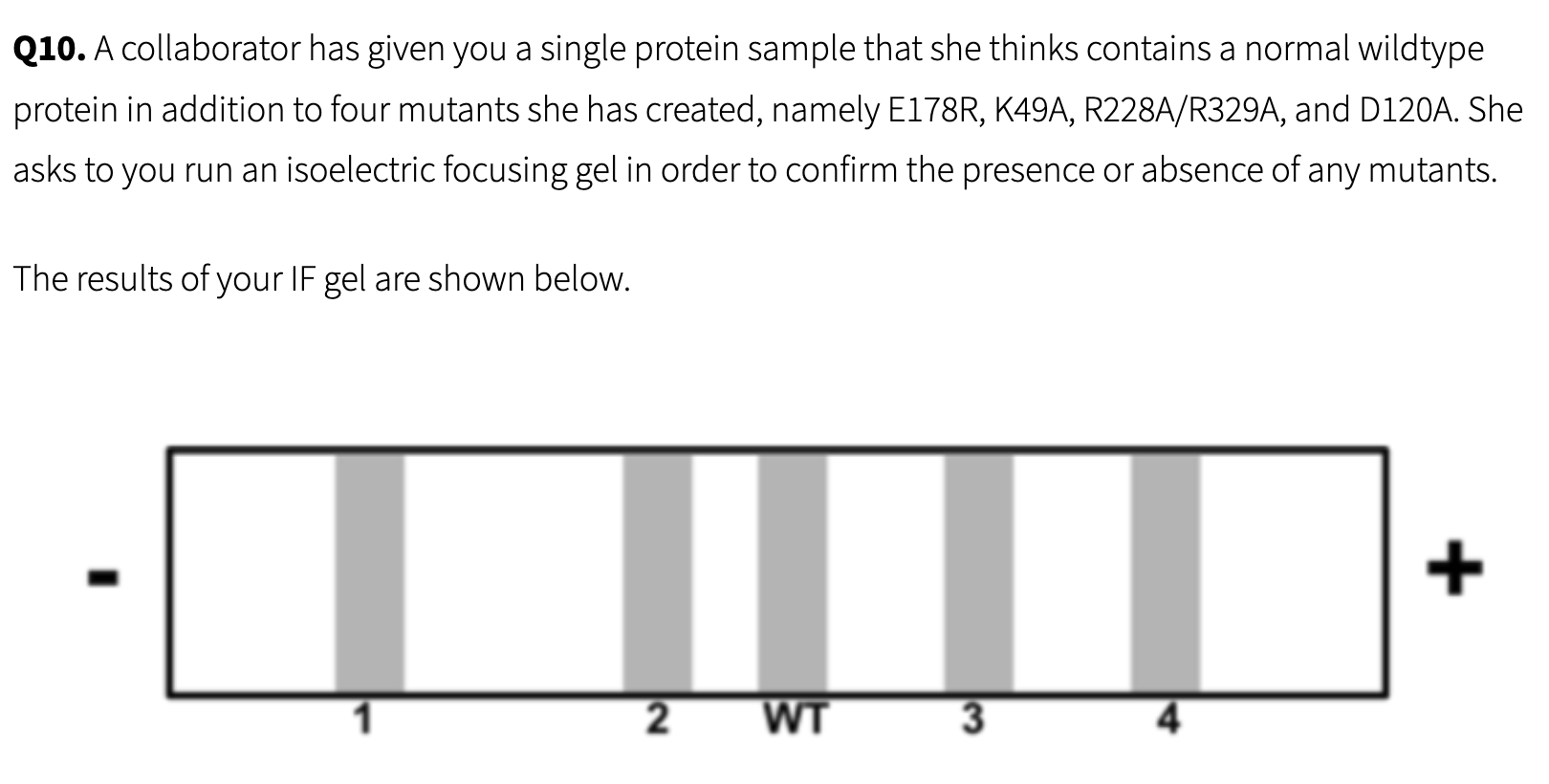
What is 4 and explain your reasoning
4) R228A/R229A — going from arginine to alanine results in a charge change of positive to neutral. Similar to the reasoning from mutation 3 except this is x2 since there is a double switch mutation.
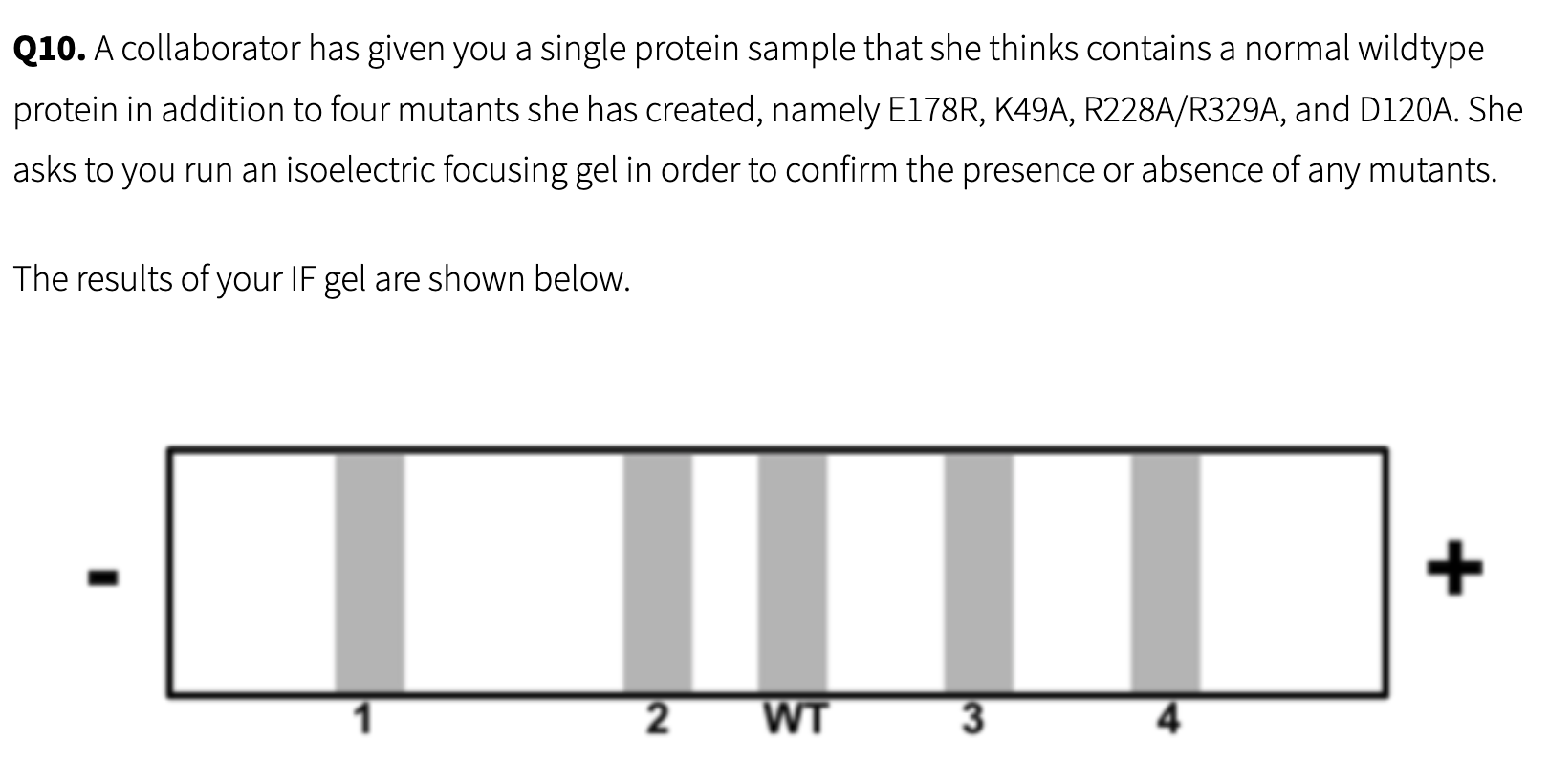
If mutation 2 and the WT were placed into a cation exchange column which would elute first?
WT will elute first — Mutation 2 is more positive than the WT. This means that in a cation exchange (cations stick to the matrix) mutation 2 will stick more to the matrix and the WT will pass through fastest.
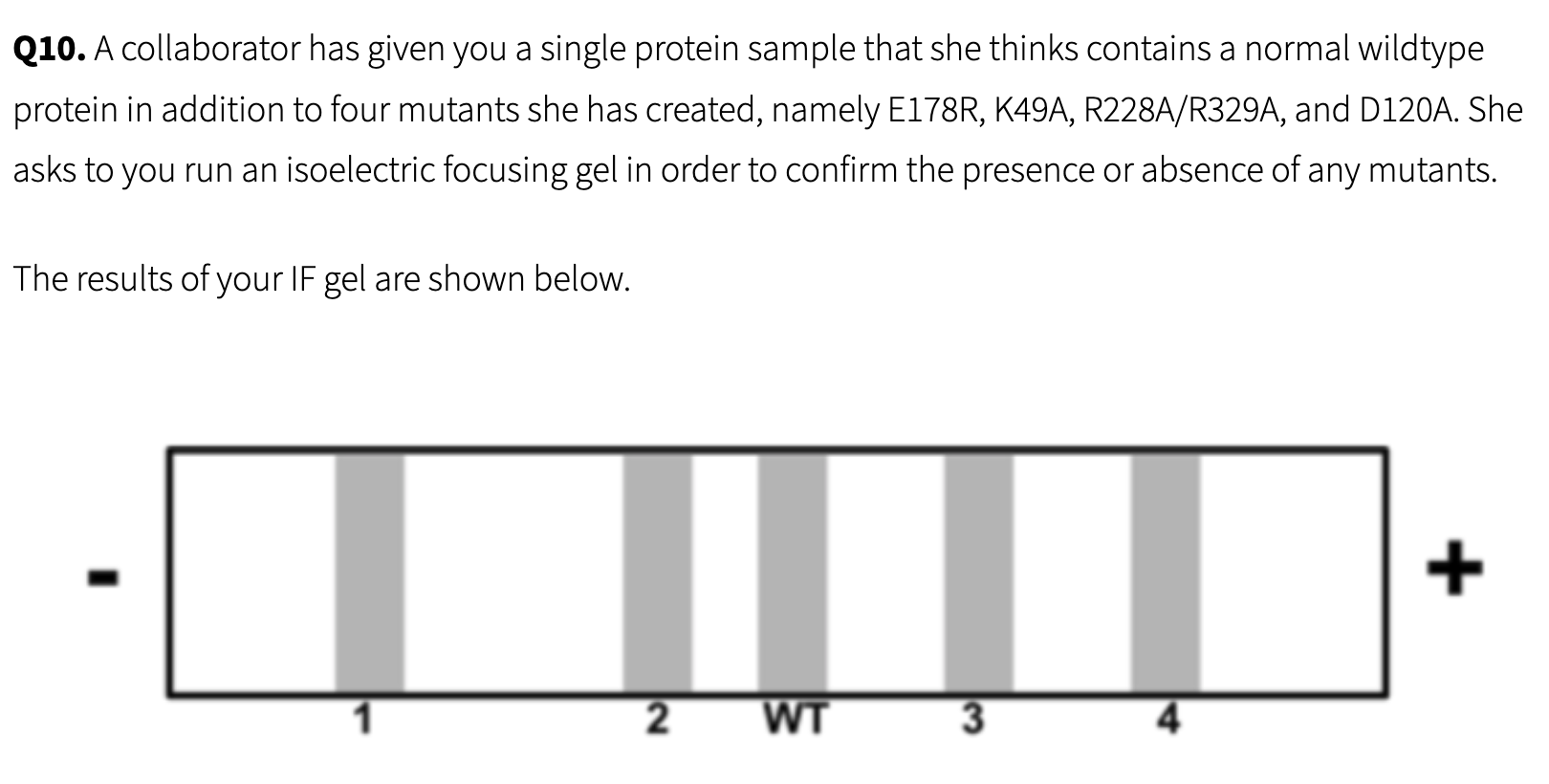
If mutation 3 and the WT were placed into a anion exchange column which would elute first?
WT would elute first — mutation 3 is more negative than the WT. This means that in an anion exchange column (anions stick to matrix) mutations 3 will stick and the WT will pass through
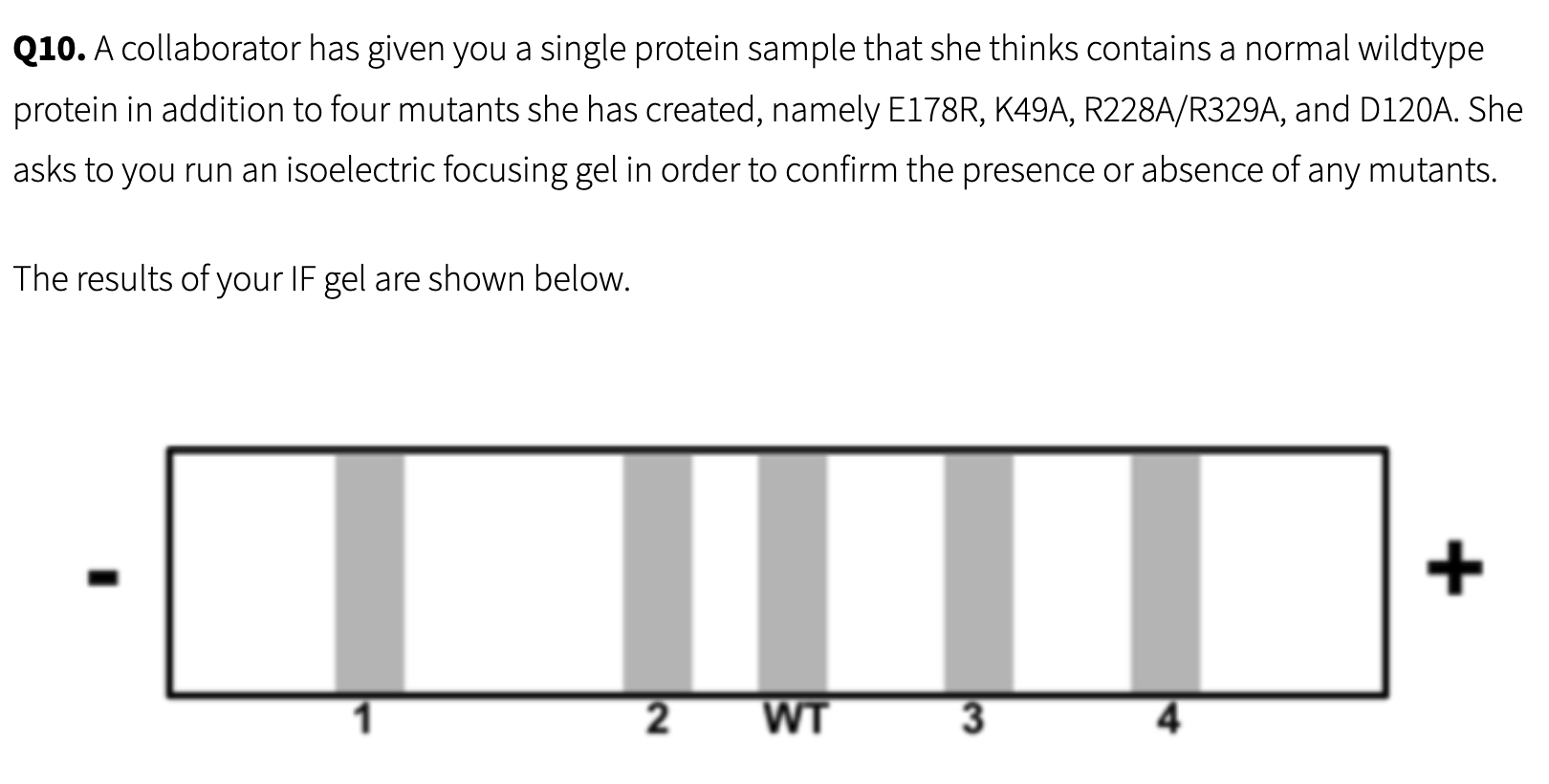
If mutation 3 and the WT were placed into a cation exchange column which would elute first?
Mutation 3 would elute first — mutation 3 is more negative than the WT. This means that in an cation exchange column (cations stick to matrix) the WT will stick and mutation 3 will pass through
The negatively charged side of the IF gel is the ______?
Cathode — think “cathode attracts cations”
The positively charged side of the IF gel is the ______?
Anode — think “anode attracts anions”
Which side of IF gel would Lysine shift: Anode or Cathode?
Cathode
Which side of IF gel would Glutamate shift: Anode or Cathode?
Anode