16/24: Cellular Cognition
 Call Kai
 Learn
Learn Practice Test
 Spaced Repetition
 Match
Match Flashcards
 Knowt Play
1/12

There's no tags or description
Looks like no tags are added yet.
Name | Mastery | Learn | Test | Matching | Spaced | Call with Kai | Chat |
|---|
No analytics yet
Send a link to your students to track their progress
13 Terms
learning
→ refers to the process by which experiences change our nervous system and by extension, our behaviour
Memory (memories, memory traces, memory engrams) → the changes resulting from learning — stored knowledge
Transient (short-term) or durable (long-term)
Explicit (conscious) or implicit (unconscious)
Personal (episodic) or impersonal (semantic)
Retrieval → process of accessing memories, whose application = intelligence
Feedback → input-output information that makes learning more effective and efficient; improvement leads to optimization
neuronal plasticity
→ refers to the ability of the nervous system to change and adapt — cellular basis of long-term memory
Measurements (via brain slice recordings):
Intrinsic excitability → the # of APs a neuron exhibits in response to depolarizing electrical current injections
Reflects precise composition of ion channels on a membrane (strongly affected by ↑ # of K+ leak channels)
+
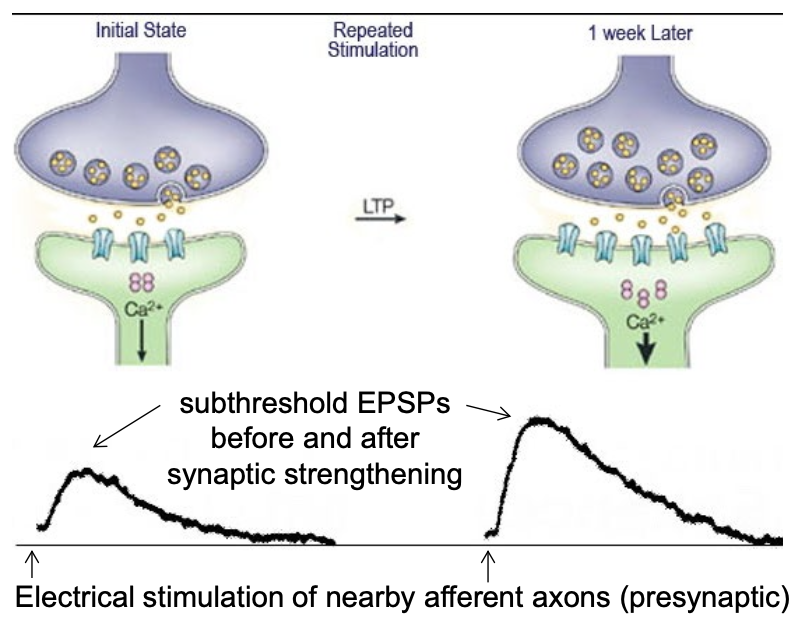
Synaptic strength → size of the response in a post-synaptic neuron when a pre-synaptic neuron has an AP
synaptic plasticity
→ refers to the changes in strength of the synaptic connection between adjacent neurons (i.e., delta synaptic strength)
Enduring, long-term changes often involve physical changes in the size of pre- and post-synaptic membranes
Pre-synaptic changes: # of vesicles, used vesicles, release of vesicles
Post-synaptic changes: # of receptors, ligand sensitivity, binding effects
Excitatory post-synaptic potential (EPSP) → depolarization as a post-synaptic response
Often involved with improving synaptic strength
habituation
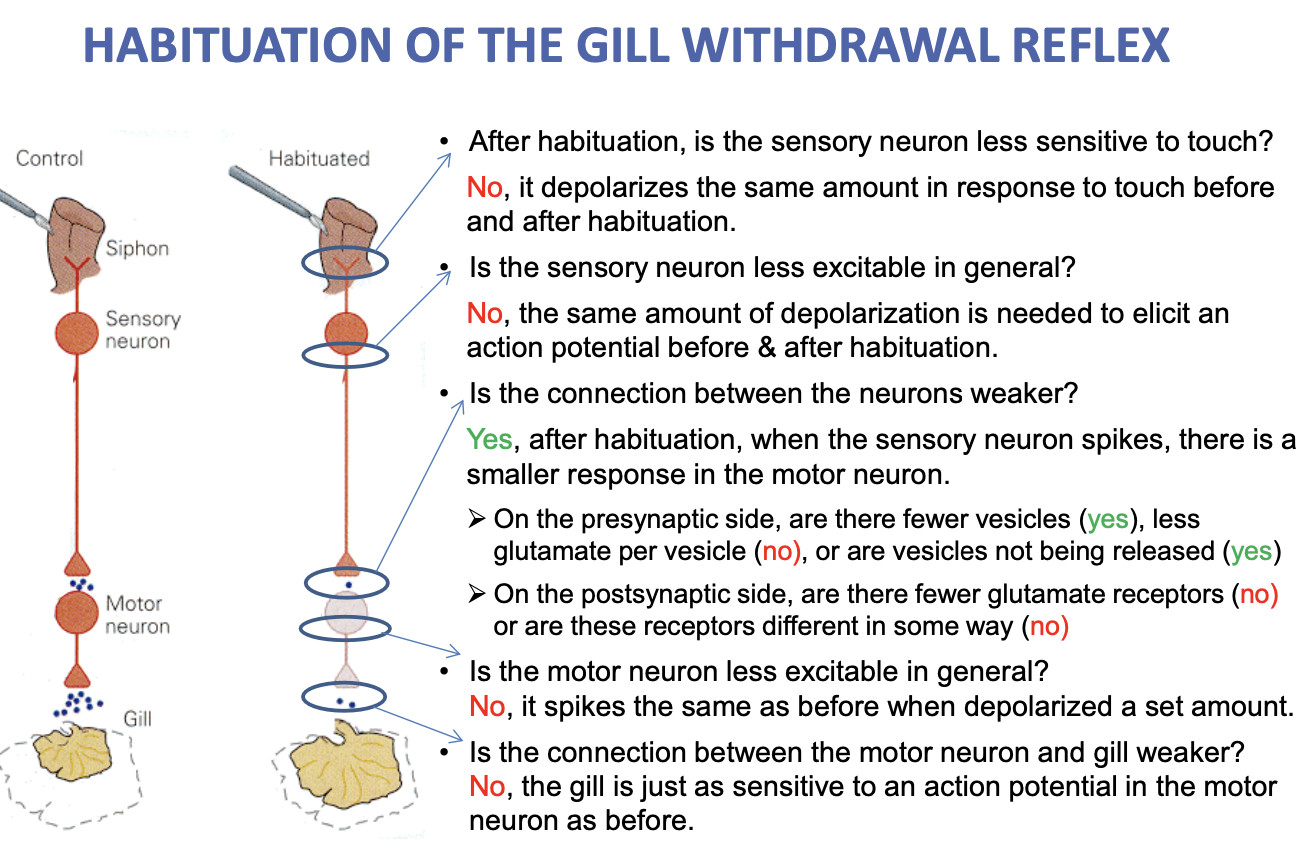
→ type of non-associative learning; reduced physiological or behavioural responding to a repeated stimulus
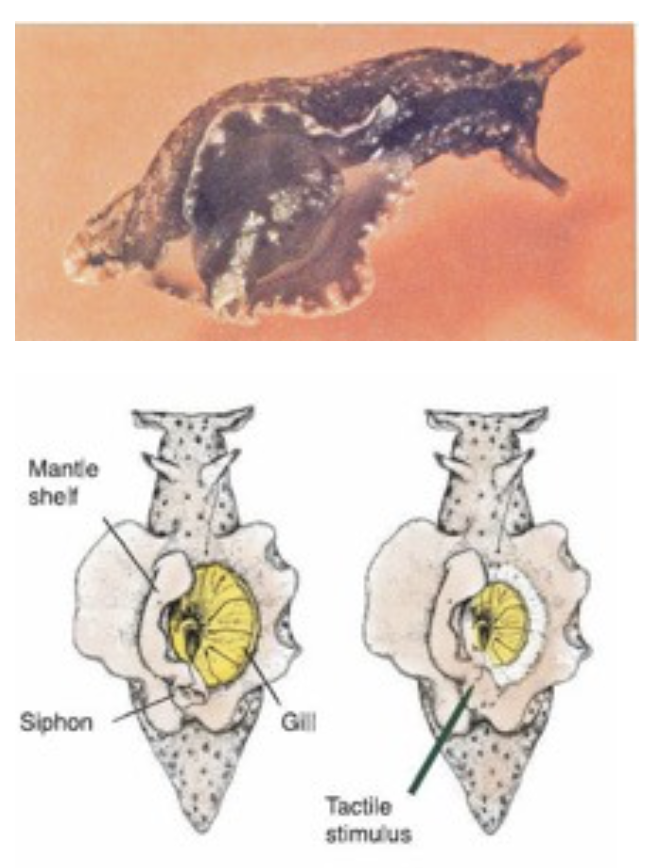
ex. Aplysia sea slugs reflexively withdraw their gill whenever their siphon is touched. After repeated siphon touches, the magnitude of the gill withdrawal reflex will reduce to a point of indifference.
Significant effects:
↓ Motor neuron response (due to ↑ sensory neuron)
↓ Pre-synaptic vesicles (available and/or being released)
sensitization
→ type of non-associative learning; when exposure to a strong (and often painful) stimulus results in heightened responses to other stimuli
long-term potentiation
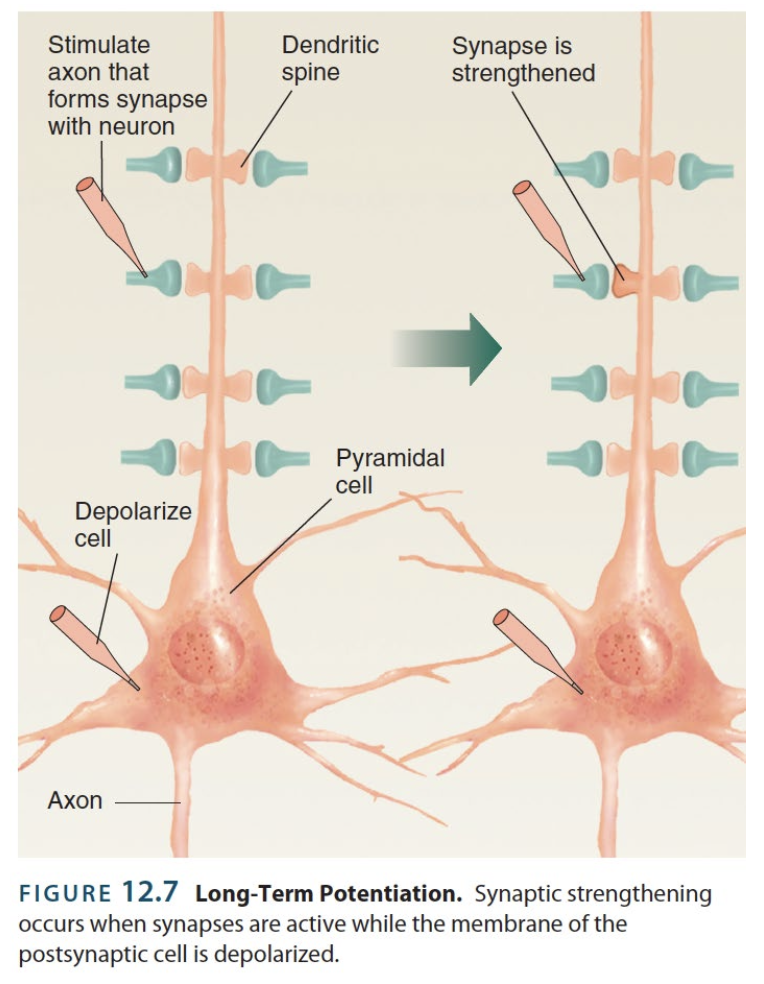
LTP → in regards to synaptic plasticity; an enduring ↑ in synaptic strength — improving
Elicited by repeatedly stimulating a neuron’s inputs with high-frequencies
Tetanic ex. 100 Hz, for 1 second, repeated 4 times
Passing threshold stimulation (summation of EPSPs/depolarizations) enables post-synaptic neurons to spike
Initiated on post-synaptic side (w/ ↑ receptors)
Nitric oxide → retrograde signaling molecule that triggers complimentary changes on pre-synaptic side (↑ neurotransmitters released per spike)
long-term depression
LTD → in regards to synaptic plasticity; an enduring ↓ in synaptic strength — weakening
Elicited by repeatedly stimulating a neuron’s inputs with low-frequencies
ex. 1 Hz, for 10 minutes
Insufficient threshold stimulation (summation of subthreshold responses/no depolarization) DOES NOT enable post-synaptic neurons to spike
Initiated on post-synaptic side (w/ ↓ receptors)
Endocannabinoids → retrograde signaling molecule that triggers complimentary changes on pre-synaptic side (↓ neurotransmitters released per spike)
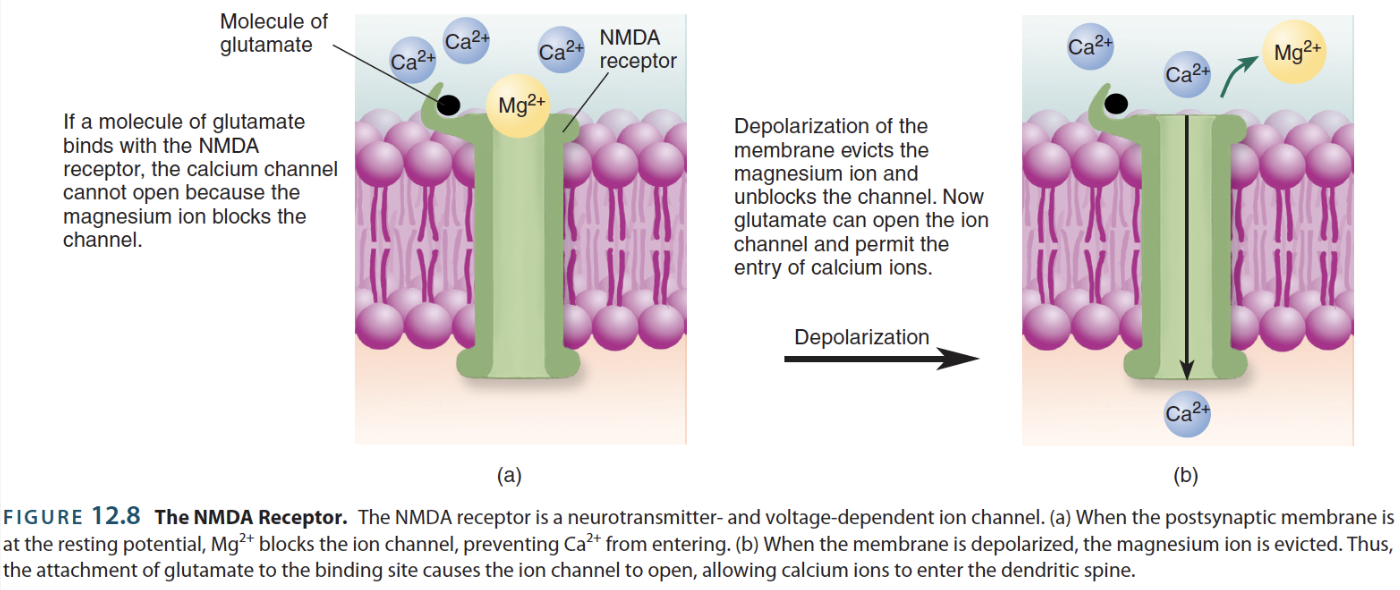
NMDA receptor
→ “coincidence” detector playing a large role in learning — ionotropic glutamate receptor located in almost every glutamatergic synapse in the brain
Rest-Hyperpolarized (< -40 mV):
At rest, the ion channel pore is clogged by Mg2+ ions
Depolarization (> -40 mV):
Mg2+ ion blockade evicted
Binded glutamate can open ion channel
Ca2+ (and Na+) ions can enter neuron
AMPA receptor
→ ionotropic glutamate receptor that mediates most of the fast excitatory synaptic currents in the brain
Often coincides with NMDA receptors (on most glutamate synapses)
Depolarization (> -40 mV): Na+ ions flow in when open, causing EPSPs
type II calcium-calmodulin kinase
CaMK-II → enzyme activated by Ca2+ ion influx through NMDA receptors
Participates in intracellular signaling cascade establishing LTP by ↑ AMPA receptors in post-synaptic membrane
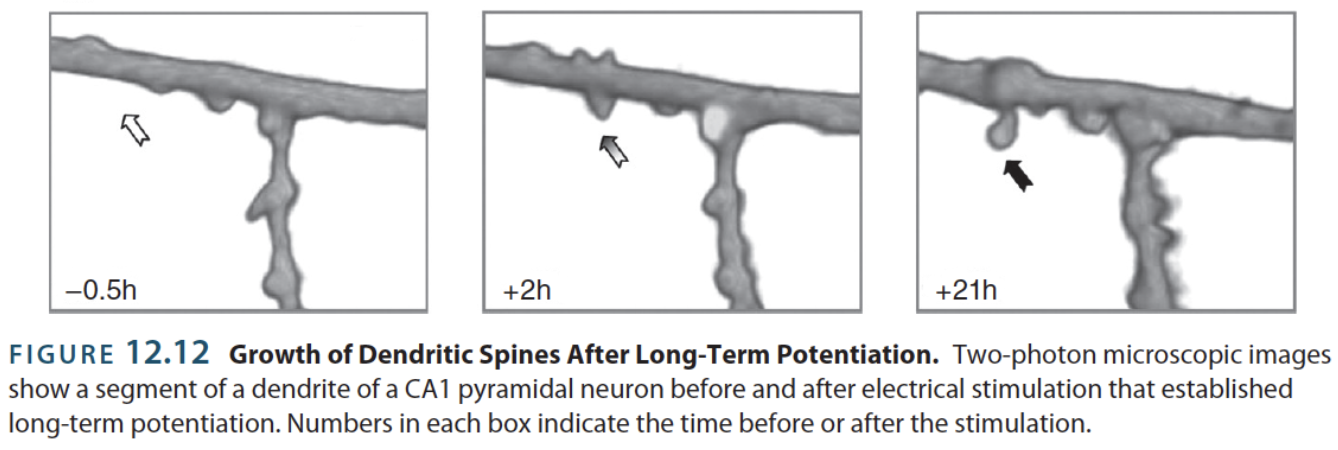
dendritic spine growth
→ for glutamatergic synapses, LTP correlates with the size of the dendritic spines + # of AMPA receptors
Relatively easy to measure
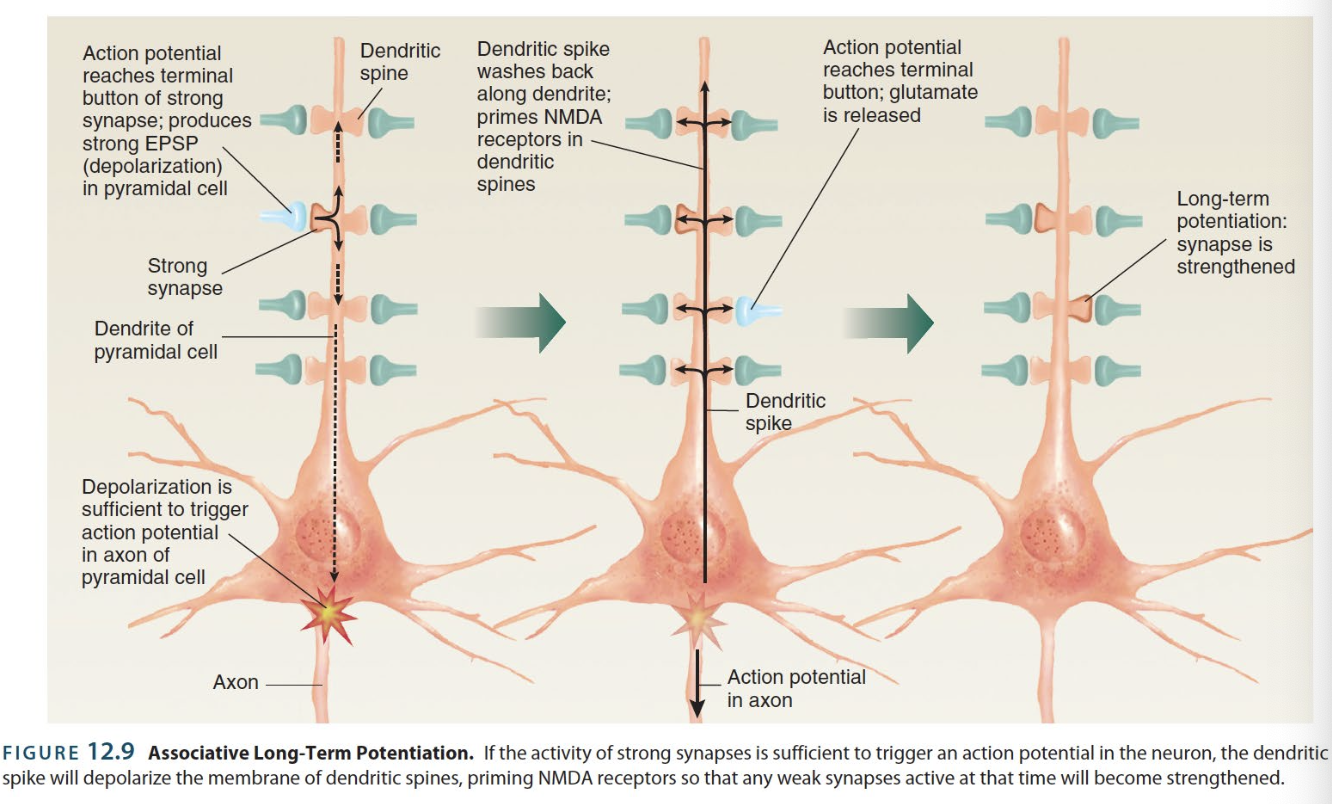
associative long-term potentiation
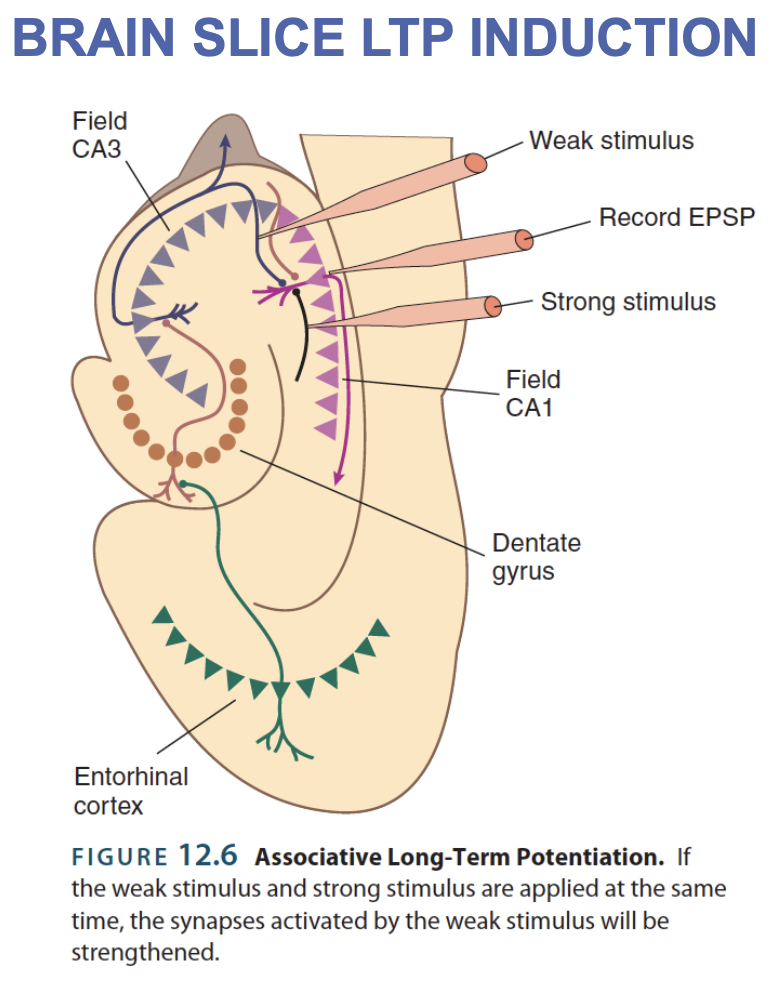
→ describes the ↑ in synaptic strength that occurs in weak synapses that happen to be active when stronger inputs get the post-synaptic neuron to spike — Donald Hebb’s hypothesis applied;
Hebb’s rule → the cellular basis of learning involves strengthening of synaptic connections that happen to be active when the post-synaptic neuron fires an AP
“Fire together, wire together”