Atomic Structure Unit Test
 Call Kai
 Learn
Learn Practice Test
 Spaced Repetition
 Match
Match Flashcards
 Knowt Play
1/110

There's no tags or description
Looks like no tags are added yet.
Name | Mastery | Learn | Test | Matching | Spaced | Call with Kai | Chat |
|---|
No analytics yet
Send a link to your students to track their progress
111 Terms
Atom
the smallest part of an element, electrically neutral
Gold Foil Experiment
experiment conducted by Ernest Rutherford— determined the nucleus is small, dense, and positively charged and that the atom is mostly empty space
Rutherford Model
developed after the Gold Foil Experiment; model of an atom with a small, dense, positive nucleus and is mostly empty space
Proton
positive subatomic particle found in the nucleus
Neutron
subatomic particle found in the nucleus with no charge
Electron
subatomic particle with a negative charge found around the nucleus
Orbital
a region of an atom in which an electron of particular energy is most likely to be located
Nucleus
the dense, positively charged central core of an atom. Contains protons and neutrons
Valence Shell
the outermost shell of electrons in an atom
Valence Electron
the electrons in the outermost energy level
Atomic Number
equal to the number of protons, gives the identity of the atom
(Average) Atomic Mass
the weighted average of all the naturally occurring isotopes of a certain element
Atomic Mass Unit (amu)
the mass of a proton or neutron
Mass Number
the sum of protons and neutrons
What is another name for the Bohr Model?
the planetary model of the atom
Lewis Structure
a diagram that depicts valence electrons as dots and shared electrons as lines around the atomic symbol
Isotope
atom of an element with a particular number of neutrons
Ground State
when all the electrons in an atom or ion are in the lowest energy state
Excited State
when an electron in the ground absorbs energy and jumps up to higher energy levels, leaving vacancies in lower energy levels
Spectral Lines
lines of light emitted when electrons return to ground state from the excited state; spectral lines are unique to each element and can be used to identify elements in a compound or mixture
What is atomos?
the idea that if you took any object and cut it over and over again, you would eventually come to a piece that cold not be cut anymore
Who created the idea of atomos?
Democritus
What did the Law of Definite Proportion state?
atoms are indivisible
all atoms of the same elements have the same properties
atoms combine in definite proportion to form compounds
Who made the Law of Definite Proportion?
John Dalton
Who discovered the first subatomic particle?
JJ Thomson
How did Thomson discover the electron/subatomic particles?
By using a cathode ray tube
What model did JJ Thomson create?
the Plum Pudding Model
What is the Plum Pudding Model?
a model where the atom itself is positive with negative electrons dispersed throughout. The positive and negative charges are equal in this model
What conclusions came from the Gold Foil Experiment?
The atom is mostly empty space
since alpha particles are positive, something in the atom must also be positive
the positive thing in the atom is very small
What is the most recent atomic model?
the wave mechanical model (aka quantum model)
What person/model claimed atoms of different elements were different?
John Dalton
What person/model claimed that electrons are really in clouds of high density/probablilty?
the wave mechanical/modern model
What person/model first envisioned atoms as tiny particles?
Democritus
What person/model claimed the atom is mostly empty space?
Rutherford
What person/model claimed electrons circle the nucleus in distinct orbits?
Bohr Planetary Model
What person/model claimed the nucleus is in the center and that it’s tiny and positive?
Rutherford
What person/model was constructed by patch working many scientific discoveries?
Wave Mechanical/Modern Model
What person/model claimed electrons can jump to higher energy levels?
Bohr Planetary Model
What person/model determined that atoms are made of smaller pieces called subatomic particles?
Thomson Plum Pudding Model (or JJ Thomson)
What subatomic element determines the identity of an atom?
proton
How many amu does a neutron weight?
1 amu
How many amu does a proton weight?
1 amu
What is the purpose of neutrons in the nucleus?
they keep the protons from repelling each other, essentially keeping the nucleus together
How many amu does an electron weigh?
1/2000 amu
What is the purpose of electrons?
they determine behavior of atoms, especially in bonding and reactivity
How many known energy levels are there?
7
How do you identify energy levels from a periodic table?
Each energy level is a period or (horizontal) row on the periodic table
What does the Bohr model show?
the internal structure of an atom
What happens as energy levels get further from the nucleus?
become larger
can hold more electrons
have more potential energy
Why are there limits on the number of electrons in an orbital?
Because of repulsions between electrons and available space
What two subatomic particles are always equal in an atom?
protons and electrons
What are the four steps to creating a Bohr model?
determine how many protons using a periodic table
determine the number of neutrons from the mass number (mass-protons)
Draw the nucleus and determine the number of energy levels
fill in the electrons using a periodic table
How do you know how many electrons can be in each energy level?
the number of elements in each row of the periodic table tells you the maximum number of electrons that fit in that energy level
What similarities do members of the same period have on the periodic table?
the same energy level
What similarities do members of the same group have on the periodic table?
same number of valence electrons
What are valence electrons?
the outermost electrons that are involved in chemical bonding
What does the number of valence electrons determine?
an element’s chemical properties
What does a Lewis Dot Diagram show?
the valence electrons for any atom as dots around the atomic symbol
Why were Lewis Dot Diagrams created?
To replace Bohr diagrams or when drawing large molecules (so you don’t have to draw out lots of subatomic particles)
How can you determine the number of valence electrons for groups 1 and 2 and groups 13-18?
For 1 and 2, they have that many (1 or 2, respectively) valence electrons
For groups 13-18, it’s that number minus 10 (ex 13 has 3, 14 has 4, etc)
What are the steps to drawing a Lewis Structure?
find the atomic symbol on the periodic table
determine the number of valence electrons based on the group
draw an imaginary box around the symbol
starting at the top and moving to the side, draw dots, one on each side until you have drawn one dot for each of the valence electrons
What does a Lewis Structure look like?
An atomic symbol surrounded by dots

What does a Bohr Model look like?
two numbers in the center, and surrounded by a number of rings with circles on them
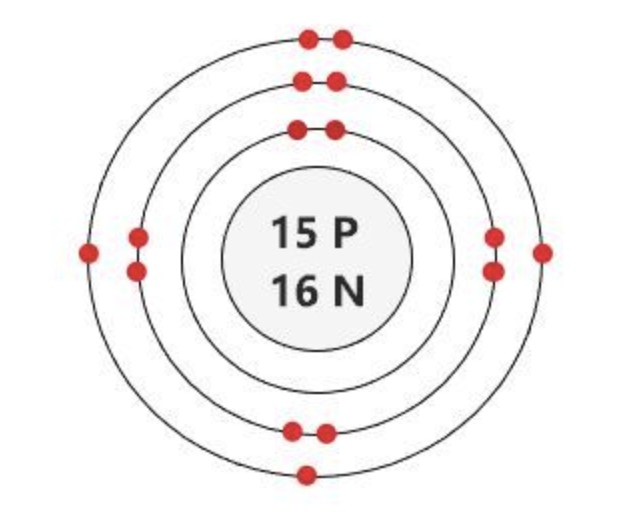
What are isotopes?
Atoms of the same element but with a different number of neutrons
What does isotopic notation show?
the mass number (top left) and the atomic number (bottom left) on the element symbol (whole right)
It can also show the charge on the top right
What does isotopic notation look like?
Mass number top left, atomic number bottom left, atomic symbol right
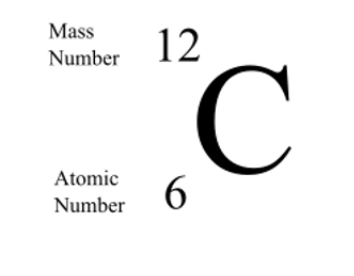
What is an ion?
A charged atom
What is a cation?
A positive ion
have more protons (+) than electrons(-)
formed when an atom loses electrons
What is an anion?
A negative ion
more electrons (-) than protons (+)
formed when an atom gains electrons
What is hyphen notation?
Atomic symbol—mass
(ex. Li-6)
How do you know whether an ion has gained or lost electrons?
If the net charge is positive, then it lost electrons
If the net charge is negative, then it gained electrons
What is average atomic mass?
the weighted average of all the naturally occurring isotopes of an element
What is a weighted average?
an average were components are not weighted equally and where abundance is taken into account
How do you calculate a weighted average?
(# x %) + (# x %) + (# x %) all divided by 100
Where do electrons live?
shells, clouds, or energy levels of an atom
Why do electrons fill the atom in a particular way?
Because of attraction to the nucleus and electron-electron repulsion
What is an electron assigned that gives its location in the atom?
quantum numbers
How many sublevels are there?
4
What are the sublevels?
s, p, d, and f
What can electrons do when they absorb energy in the form of heat or electricity?
Jump to higher energy levels
What is the low energy state called?
ground state
What is the high energy state called?
excited state
Why can’t electrons stay in the excited state for very long?
because they are highly attracted to the nucleus
How do electrons return to the ground state?
They release energy, which is equal to the amount that they absorbed to get to the excited state to begin with
What does the release of energy (when electrons return to the ground state) emit?
visible light
How are spectral lines formed?
When an electron returns to the ground state from the excited state, they release energy which can be seen as visible light, which makes the spectral lines
What is this variable and what does it represent: λ?
Lambda
It represents wavelength in meters
What is this variable and what does it represent: v?
Nu
It represents frequency of light (s-1, 1/s, or Hz)
What does the variable E represent?
the energy of a photon (in Joules, J)
What does the variable h represent?
Planck’s constant
How are the speed of light and Planck’s constant formulas similar?
they both have frequency (v)
Which of the following was not a part of Dalton’s Atomic Theory?
a. all matter is composed of extremely small particles called atoms
b. in chemical reactions, atoms are combined separated, and rearranged
c. atoms of different elements combine in simple whole number ratios
d. atoms can be subdivided, created, or destroyed
d. atoms can be subdivided, created, or destroyed
What scientist is associated with the Law of Definite Proportion?
John Dalton
What did the law of Definite Proportion (John Dalton) state?
atoms are indivisible
all atoms of the same elements have the same properties
atoms combine in definite proportion to form compounds
What were two major discoveries which were made about the structure of the atom from the Gold Foil Experiment?
the nucleus is in the center of the atom and is small, dense, and positive
the atom is mostly empty space
What does John Dalton’s atomic model look like?
A circle
What is a molecule?
the smallest particle of a compound
Element
substances made of one type of atom
Compound
a combination of two or more elements that are chemically combined
What does the proton tell you about the atom?
its identity
the atomic number